



Is your life about to put you in a new market? Bring it to a strategy call and we'll run the diligence honestly — whether there's a real deal hiding inside your next few years of travel. No pitch.
Hey,
My daughter set a state record this spring and is headed to a top-tier track program on scholarship this fall. Move-in is late September. Somewhere between booking the first parents' visit and pricing flights to a city I'd never thought twice about, a familiar voice in my head got loud:
I'm about to spend the next four years frequenting a place I've never invested in.
That's the exact moment my investing filter kicks in — invest where your life already goes. Here's what that filter looks like in practice, why college towns reward it, and how to evaluate one without stepping on a regulatory landmine.
I've spent 15+ years in this space, trained more than 10,000 operators through CashFlowDiary, and recorded 237+ podcast episodes breaking down the deals that work and the ones that don't. The pattern below shows up in every cycle.
• • •
Invest Where Your Life Already Goes
The cheapest market research on earth is the research you were already going to do for free. When your life puts you in a city eight or ten times a year, you see neighborhoods across seasons, you meet the locals who run things, you feel the parking and traffic that look fine on Zillow but feel off in person — and you get natural oversight on any property because you're already showing up. Out-of-state investing fails when the operator guesses about a place they visit twice a year. When the trip is happening regardless, the only question is whether it pays for itself.
This isn't a niche trick — it's how a lot of durable portfolios actually get built. The deals that hold up over a ten-year hold tend to be the ones where the operator had a real reason to be in the market beyond a spreadsheet. A kid in school. Aging parents two states away. A job that pulls you to the same city every quarter. A sport that takes you to the same regional venue every spring. The trip was always going to happen. The only decision is whether you let it pay for itself.
Why College Towns Are Durable Rental Markets
College towns have something most short-term-rental markets don't: built-in demand that doesn't care about weather or the economy. A beach town empties in November. A ski town empties in May. A college town runs on a different clock — move-in week, parents' weekend, homecoming, graduation, recruiting visits, alumni reunions, summer programs. The calendar fills itself, and the dates are published years in advance.
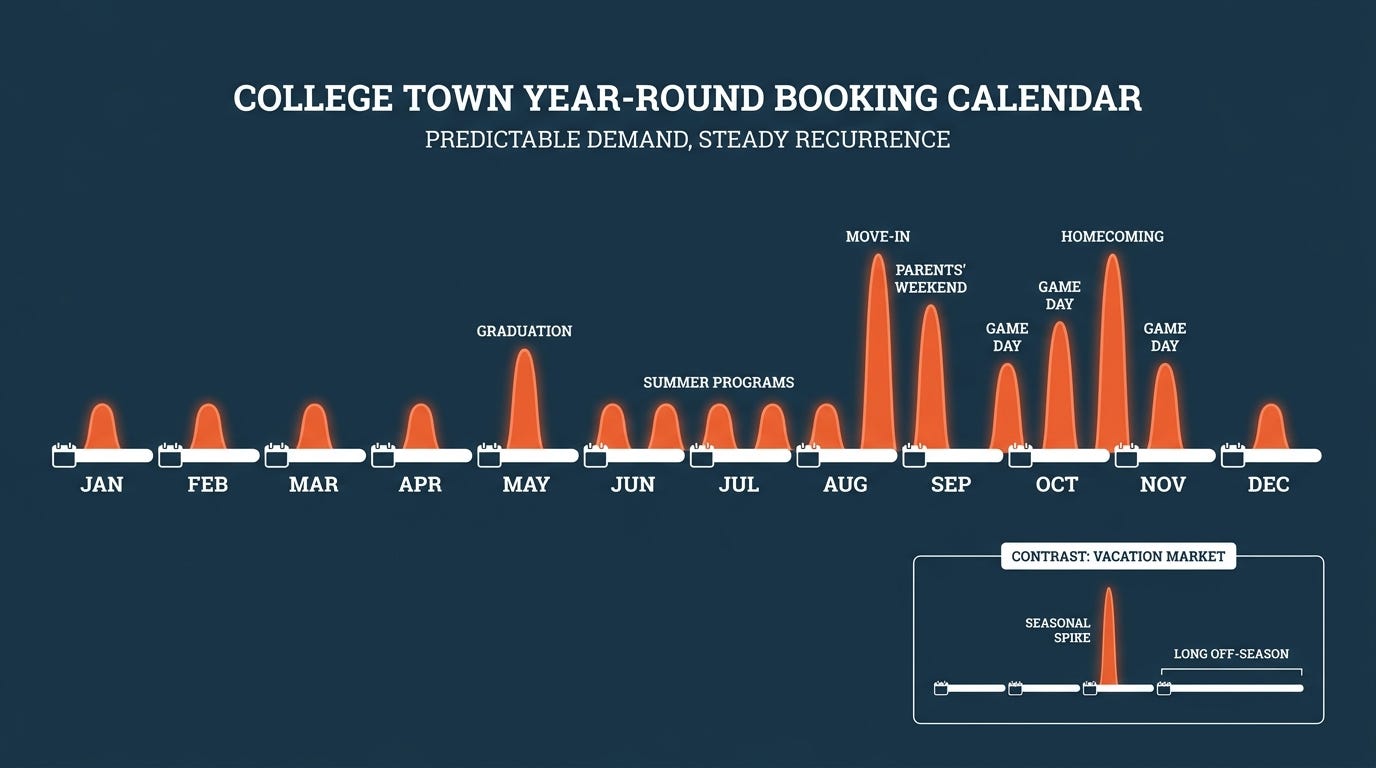
When the economy turns, application volume historically rises — people go back to school when jobs get scarce. Most universities house only a fraction of their students, so the rest spill into the surrounding rental market every August. And a town built around a 20,000-student university often has only a few hundred hotel rooms; on a home football weekend, that math breaks immediately.
💡 Key reframe: You're not underwriting "people who want to visit the city." You're underwriting specific guests — parents, recruits, alumni, visiting faculty — with specific reasons to come, specific dates, and specific willingness to pay for proximity.
College Town vs. Vacation Market — Two Different Businesses
Underwrite them the same way and you'll mismodel one. Vacation demand is weather-driven and seasonal — a sharp peak and a long off-season. College-town demand is calendar-driven and event-stacked — predictable high-rate weekends spread across the academic year, with longer booking lead times and lower cancellation rates.
And the guest profile is the quiet advantage. Vacation guests are discretionary — they buy an experience and cancel when money gets tight. College-town guests are showing up for a fixed reason on a fixed date: a graduation that can't move, a recruiting visit, a parents' weekend printed on a calendar two years out. Longer lead times, lower cancellation rates, and far more tolerance for a premium rate around the dates that matter. You're underwriting commitment, not impulse.
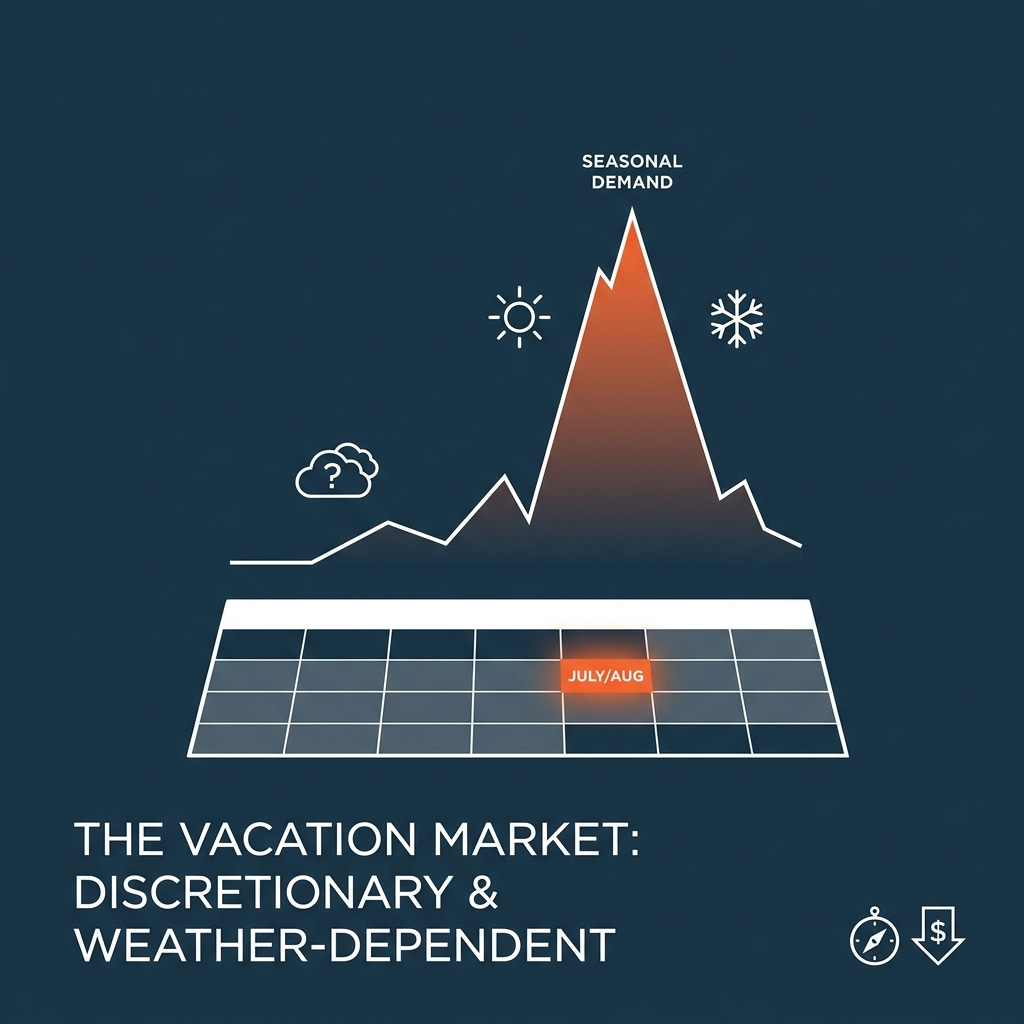

⚡ The math operators skip: College-town rentals win on a smaller number of very high-rate weekends doing most of the heavy lifting — not year-round moderate occupancy. The annual revenue can pencil the same and arrive through a completely different door.
How to Evaluate a College Town Before You Buy
The thesis is only as good as the diligence. Four checks have to clear before any college-town deal gets serious:
Enrollment + dorm gap. Pull ten years of enrollment from the university's institutional-research page (flat or growing is the bar), then subtract on-campus housing capacity. That gap is your addressable market — and it widens in your favor when enrollment rises while dorm construction stays flat.
Event-calendar density. Map twelve months of high-demand dates. Count the weekends where the rate realistically clears two to three times baseline. Fewer than fifteen and the thesis softens.
STR regulations. This is where most college-town deals die — after closing. Check the municipal code, county rules, and HOA covenants, and call the planning department before you write an offer. Bans, primary-residence requirements, and maxed-out permit caps are common.
The 30-day rule. Many markets that restrict nightly STRs still allow mid-term stays of 30+ days — visiting faculty, relocating families, traveling nurses. If the STR rules are tight, the mid-term play often still works; you just underwrite monthly, not nightly.
Regulatory diligence kills more college-town deals than bad numbers. Check permit availability before you write an offer. — J. Massey
I didn't pick this market. My daughter did, with a discus and a college decision. My job is to notice.
Common Questions
How do I check if a college town allows short-term rentals? Start with the city's municipal code and zoning ordinance, then county rules and any HOA covenants. Call the planning department before you write an offer — ask about permit availability, primary-residence rules, and whether new licenses are paused. The rules change fast.
What's the ideal enrollment-to-dorm gap? The bigger the better. 20,000 students with 6,000 beds on campus = 14,000 looking off-campus. Check whether the university is building dorms, because that shrinks your market over time.
Do these work as mid-term rentals if STRs are banned? Often yes — visiting professors, relocating families, traveling healthcare workers, and parents around graduation all need month-long stays. The underwriting shifts from nightly to monthly, but the thesis holds.
Ready to find the deal hiding in your next four years?
If a life event is about to put you in a new market repeatedly, the trip is already happening — and so is the market research. On a strategy call we run the enrollment, calendar, and regulatory diligence honestly and decide whether there's a real deal inside it.
• • •
Keep reading:
The World Cup Didn't Create Opportunity. It Revealed the Demand You're Missing.

Booked demand is up 40%+ in host cities while asking rates doubled — and the real lesson is the year-round demand you can't see.
P.S. Where does your life already take you eight or ten times a year? Reply with the city — that's where I'd start looking for your next deal.
CashFlowDiary — real numbers, real strategy, one shipped idea at a time.
Ready for the next step?
The STR regulation check burying the lead is the real problem with most college town pitches. Operators fall in love with the enrollment gap and the football weekends and skip the municipal code until after closing. The deal dies on a permit cap they could have found in twenty minutes.