


Before you price your next big week — or any week — get a second set of eyes on your demand model. No pitch. You leave the call with a clear read on the demand moving through your market that you can't currently see.
Hey,
Five days into the 2026 World Cup, the data already tells a story most operators don't want to hear.
Booked demand is up sharply across host cities — 40% or more in tight-supply markets, and over 250% in places like Guadalajara and Monterrey. That sounds like a clean win. Then you see the other number: across host cities, hosts have raised their asking rates more than 90% on average, and in oversupplied markets like Miami and Atlanta they're asking roughly double their normal nightly rates. The catch is that guests are actually paying those elevated rates in only about five of eleven host cities.
Asking prices and booked prices have come apart. The gap isn't greed. It's structural — and it has almost nothing to do with soccer.
I've spent 15+ years in this space, trained more than 10,000 operators through CashFlowDiary, and recorded 237+ podcast episodes breaking down the deals that work and the ones that don't. The pattern below shows up in every cycle.
• • •
What High Ticket Prices Actually Filter
Ticket prices for this World Cup are the highest in tournament history — it's the first World Cup with dynamic pricing, and every category is running well above past averages. What matters is what that pricing does upstream of your calendar.
High ticket prices screen out the mid-tier traveler before they ever reach the accommodation decision. The casual fan who would've filled a two-bedroom in Kansas City or Atlanta for a group-stage match? Priced out at the gate. The international traveler from one of the dozens of countries facing US travel restrictions? Filtered before they booked a flight.
What's left is a narrower band of demand than the projections assumed. The operator who banked on filling every night at elevated rates is now holding inventory they can't move at the price they need. And vacancy costs more than any nightly rate you didn't get.
💡 Key reframe: Demand filters happen upstream from the booking. If you priced for high volume without accounting for ticket costs and travel restrictions, you built your strategy on a projection that never materialized.
How to Price When Pride Gets Expensive
The fix isn't complicated. It's hard to execute, because it means letting go of the number you decided the property was worth three months ago. Time is your inventory. You don't sell yesterday.
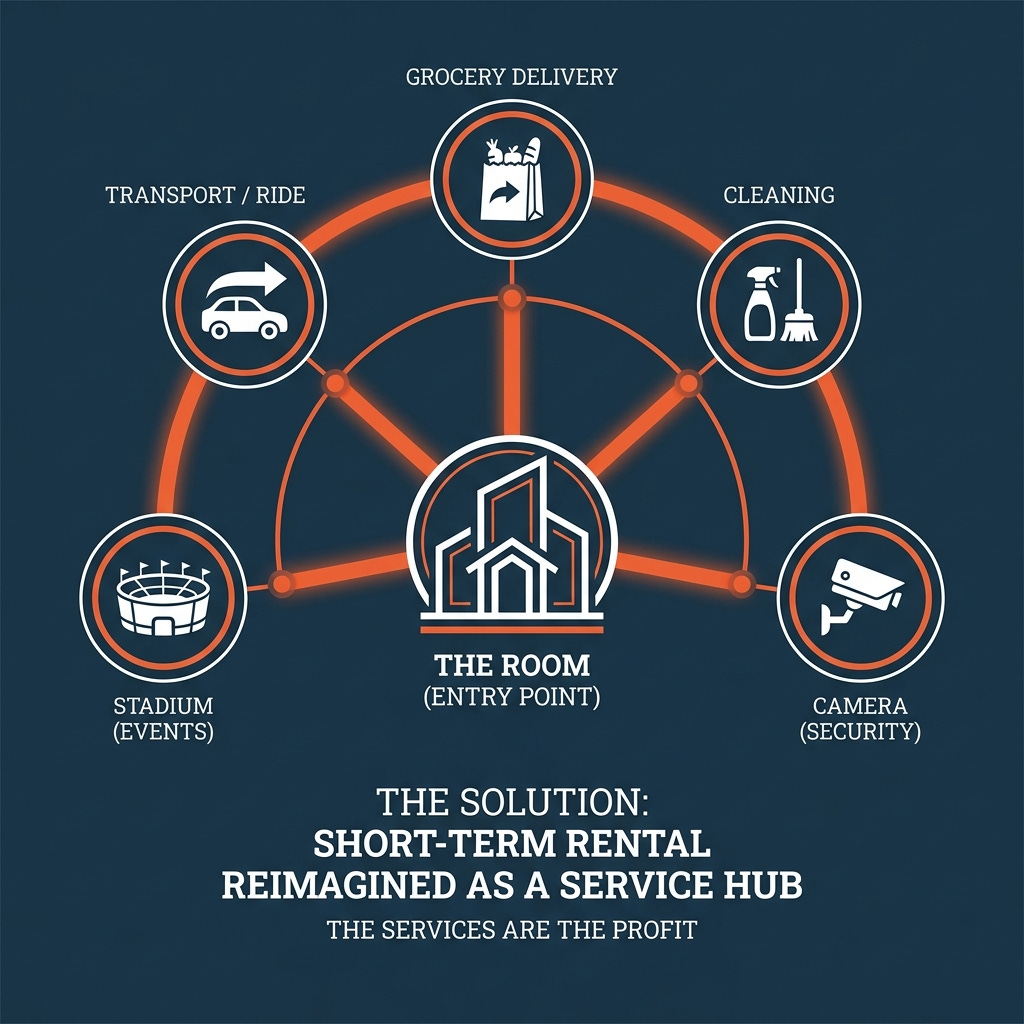
The operator running no-pride pricing isn't leaving money on the table. They recognized that $250 a night booked beats $1,000 a night vacant — then built a revenue model that doesn't stop at the nightly rate. The room is the entry point, not the product.
McDonald's doesn't make its money on the burger. Disney doesn't make it on admission. The operator who treats the accommodation as a loss leader and builds a menu of ancillary services is playing a different game than the one stuck on occupancy and ADR: transportation to the stadium, pre-scheduled rides that dodge surge pricing, grocery delivery, mid-stay cleanings, a photographer. None of it requires owning anything. It's a concierge layer on top of an asset you don't even own — and it all gets systematized into the guest guide and booking flow before anyone arrives.
⚡ The math operators skip: A booked night at $250 generates more than a vacant night listed at $1,000. Then ancillary services turn that same booking into two or three times the revenue — with no additional property.
The Demand That's Been There All Along
The World Cup will end. Most operators will close the books, count the extra nights, and move on. The operator worth watching is the one who leaves this tournament with different eyes.
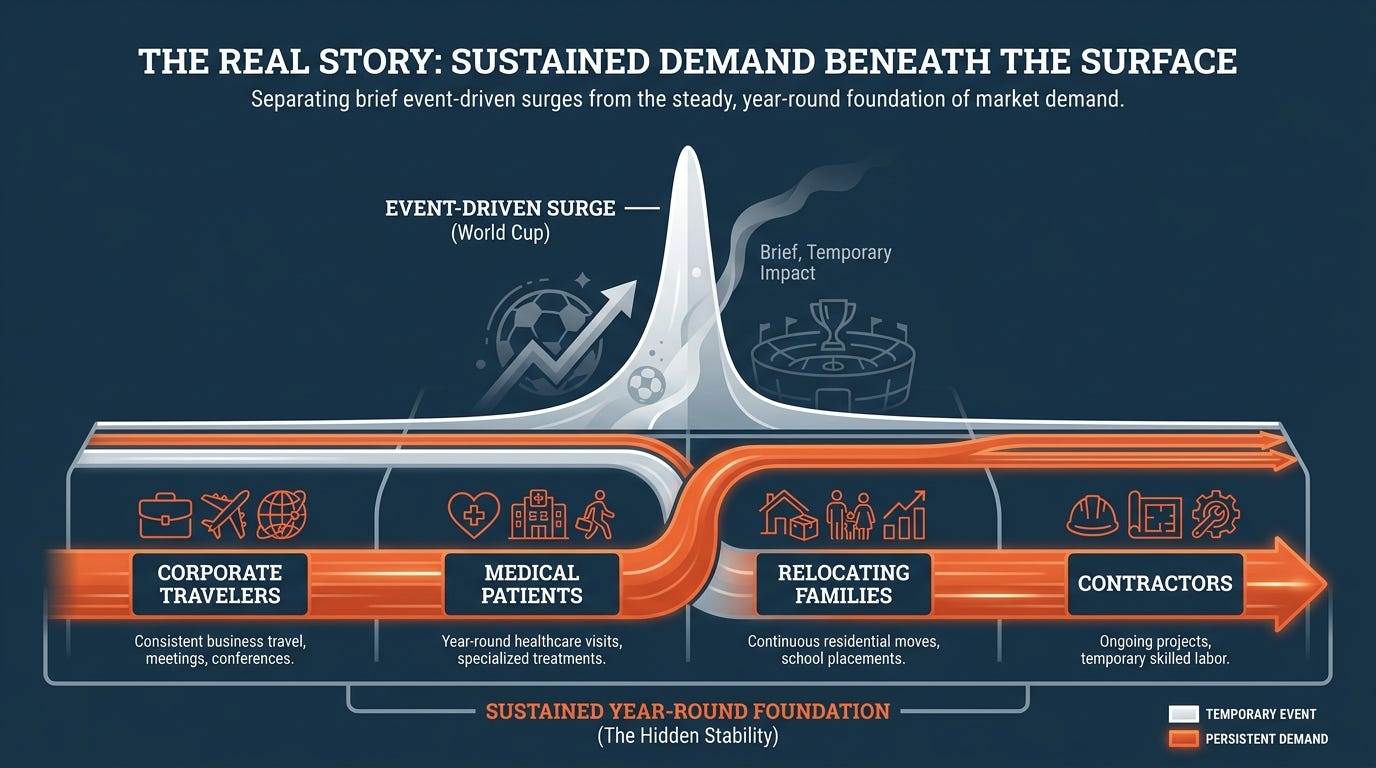
The opportunity was never the World Cup. It's what the World Cup made visible for a few weeks. There are corporate travelers moving through your market every week. Medical patients and their families. Relocating households. Government contractors. Sports fans coming for events that never make national headlines but still fill rentals.
They're invisible to operators who don't build for them, price for them, or market to them. The temporary-housing market is far bigger than beach-and-leisure signals — and it doesn't spike rates, it fills calendars consistently at margins that compound.
Vacancy costs more than any nightly rate you didn't get. — J. Massey

Two Models, Two Outcomes
The operator who built their business around vacation is running one model. The operator who recognizes they're in the temporary-housing business is running another.
Vacation demand is seasonal, event-driven, and competitive. Temporary-housing demand is year-round, need-based, and undersupplied in most markets. The shift isn't about working harder. It's about seeing what's been invisible all along — and asking one question: what else has been moving through my market that I couldn't see when I was only looking for vacation?
The opportunity was never the World Cup. It's what the World Cup made visible.
A 4-week way to find the demand you're missing:
Week 1 — Audit. Pull your last 12 months of bookings. Mark which weeks filled outside peak vacation season. Those are your hidden demand windows.
Week 2 — Map. List the corporate HQs, hospitals, military bases, and universities within 20 miles. Each is a non-vacation demand engine that runs year-round.
Week 3 — Reposition. Rewrite one listing for a need-based guest (a relocating family or a traveling nurse), not a vacationer. Adjust photos, amenities, and minimum stay to match.
Week 4 — Systematize. Build the ancillary-services menu into your guest guide and booking flow so the margin compounds without added labor.
Common Questions Operators Are Asking
Why are some host cities sold out while others sit vacant? Cities that drew high-demand fixtures attracted travelers willing to pay premium rates. Cities that didn't priced for demand that never came — and high ticket prices plus travel restrictions filtered mid-tier travelers out upstream.
What is no-pride pricing? Dropping your rate to fill the calendar rather than holding out for a number you set months ago. A booked night at $250 beats a vacant night listed at $1,000. Time is inventory you can't sell yesterday.
What non-vacation demand do most operators miss? Corporate travelers, medical patients and families, relocating households, government contractors, and regional-event attendees — year-round, predictable bookings that never show up in a vacation-focused demand scan.
Ready to see the demand you're missing?
If the World Cup just showed you that your market has demand you weren't pricing for, that's the whole game. On a strategy call we map the non-vacation demand already moving through your market — and the model to capture it year-round.
• • •
Keep reading:
World Cup 2026: Most Operators Priced With Pride, Not Math

Across 16 host cities, asking rates ran $497 a night while guests booked at $332. Here's what the booked data actually rewarded.
P.S. The teams change every four years. The lesson doesn't: the demand you can't see is worth more than the weekend you can. Reply and tell me one non-vacation demand source in your market — I read every response.
CashFlowDiary — real numbers, real strategy, one shipped idea at a time.
Ready for the next step?
Sources
1. 2026 World Cup ticket pricing (record-high, first dynamic-pricing World Cup): ESPN · PBS NewsHour
2. Host-city booking demand +40%/250% and asking rates ~2x (AirDNA/Beyond/Key Data): The Host Report