


Not sure whether your next hire is a VA or an operations lead? Bring your portfolio to a strategy call. No pitch — you leave with a clear read on which hire actually removes your bottleneck.
Hey,
Most operators hire the VA at property three when they needed the operations lead at property two. Same payroll, same bottleneck — just more expensive.
The wall shows up around property three. Sometimes four. Rarely past five. The friction isn't work volume — you can handle the work. The problem is you can't run more than two properties out of your head, and most operators try to do exactly that for too long. Comms slip, reviews drop, the cleaning crew quits on a Sunday, and the operator concludes scaling was a mistake.
It wasn't. The architecture was wrong.
I've spent 15+ years in this space, trained more than 10,000 operators through CashFlowDiary, and recorded 237+ podcast episodes breaking down the deals that work and the ones that don't. The pattern below shows up in every cycle.
• • •
What a VA Actually Solves — and Where It Stops
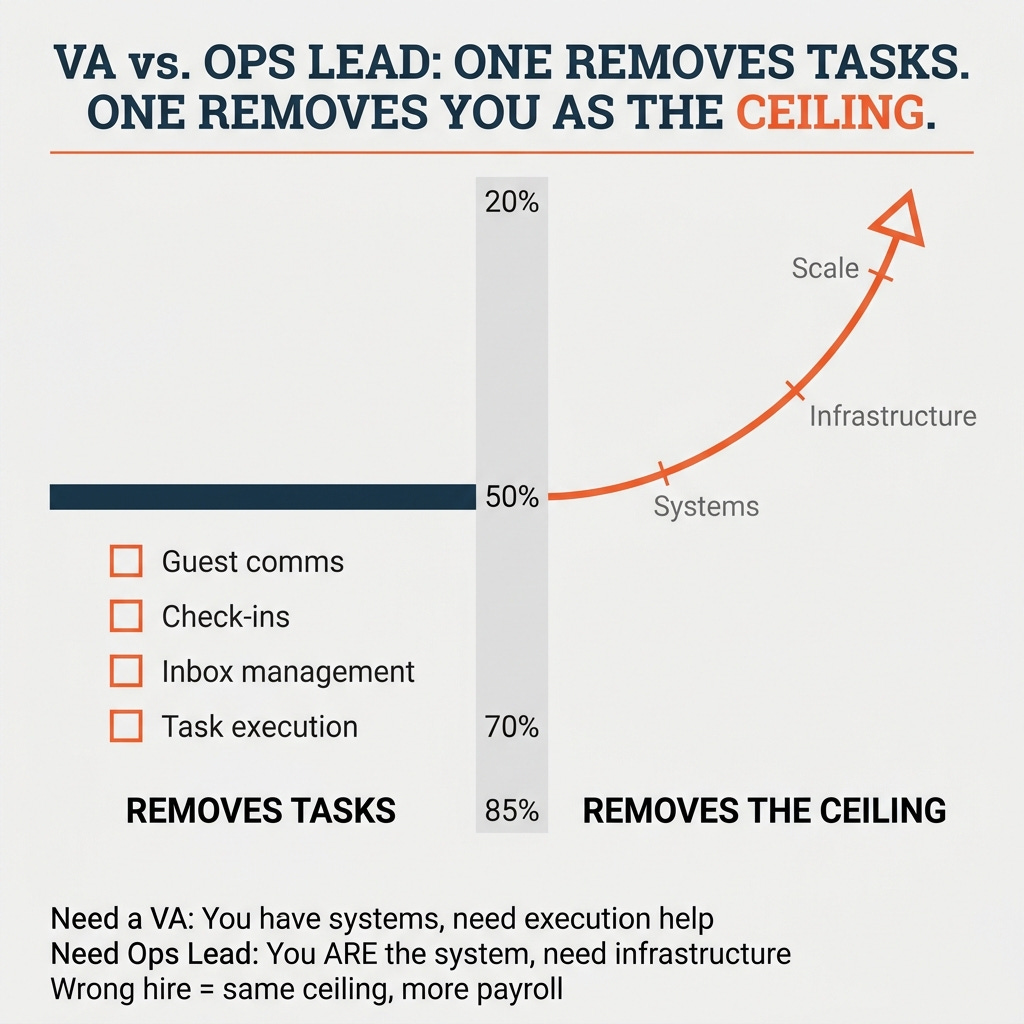
The VA hire solves messaging volume. Forty guest conversations at once — check-in questions, WiFi passwords, early-arrival asks, late-checkout negotiations. The VA takes the inbox off your phone. Real relief, for about six weeks.
Then the toilet handle breaks. Linen service misses a pickup. A guest reports damage. The smart lock dies at 9pm. The supply closet runs out of trash bags. The VA solves none of those — they were hired to execute tasks you hand them, not to build the systems that handle them.
💡 Key reframe: Task execution and system architecture are different roles. Hire for one when you need the other and the bottleneck stays exactly where it was.
What an Operations Lead Builds
An ops lead doesn't manage operations. They architect them: vendor relationships with cleaners, maintenance crews, and locksmiths; inventory systems so the supply closet never runs dry; maintenance response trees for the issues that recur every week; quality control that catches the slow-WiFi pattern before the third guest mentions it; and the communication templates and escalation paths the VA later runs inside.
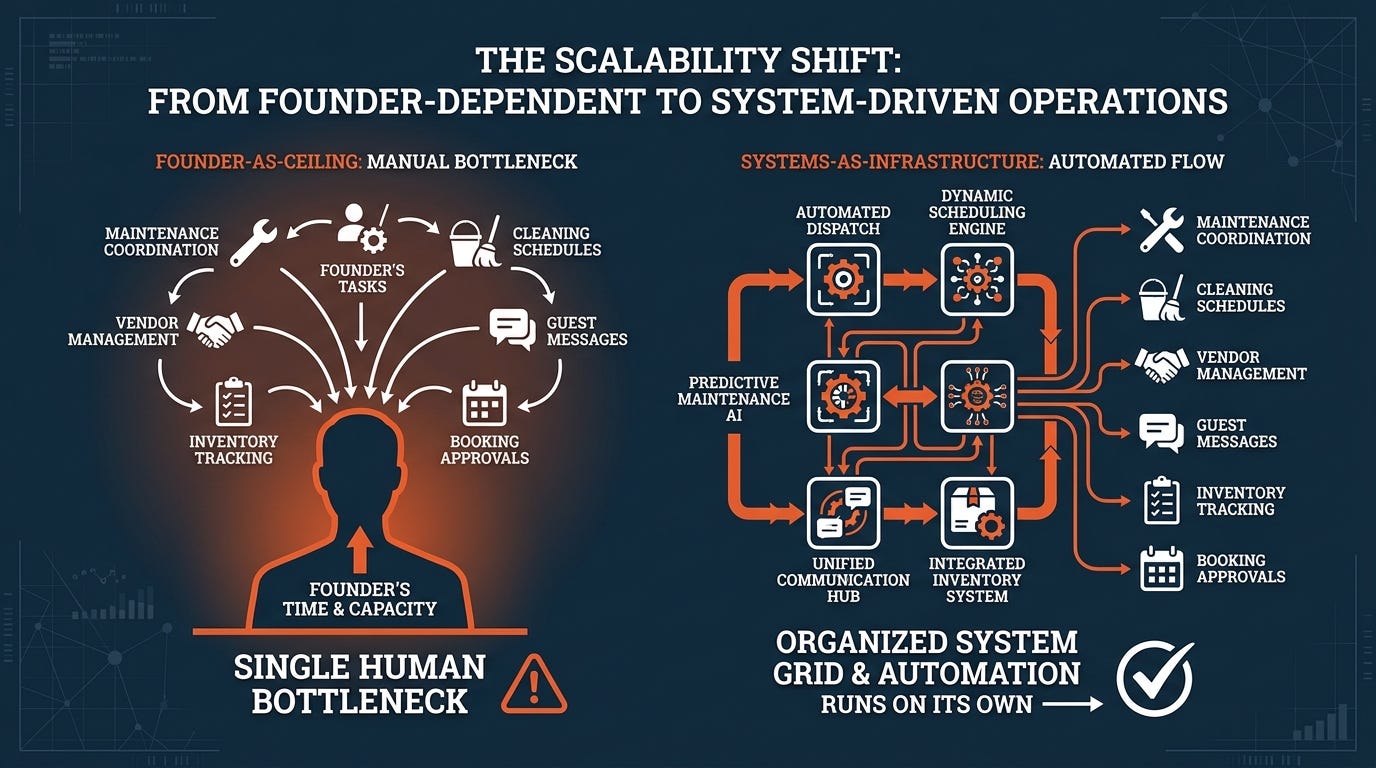
VAs execute the tasks you define. Ops leads define the tasks that need executing. VAs report problems to you; ops leads solve them before they reach you. One role removes tasks from your plate. The other removes decision load entirely.
Picture the broken lock at 8pm. With a VA, the message gets forwarded to you, and you start dialing locksmiths. With an ops lead, there is already a locksmith on file, a backup access code the guest can use tonight, and a compensation protocol that triggers without anyone asking you. Same incident, two completely different demands on your evening — and only one of them scales.
The Cost Math Nobody Runs
VAs run $15 to $35 an hour. An operations lead runs $50K to $80K a year for an experienced hire, or $35 to $60 an hour fractional. That looks expensive — until you price your own time.
Twenty hours a week on operational tasks an ops lead would own is 80 hours a month. At a conservative $100 an hour for founder time, that's $8,000 in opportunity cost every month — spent on work that keeps you exactly where you are. The ops lead hire is an arbitrage on founder time. The ROI shows up in what you stop doing, not what they start doing.
And the reclaimed time is where the real return lives. The operators who make this hire are the ones who take a 30-day stretch away without revenue dropping, because the business no longer depends on them being reachable. That is the actual product of the ops-lead hire: not a lighter inbox, but a business that keeps running when you step out of it.


⚡ The math operators skip: $8,000/month of founder time trapped in operations buys an ops lead with room to spare — and the ops lead is the only one of the two hires that raises your ceiling.
The Right Sequence — Most Operators Get It Backwards
The common mistake: add a VA, then six months later realize you needed an ops lead. Now you're managing the VA and still carrying the operational load. The right order is the reverse — the ops lead builds the systems first, then the VA executes within them. Hire the VA first and you stay the ops lead: the easy parts get delegated, the hard parts stay yours.
Wrong hiring order isn't a small mistake. It's the same bottleneck at a higher payroll. — J. Massey
The VA gives you time back. The ops lead gives you a business that runs without you.
A 4-step diagnostic to know which hire you need:
Count the hours. Add up last week's operational time — vendor calls, maintenance dispatch, inventory checks, quality control. Above 15 hours, the VA threshold is already behind you.
Check the flow. Do problems reach you before they're solved? If yes, you have a systems gap, not a volume gap.
Find the documents. If no written systems exist for common issues, an ops lead builds them. A VA would just route around the gap.
Build, then staff. Bring the ops lead in to architect the infrastructure first, then add a VA to execute inside it.
Common Questions Operators Are Asking
When should I hire a VA instead of an ops lead? When your only constraint is guest-messaging volume and your operational systems already exist. If the systems don't exist yet, hire the ops lead first.
What's the threshold for an ops lead? Roughly three to five properties, or the point where you spend more time managing operations than growing the business. It's about infrastructure, not door count.
Will AI replace the ops lead? No — it amplifies them. More than 70% of vacation rental managers already use AI in some form (Hostaway). VAs use the AI tools you hand them; the ops lead builds the AI infrastructure the whole operation runs on.
Ready to stop being the bottleneck?
If you spent more than 15 hours last week on operations, the question isn't whether you can afford an ops lead — it's whether you can afford to stay the ceiling. On a strategy call we map which hire your portfolio actually needs and the sequence to bring them on.
• • •
Keep reading:
You're Not Saving Money by Doing It Yourself

A VA costs $15 an hour. You're “free.” So you keep answering every guest message yourself — and quietly capping your business at three properties.
P.S. Look at last week's calendar and count the operational hours. Reply with the number — I read every response, and it's the fastest way to tell which hire you actually need.
CashFlowDiary — real numbers, real strategy, one shipped idea at a time.
Ready for the next step?
Sources
1. AI adoption among vacation rental managers (70.1%, in some form): Hostaway — AI in Vacation Rentals