


The math that feels like saving is actually the most expensive decision in your operation.
Hey,
You’re at three properties and you’re still answering every guest message yourself.
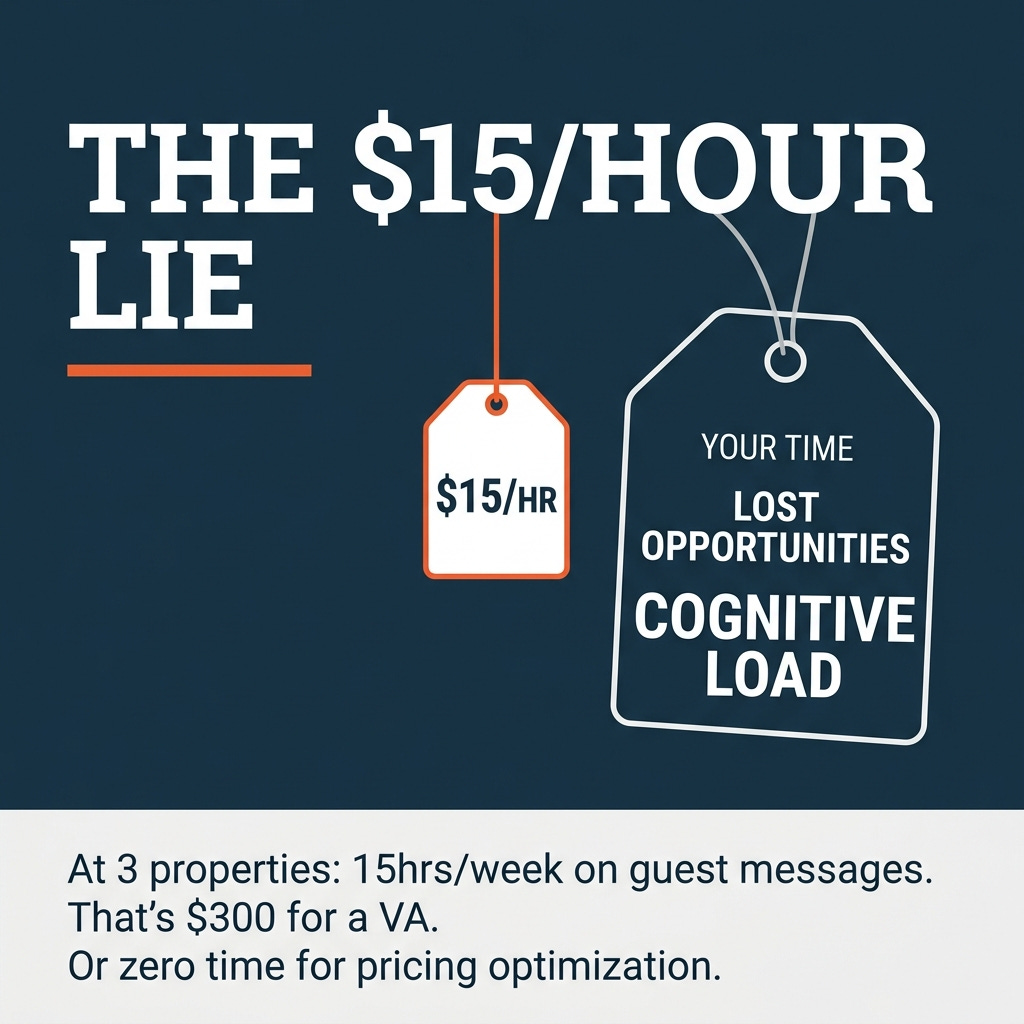
The math feels simple: a VA costs $15–20 an hour. You’re “free.” So you keep doing it, and you tell yourself you’re saving money.
I’ve spent 15+ years in this space, trained more than 10,000 operators through CashFlowDiary, and recorded 237+ podcast episodes breaking down the deals that work and the ones that don’t. This is one of the most expensive beliefs I see — and it’s invisible, because it never shows up on a spreadsheet.
That’s not what’s actually happening when you “do it yourself.” Here’s what is.
• • •
The Belief That Costs More Than the Hire
When operators tell me they can’t afford a VA yet, I ask them to walk me through their week. The pattern shows up fast: 15–20 hours on guest communication, review responses, and coordination that could run on autopilot.
The hourly comparison is backwards. You’re not comparing $15/hour to $0/hour. You’re comparing $15/hour to the revenue you didn’t capture because you were standing in a checkout line typing a reply to a guest in Barcelona instead of analyzing your pricing or setting up property number four.
💡 Key reframe: Delegating repetitive work gives operators back 15–20 hours a week. That’s not theoretical — it’s what happens the moment you stop trading your attention for work a system should handle.
The Three-Property Wall Is Cognitive Load, Not Money
The bottleneck at three properties isn’t capital. It’s cognitive load.
STR hosting runs 24/7, 365 days, with guests reaching out at all hours. At one property, you can hold it in your head. At two, you’re stretched but functional. At three, the system breaks — because the system is you.
Every message requires context-switching. Every response pulls you out of whatever you were doing. Every notification trains you to stay tethered to your phone. The work isn’t hard. It’s relentless. And relentless work doesn’t scale — it erodes the decision quality you need to grow.
Everything routes through one point — and that point is the thing capping your growth.
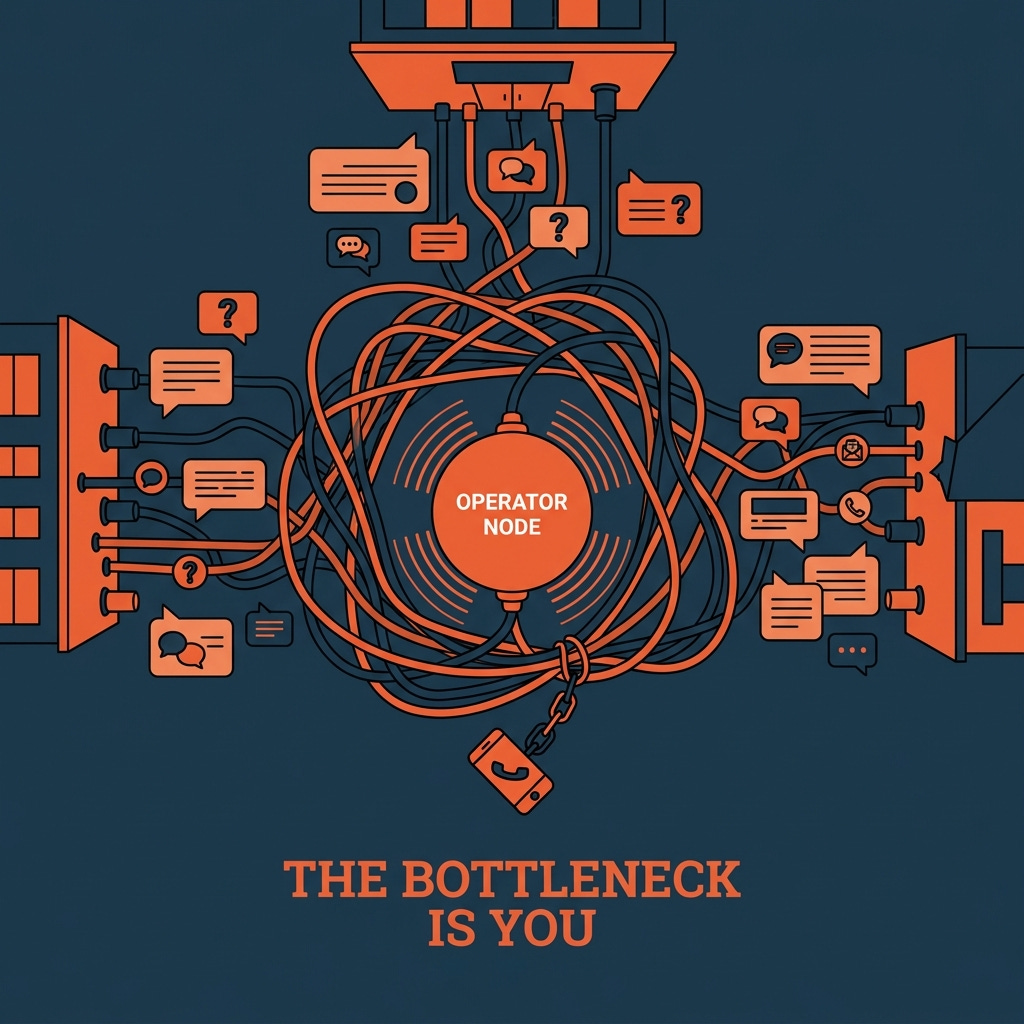
The resistance to hiring isn’t financial. It’s psychological. You’ve built a business where you are the business, and you’ve convinced yourself that’s what control looks like. Studies put 70–90% of small-business owners in the same trap: “If I want it done right, I have to do it myself.” That belief doesn’t protect quality. It guarantees burnout.
The Real Math of Guest Communication
Let’s run the actual numbers.
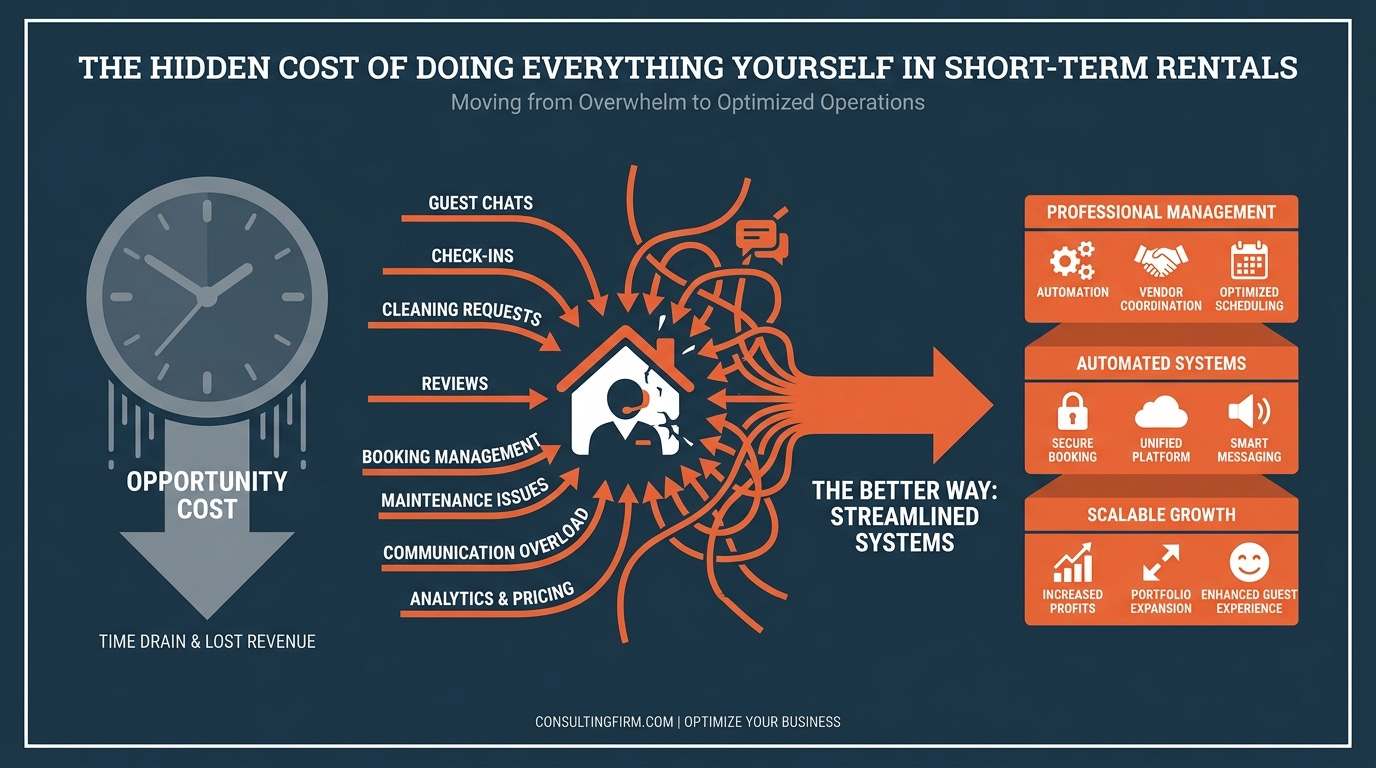
$15 an hour vs. the revenue you never capture — the comparison that actually decides whether you reach property four.
At three properties with 70% occupancy, you’re handling roughly 15–20 guest interactions a week — pre-booking questions, check-in coordination, mid-stay requests, checkout follow-ups, reviews. At 5–15 minutes each (with context-switching), that’s 10–15 hours a week minimum, before the mental overhead of staying available.
⚡ The math operators skip: A VA covering that workload costs $300–400 a week. Your “free” alternative is 10–15 hours you could spend on pricing, market analysis, or property four. And a single pricing adjustment across three properties can add $500–1,000 in monthly revenue. You’re trading that to “save” $300 a week. That’s not savings — that’s expensive.
Automate First, Then Delegate
The objection I hear most: “I can’t afford a VA and automation tools.” You don’t need both on day one. You need the right sequence.
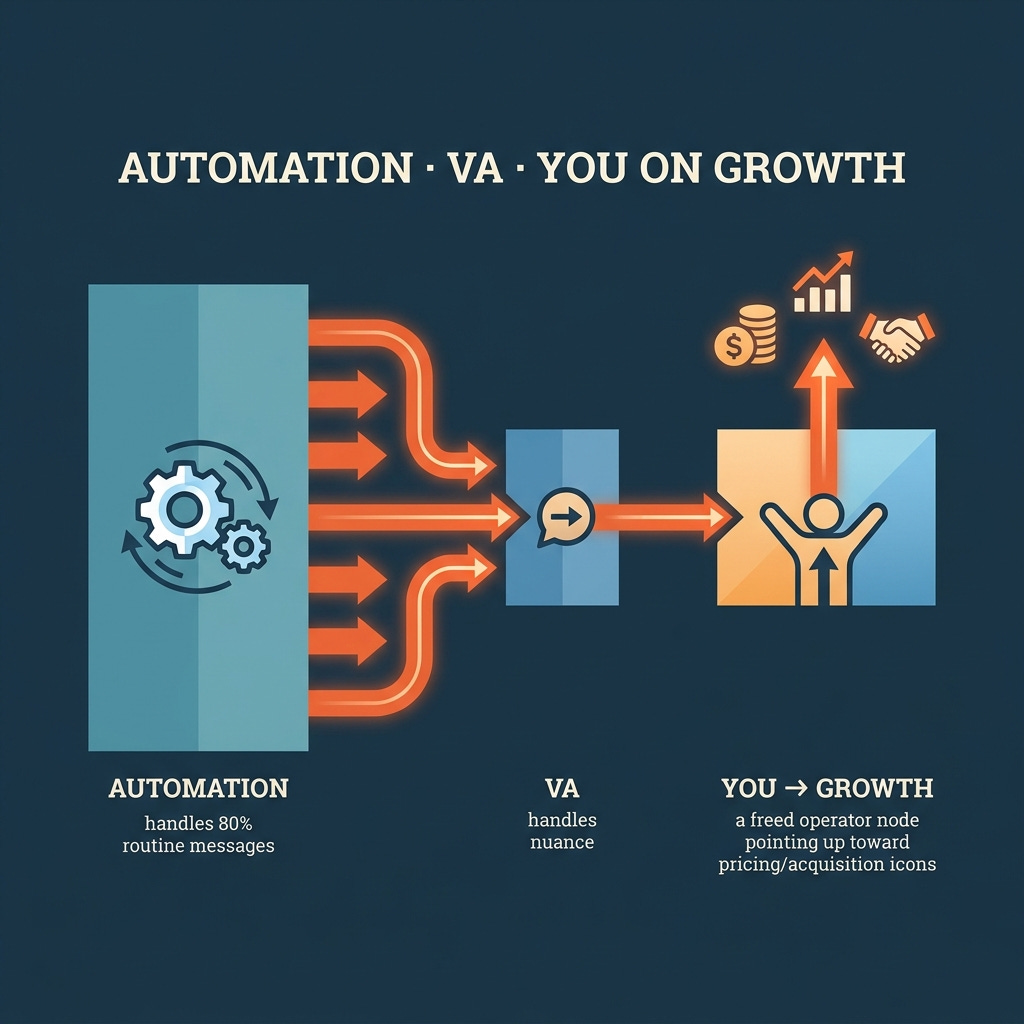
Start with automated guest communication. The right tools handle 80–90% of routine messages — pre-booking FAQs, check-in instructions, house rules, checkout reminders — without you touching them. The VA then handles what automation misses: edge cases, relationship-building, the 10–20% that needs human judgment.
Automation handles volume. The VA handles nuance. You handle growth.
That’s the model. Deploy messaging automation first (a weekend to set up, $20–50/month), then bring in the VA for what’s left. You’ve just cut your communication workload by 80% for under $500/month total — and bought back the hours that actually move the business.
Here’s the sequence that works:
Week 1 — Automate the routine. Set up automated guest messaging: pre-booking FAQs, check-in instructions, house rules, checkout reminders. Any tool that integrates with your booking platform. This clears 80% of routine communication immediately.
Week 2 — Document the process. Every message type, every scenario, every response template becomes the VA’s playbook.
Week 3 — Hire the VA (10 hrs/week). Have them shadow your communication for three days, then hand over the inbox with you in review mode.
Week 4 — Move to spot-check. Review 20% of interactions instead of 100%. Refine the playbook as you go.
Week 6 — Step out. Stop reviewing unless the VA flags something. Redirect the reclaimed hours to pricing, market research, or your next acquisition.
Six weeks from full-manual to systematized delegation. The operators who make this hire all report the same thing: the first two weeks feel uncomfortable, nothing breaks, and by week six they’ve had their best month — because they finally had time to work on the business instead of inside its inbox.
One operator I worked with hit this exact wall at property four. He was convinced hiring help would blow his margins, so he kept the inbox himself — and his pricing hadn’t been touched in five months, because he never had a clear hour to look at it. We set up automated messaging that weekend and brought on a VA at ten hours a week. Six weeks later he’d reworked pricing across all four properties and added just over $2,300 in monthly revenue. The VA cost him $1,600 a month. He wasn’t saving money by doing it himself — he was paying about $700 a month for the privilege of staying stuck.
Automation → VA → you on growth. The same operation, minus the tether.
Common Questions About Hiring at Three Properties
Can I actually afford a VA at three properties? You’re already paying for one — in unbilled hours. A VA covering guest communication runs $300–400 a week; the 10–15 hours it frees up is where pricing and acquisition decisions live. The question isn’t whether you can afford the VA. It’s whether you can afford to keep being the inbox.
Automation or a VA first? Automation first. The right messaging tools handle 80–90% of routine guest communication for $20–50 a month and take a weekend to set up. Bring the VA in second, to handle the 10–20% of edge cases and relationship work automation can’t. Automation handles volume; the VA handles nuance.
What does a VA realistically cost — and save? Budget $300–400 a week for guest-communication coverage. Against that: a single pricing adjustment across three properties can add $500–1,000 in monthly revenue, and you reclaim 10–15 hours a week. The cost is visible on a spreadsheet. The savings — the opportunity you stop missing — aren’t, which is exactly why operators underprice them.
Ready to stop being your own bottleneck?
If guest communication is dictating your schedule instead of fitting into it — you’re checking your phone at dinner, answering at your kid’s game, waking up for a 2 AM message — that’s not dedication, it’s a structural problem. The strategy call is where we map the automation-and-delegation sequence for your operation so property four stops feeling impossible.
• • •
P.S. Every week you wait costs more than the VA would. You’re losing pricing optimization, missing market shifts, burning cognitive capacity on repetitive work instead of strategic decisions. The operators who scale past three properties don’t have more discipline — they have better systems, and they stopped confusing effort with effectiveness. Build the system. Automate first. Hire second. Redirect your time to growth third. Start this weekend.
CashFlowDiary — real numbers, real systems, and the operating architecture behind portfolios that actually scale. Reply anytime; I read every one.