


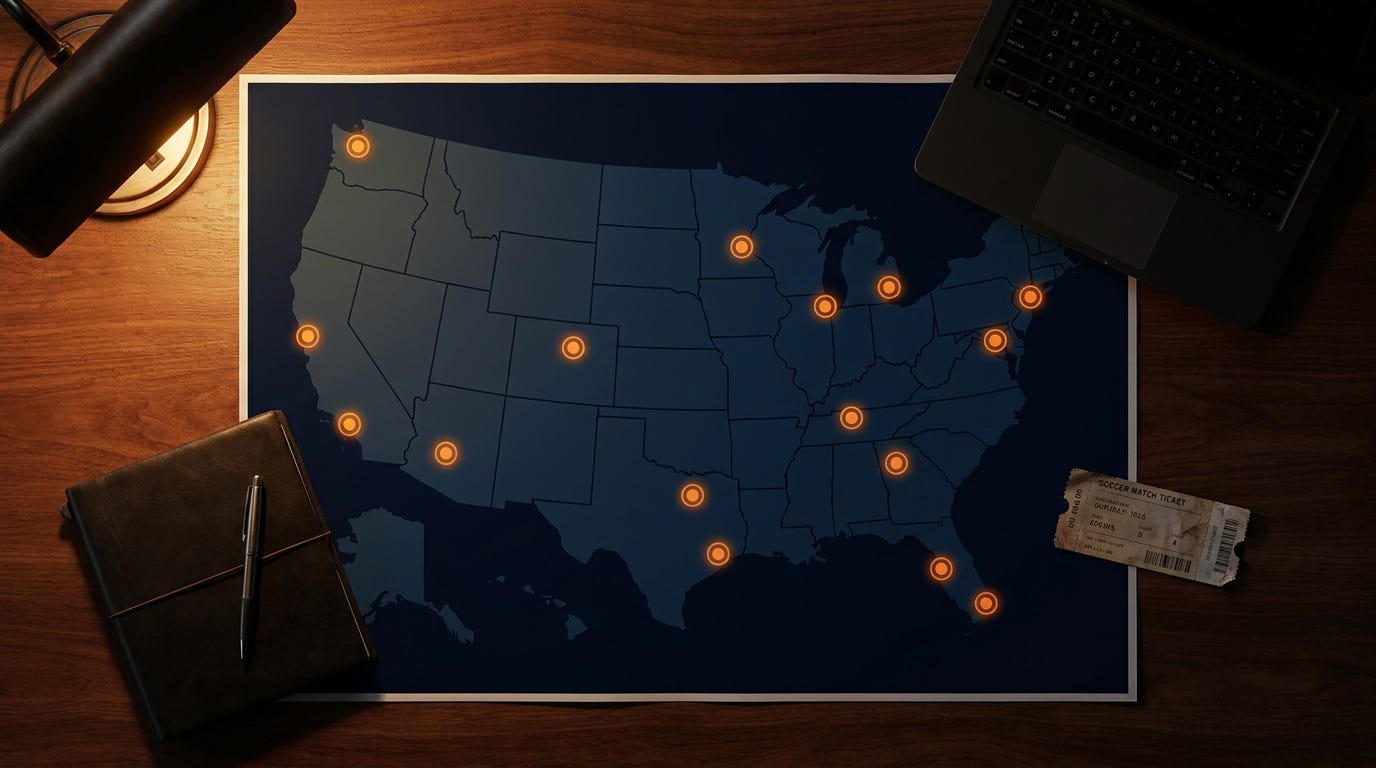
Hosting in a World Cup city? A strategy call maps your city's match calendar, compression windows, permit timeline, and minimum-stay plan into one playbook — so you price the window that's actually yours. No pitch — you leave with the plan.
Hey,
Eleven US cities. 78 matches. 48 teams. Thirty-nine days from June 11 to the Final on July 19. If you're a host in one of those cities, the temptation is to treat the whole tournament as your window. It isn't.
Your revenue window is your city's match calendar — and those calendars are wildly different. New York hosts straight through the July 19 Final: the full thirty-nine days. San Francisco wraps after the Round of 32 in late June: about three weeks. Same tournament, completely different opportunity — and pricing both the same way leaves money on one and an empty calendar on the other.
So this is the playbook: read your city's depth, price the compression, mind the regulation, and match your stays to the games. Get those four right and you capture the window that's actually yours. Here's how each one works.
I've spent 15+ years in this space, trained more than 10,000 operators through CashFlowDiary, and recorded 237+ podcast episodes breaking down the deals that work and the ones that don't. The operators who win a multi-city event don't play it generically — they play their specific city's calendar.
• • •
Your revenue window is your city's match calendar
World Cup demand isn't spread evenly across thirty-nine days — it concentrates on the dates your city has matches, and it runs as deep as your city goes. A city hosting only group-stage matches and a Round of 32 has a three-week window. A city carrying a semifinal or the Final stays hot deep into July. Atlanta runs eight matches through a semifinal — one of the deeper demand runs in the tournament — while Dallas hosts nine, the most of any US city.
And there's a tail most operators miss entirely: the fan festivals. They generate ambient, non-match-day demand for weeks — Philadelphia's runs about thirty-nine days, Atlanta's about sixteen. If you only price the match dates, you leave the festival nights empty. Pull your city's full schedule — matches and festival — and that's your real window.
Key reframe: stop pricing “the World Cup.” Price your city's match calendar. Depth sets the length of your window; the festival sets its tail.
Why the demand is landing on you: hotels are collapsing
Here's the structural shift that makes this window real. Roughly 80% of hotel bookings across the US host cities are running below forecast, and in March, FIFA canceled about 70% of its originally reserved room blocks in Boston, Dallas, Los Angeles, Philadelphia, and Seattle. All that inventory dumped back into the market — and the demand pressure shifted to short-term rentals. The pattern repeats every cycle: hotels block early, cancel late, and STRs pick up what they drop.1
The numbers back it up. Short-term-rental demand is up about 136% year over year in Guadalajara, 125% in Monterrey, and 44% in Kansas City — even as 85–90% of Kansas City's hotels came in below projections. Dallas alone is looking at something like 307,000 projected Airbnb guest-nights. The crowd needs somewhere to stay, the hotels mispriced and pulled back, and that gap is the opportunity sitting in front of you.2
Your revenue window isn't the tournament. It's your city's match calendar. — J. Massey

Match depth sets your window's length; the fan festival sets its tail.
The four checks before you price your city
Run every host-city decision through the same four filters. Match depth: how far does your city go — a Round of 32 exit, or the Final? That sets your window's length. Compression: thirty-nine tournament days squeeze bookings into a handful of match dates, and thin-supply markets like Monterrey, Guadalajara, and Kansas City show the steepest match-day premiums — so price those blocks separately from ordinary summer nights. Regulation: Los Angeles and New York are the strictest; San Francisco, Miami, Philadelphia, and Seattle all require permits with multi-week processing — check your city's official .gov site before you list, because the timeline alone can rule you out.
The fourth check is the one operators botch most: minimum stays. Align them to the match blocks, not the calendar week. A three-night minimum around a Saturday match captures the Friday arrival and the Sunday departure exactly when demand peaks. A seven-night calendar-week minimum, by contrast, scares off the fans who came for one game and leaves your highest-demand nights unsold.
Why this matters: match depth controls your window. Compression controls your pricing power. Regulation controls whether you operate at all. Minimum stays control how much you capture. Miss one and the playbook breaks.

Thin-supply cities like Kansas City and Monterrey spike hardest on match days.

Big metros like New York and LA absorb demand more smoothly — price the blocks, not the month.
Match depth: Round of 32, or the Final? That's your window length.
Compression: price match-date blocks separately from ordinary summer nights.
Regulation: permit required, and how long to process? LA and NYC are strictest.
Festival tail: ambient demand for weeks — Philadelphia ~39 days, Atlanta ~16.
Minimum stays: 3-night blocks around Saturday matches beat 7-night minimums.
Common Questions
My city exits early — is it even worth it? It can be, but your window is short and front-loaded. Price the few match dates you have aggressively, set tight 2–3 night minimums around them, and don't hold out for late-July demand that won't come to your city. A short window played sharp beats a long one played lazy.
Everyone says hotels are cheaper now — won't that undercut me? Some hotels repriced down, which is exactly why you price to the match-day compression, not a fantasy markup, and lean on what a hotel can't offer: room for a group, a full kitchen, walkability to the venue. Compete on the match-day block, not the random Tuesday.
How do I find my city's exact schedule and rules? Your city's match calendar is public, the fan-festival dates are published locally, and your STR rules live on the city's official .gov site. Twenty minutes with those three sources gives you the whole playbook for your market.
Keep reading:
The World Cup Didn't Create Opportunity. It Revealed the Demand You're Missing.

Booked demand is up 40%+ in host cities while asking rates doubled — and the real lesson is the year-round demand you can't see.
Ready to build your city's playbook?
Eleven cities, eleven different windows — and yours has a specific shape worth pricing on purpose. On a strategy call we'll map your city's match depth, compression dates, permit timeline, and minimum-stay plan into one playbook you can run this week. No pitch — you leave with the plan for your market.
• • •
P.S. Pull your city's match dates and fan-festival window tonight, then write your minimum-stay blocks around the Saturday games. Reply with your city and I'll tell you how deep your window runs.
CashFlowDiary — real numbers, real strategy, one shipped idea at a time.
Ready for the next step?
2026 World Cup US host cities (11): Atlanta, Boston, Dallas, Houston, Kansas City, Los Angeles, Miami, New York/New Jersey, Philadelphia, San Francisco Bay Area, Seattle — hosting 78 of the tournament's matches, Jun 11–Jul 19. Window depth varies (SF exits after Round of 32; NY hosts the Final). Fan-festival windows: Philadelphia ~39 days, Atlanta ~16. From reported schedules — confirm your city's exact dates.
Market data: ~80% of US host-city hotel bookings below forecast; FIFA canceled ~70% of room blocks in Boston, Dallas, LA, Philadelphia, Seattle (March 2026). STR demand up ~136% YoY in Guadalajara, ~125% Monterrey, ~44% Kansas City (where 85–90% of hotels came in below projections); Dallas ~307,000 projected Airbnb guest-nights. From reported market data — verify current figures.