


Pricing an event-pegged property right now? Don't guess from the headlines. Book a strategy call and we'll read your market's actual booking pace together — you leave with the move, not a pitch.
Hey,
Six weeks before kickoff, Deloitte and Airbnb projected $212 million in World Cup host earnings across North America and a 90% jump in nightly rates. Operators saw the headlines, priced to the dream, and waited.
Then the tournament started. And a lot of calendars stayed empty.
Not because the fans didn't come. Because the prices didn't match what the fans would actually pay.
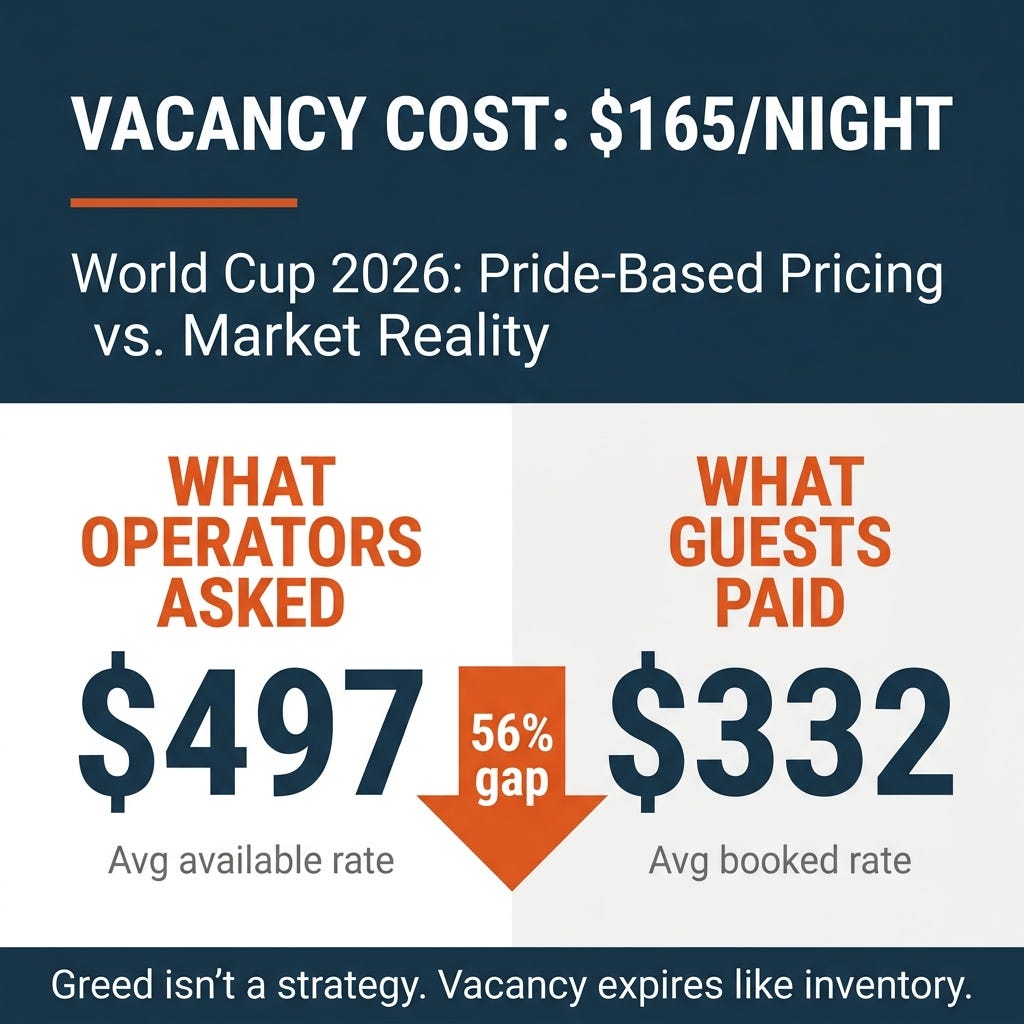
Here is the number that explains it. Across 16 host cities, operators asked an average of $497 a night. Guests actually booked at $332 — about 50% below the asking price (AirROI World Cup data, May 2026). That gap is what pride costs, measured in real time.
I've spent 15+ years in this space, trained more than 10,000 operators through CashFlowDiary, and recorded 237+ podcast episodes breaking down the deals that work and the ones that don't. This gap shows up in every cycle — a once-in-a-generation event just made it impossible to miss.
• • •
The Projection vs. the Payout
The projection wasn't a lie. It was a ceiling — the best case if every operator priced perfectly and every fan paid full freight. Deloitte modeled 60% occupancy and a 90% price premium. The live booking data never got close.
Atlanta is the cleanest example. Operators there asked 86% over last year. Guests booked at 30% over — a 56-percentage-point gap between the asking price and the market price (AJC, June 2026). Matchday occupancy actually fell 2% year over year. Same property, same event; the entire difference was in the pricing. Operators cut $5,000 to $6,000 off their asking prices, but did it too late, after the early-booking window had already closed.
The Gap Is the Cost of Emotional Pricing
A $497 ask and a $332 booking are not two numbers. They are a decision. The first is what you wish the night were worth. The second is what someone with a credit card and other options decided it was worth.
Houston tells the other end of the story: the cheapest booked rate of any US host city at $202 a night — and budget units there filled first while luxury inventory sat. Dallas hosts went the other way, asking the most aggressive premiums of any host city: remaining nights listed around $944 a night on average, while the rooms that actually booked went for a fraction of that (AirROI). Fans spent their money on tickets and flights. Lodging is where they economize. The supply didn't help either — Airbnb's $750 new-host bonus pulled a wave of fresh listings into every host city right before kickoff, so even cities with strong demand growth watched their premium evaporate against the competition.

Where It Actually Paid
The winners weren't the operators with the highest prices. They were the ones who read demand and met it early. Miami held its group-stage rate increases to about 18% over last year, and booked nights still climbed 55% (Miami Herald, AirDNA). Boston booked 63% of its opening weekend at roughly $453 a night. Kansas City led the country in year-over-year booking growth at 44% — though even there, a 40% jump in new listings ate into the gains. Dallas and Fort Worth still pulled demand 25 to 47% above last year by letting the budget units book first and pricing the premium nights last.
The thread running through every winning market is the one I keep coming back to: the short-term rental business isn't dying, it's sorting. The event didn't reward the boldest price. It rewarded the operator who read demand and met it first.
The World Cup didn't reward the highest price. It rewarded the operator who read demand and met it first.


💡 Key reframe: The room is the door, not the product. Operators who cut the nightly rate and added transportation, food delivery, photography, and extra cleanings made more per booking than the ones holding out for a fantasy rate on an empty calendar.
⚡ The math operators skip: A $497 ask at 20% occupancy loses to a $332 ask at 60% occupancy — every time. An empty premium night earns exactly zero, and zero doesn't care how proud you were of the price.
Your 4-Week Event-Pricing Playbook
Week 1 — Find the real comp. Pull the actual booked rate for comparable nights in your market, not the asking rate. Asking prices lie; booked prices don't. That number is your anchor.
Week 2 — Price to pace, not to the projection. Set your opening rate near the booked comp and watch the daily pickup. If nights fill, raise. If they don't, you priced for pride — adjust this week, not next month.
Week 3 — Build the service menu. List every favor you'd normally comp — airport runs, grocery stocking, early check-in, extra cleanings — and price each one. The booking is the entry point; services are where the margin lives.
Week 4 — Tier by the calendar, then hold your nerve. Charge the premium on true peak nights, ease off on the shoulder days to protect occupancy, and be ready to take the last-minute booking. Roughly a third of event bookings land in the final week.
Common Questions About Event Pricing
How much are Airbnb hosts actually making during the 2026 World Cup? Less than the headlines promised. Deloitte projected an average of $4,000 per US host, but that assumed 60% occupancy and a 90% premium. Real booked rates averaged $332 a night against $497 asking — roughly 50% lower — and occupancy in many cities ran well below the model.
Which host city is best for short-term rentals right now? By booked performance, Miami (+55% nights), Boston (63% of opening weekend booked), and Kansas City (+44% bookings) led the US — all by pricing to market reality early rather than holding out for projected rates.
Why is World Cup rental demand lower than expected? Three reasons: operators priced to projections instead of pace, a flood of new listings from Airbnb's $750 host bonus diluted demand, and fans economized on lodging after spending on tickets and flights. The demand is real — it just won't pay a fantasy rate.
Ready to Price Your Next Event to Reality?
You don't need the next World Cup to use this. Every festival, conference, and game weekend in your market is the same test of pricing nerve. If you've got an event-pegged property and you're not sure whether to hold your price or move it this week, let's read your market's pace together — you'll leave with the call, not a pitch.
• • •
P.S. The operators sitting on empty inventory right now aren't unlucky. They're anchored to a number a press release gave them in April. Don't be the listing that's still priced at double what comparable nights actually booked for.
Wealth & Freedom Blueprint is the newsletter of CashFlowDiary, written by J. Massey — short-term rental investor, educator, and consultant since 2008.