


Your next booking might already be in your inbox. If every booking you get comes from a stranger, you're paying full price for every night. On a strategy call we'll map where your guest-retention leaks are - no pitch, you leave with the diagnostic.
The cheapest booking you'll ever get is the one that comes back on its own.
Hey,
The most expensive guest you'll ever host is the one you have to win twice.
Think about what it takes to fill one night with a stranger: the photos, the OTA commissions, the promotional discount you offered because someone needed one more reason to trust you. Between advertising and platform fees, winning a brand-new guest can eat 15% to 25% of the booking value before anyone touches a key.
Now think about the guest who already stayed. They know the bed. They know the coffee. They know you answer messages in minutes, not days. They book again without ads, without discounts, without convincing.
Most operators pour everything into finding strangers and almost nothing into keeping the people they already won. That's backwards - and fixing it costs almost nothing but attention.
I've spent 15+ years in this space, trained more than 10,000 operators through CashFlowDiary, and recorded 237+ podcast episodes breaking down the deals that work and the ones that don't. The pattern below shows up in every cycle.
• • •
Your Cheapest Revenue Is the Guest Who Already Stayed
The numbers don't need decoration. Frederick Reichheld at Bain & Company found that increasing customer retention by 5% can raise profits by 25% to 95%.1 Acquiring a new customer can cost five to ten times more than keeping an existing one - the exact multiplier varies by market, but the direction never does.
Referrals carry the same economics with a trust layer on top. Nielsen found that 92% of consumers trust recommendations from people they know above every other form of advertising.2 When a past guest tells a friend to book your place, that friend arrives pre-sold.
For a single-unit operator this isn't a vanity metric. Every repeat booking skips the commission-and-discount toll booth entirely - money that lands in margin instead of marketing.
Retention compounds. Churn bleeds. A five-unit portfolio where guests come back will outrun a ten-unit portfolio that has to win every booking from scratch.
- J. Massey
💡 Key reframe: retention isn't a hospitality nicety - it's a unit-economics lever. If 20% of your bookings come from repeat guests or referrals, you've cut acquisition costs on one-fifth of your revenue. That margin goes straight to your bottom line.
Know the Line Before You Build
Airbnb's rules are specific, and the penalty for crossing them is your account. Before you build any retention system, know both sides of the line.
Prohibited: asking guests to communicate or pay off-platform before a booking is confirmed, collecting fees outside Airbnb to dodge service charges, and soliciting direct bookings to avoid fees. Airbnb's message filters block phone numbers, emails, and external links before confirmation - and off-platform bookings forfeit AirCover protection entirely.
Allowed: messaging guests through Airbnb after a booking is confirmed or completed, following up post-stay, and building a brand - a website, a newsletter, social channels - that guests choose to follow on their own. The distinction is intent: serve guests better and let them opt in, and you're fine. Build a fee workaround, and you're not.

Retention starts during the stay - the welcome book, the insider guide, the details strangers don't get.
Earn the Return While They're Still in the House
Retention starts during the stay, not after it. The welcome book that goes beyond a generic restaurant list - seasonal events, hidden trails, the coffee shop that opens at 6am - plants the seed with one line: you won't see it all in one visit.
Ask better questions at check-in: what brings them to town, who they're with, what they're celebrating. A family with kids needs different recommendations than a couple on an anniversary trip. The operator who adjusts is the one guests remember.
Then the checkout note - handwritten or printed, a real thank-you and a soft return seed: "If you're ever back in the area, we'd love to host you again." No pitch. No discount code.
And within 48 hours of checkout, send a personal message through Airbnb that references something specific: "Hope the hike to Eagle Point was worth the early start." Specificity triggers the guest to relive the stay - and that emotional replay is the retention mechanism. The review window runs 14 days; act while the memory is warm.
⚡ The math operators skip: a 5-star review does double duty. It moves your search position today, and the act of writing it makes the guest relive the stay - which primes the rebook tomorrow. The 48-hour window is when both are still warm.

The churn treadmill: every booking a stranger, every night bought at full acquisition cost.

The return path: familiar door, zero acquisition cost, a guest who arrives pre-sold.
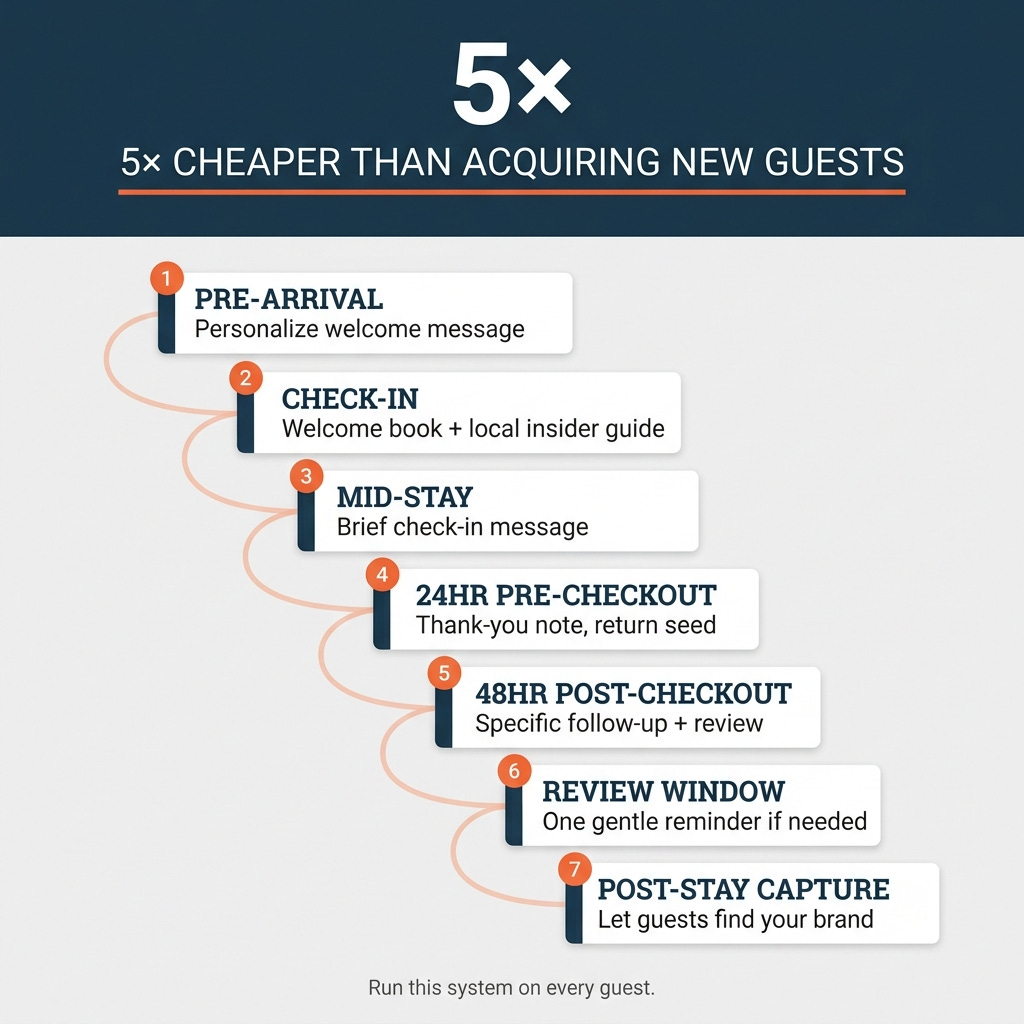
The Seven-Step System You Run on Every Guest
Pre-arrival: personalize your welcome message around why they're coming - celebration, work, family.
Check-in: welcome book out, smart-TV welcome screen on, QR code to your local guide on the fridge.
Mid-stay: one short "settling in okay?" message through Airbnb. Two sentences, max.
24 hours before checkout: the checkout note - thank-you plus return seed, no pitch.
Within 48 hours after: a personal message referencing something specific from their stay. Submit your review.
Review window: if they haven't reviewed by day 10, one gentle nudge. One.
Post-stay: if they find your newsletter or social channels on their own, welcome them. Never push.
Operators who run this on every guest - no exceptions - see 15% to 25% of bookings come from repeat guests and referrals within 12 months. That's not a promise; it's the pattern across the operators we work with.
Keep reading: repeat business is the Frequency lever - one of the four that decide what your property earns.
The 4-Lever Revenue Formula: Stop Fixing the Wrong Thing First

Your Airbnb revenue is Leads x Conversion x Frequency x Margin. Find the one capping you, and move only that.
Common Questions From Operators
Can I contact a guest after checkout? Yes - through Airbnb messaging, any time after the booking is confirmed or completed. What's prohibited is moving pre-booking conversations or payments off-platform.
Is asking guests to book direct next time against the rules? Yes. Soliciting off-platform bookings to avoid fees violates Airbnb's policies and risks account suspension. Build repeat business inside the platform.
What perks can I offer referred guests? Hospitality perks - a local gift, a welcome-basket upgrade, a personal touch. Cash or fee-equivalent incentives that function as off-platform payment cross the line.
Ready to Turn One-Time Stays Into a Repeat-Guest Engine?
If you want an operator's eyes on your retention setup - where the leaks are, which lever to pull first - that's exactly what we do on a strategy call. No pitch. You leave with the diagnostic.
• • •
P.S. - Start with one habit this week: message your last checkout within 48 hours and mention something specific about their stay. That single habit starts the whole flywheel.
This is educational content, not legal advice. Airbnb's policies change - confirm current rules in Airbnb's Help Center.
Ready for the next step?
Frederick F. Reichheld and W. Earl Sasser, Jr., Bain & Company / Harvard Business Review: increasing customer retention rates by 5% increases profits by 25% to 95%.
Nielsen, Global Trust in Advertising (2012): 92% of consumers trust recommendations from people they know above all other forms of advertising.