


Hey,
You rewrite the listing title for the tenth time. You swap the cover photo. You nudge the nightly price by five dollars. And the number at the bottom of your dashboard barely moves.
That is not a work-ethic problem. It is an aim problem. Your Airbnb revenue is not one number you push on — it is four numbers that multiply. And because they multiply, a weakness in any one of them quietly caps everything else.
Here is the formula that ends the guessing — and the ten-minute exercise that tells you exactly which lever to pull first.
I have spent 15+ years in this business, trained more than 10,000 operators through CashFlow Diary1, and broken down 237+ podcast episodes2 of the deals that worked and the ones that did not. The same mistake shows up in every cycle: an operator pours effort into the lever that was never the constraint.
• • •
The formula in one line
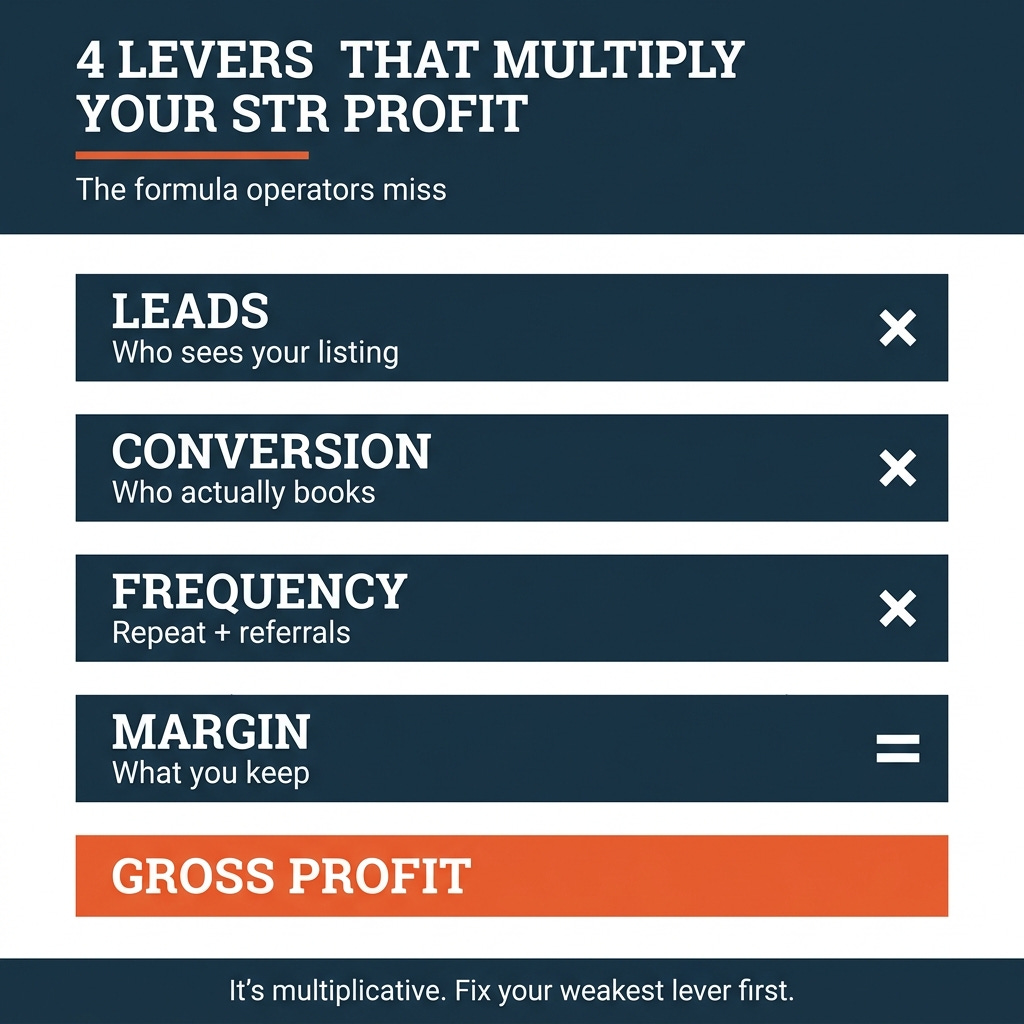
Revenue = Leads × Conversion × Frequency × Margin.
Every dollar your listing earns traces back to those four numbers. Because they multiply, a weakness in any one caps the whole result — and a fix to the weakest one moves everything downstream. That is why “work harder on all four” is the wrong instruction. You want the single lever dragging the product down.
Say your listing gets 400 views a month, converts at 1%, books an average four-night stay at $120 a night, and you keep 60% after costs. That is four bookings — about $7,680 booked and roughly $4,600 kept.
Now double the weakest lever instead of nudging all four. Take conversion from 1% to 2% and the same 400 views becomes eight bookings — $15,360 booked, about $9,200 kept. You did not buy traffic, run a sale, or add a property. You moved one number.
Doubling a 0.5% conversion rate is the same revenue win as doubling your traffic — at a fraction of the cost. — J. Massey

Four levers. One of them is your ceiling right now.
Leads and Conversion — the top of your funnel
Leads is how many of the right travelers ever see your place. Search ranking, your cover photo, your title, and your price band decide it. If 200 people see your listing this month instead of 100, everything below inherits the lift.
The trap is chasing more eyeballs when the problem is the wrong eyeballs. A listing buried on page four does not need a new headline — it needs to rank. Fix visibility before you touch copy.
Conversion is the share of viewers who actually book. Move it from 0.5% to 1% and you have doubled revenue without a single extra visitor — usually the cheapest lever to move and the one operators ignore. It lives in the details a guest checks right before they commit: review count and recency, photo quality, the first three lines of your description, and whether the price fits what they see.
💡 Key reframe: more traffic is the expensive fix. A higher conversion rate is the cheap one — and it multiplies every visitor you already have.
Frequency and Margin — what most operators leave on the table
Frequency is how often the same guest — or someone they sent — comes back. Most operators treat every booking as a stranger. But a past guest already trusts you: they convert higher and cost nothing to reach. A direct rebooking also skips the platform fee3, so it is worth more per night than a new booking at the same price.
This is the lever almost nobody works, which is exactly why it is the easiest place to find hidden revenue. Capture consented guest emails at the touchpoints you control, then give past guests a reason to book direct next time.
Margin is what survives cleaning, supplies, software, and fees. Two operators can post identical top-line numbers and take home wildly different amounts. Raise your effective rate, trim a bloated cost, or shift bookings off high-fee channels and margin widens without a single new guest.
⚡ The math operators skip: revenue you do not keep is not revenue. Margin turns “busy” into “profitable,” and it moves fast because it needs zero extra demand.

Nudging all four at once: motion without movement.

One lever, moved all the way: the number actually changes.
Find your weakest lever first
Here is the ten-minute exercise. Pull your last 90 days and write down four numbers:
Leads — roughly how many people viewed your listing.
Conversion — bookings divided by views.
Frequency — the share of bookings from a repeat or referred guest.
Margin — what you actually kept after every cost.
Now ask one question: which of these, if I doubled it, would change my bottom line the most? That is your constraint. Work it until it is no longer the weakest link — then re-run the exercise and move to the next one. One lever at a time beats a dozen half-finished tweaks.
And notice what sits under all four: the guest. Who books you defines the right photos (Leads), the right first three lines (Conversion), the reason to come back (Frequency), and the amenities worth paying for versus cutting (Margin). Guess at your guest and you will feel like you are fighting four problems at once. Know the guest and the four levers start pointing the same direction. If you want how I work this in practice, it is the throughline of everything I write at CashFlow Diary.
Common questions about the 4-lever formula
Which lever should I fix first? The one that, if doubled, would move your revenue the most — almost always your lowest relative number, not the one that is most fun to tinker with.
Do I have to fix all four at once? No — that is the mistake. Move one, re-measure, then move the next. The levers multiply, so a single unlocked constraint lifts everything downstream.
Are these numbers realistic? They are illustrative math showing how the levers multiply — plug in your own 90-day figures and the same logic holds.
Ready to find your constraint?
If you would rather not guess which lever is capping you, that is exactly what a strategy call is for — we put your real numbers on the table and name the one to move first.
• • •
P.S. — The lever you least want to look at is usually the one capping you. That is not a coincidence. Start there.
Cashflow Diary Direct — one shipped idea a week for short-term-rental operators who would rather move the right number than every number.
CashFlow Diary has trained short-term-rental operators through its courses, coaching, and community since 2013; the 10,000+ figure reflects cumulative students across those programs.
Episode count reflects the CashFlow Diary podcast catalog to date; the figure is approximate and grows over time.
Platform booking fees vary by channel and market. A direct rebooking avoids the OTA service fees charged on a comparable platform booking, which is why a repeat direct guest is worth more per night than a same-priced OTA stay.