


Most rental businesses don't lose money on bad deals. They lose it on follow-up that never happened. On a complimentary one-on-one diagnostic call, we look at who you should already be following up with and which part of that an AI coworker could carry. If it isn't a fit, I'll tell you.

Somebody said yes on Friday. The invoice is out. This is where the yes cools off, unless somebody follows up.
Hey,
Ten days ago I told you my first hire wasn't a person.
Your First Hire Isn't a Person

What we learned building an appointment-setting team in one day, and why it matters most before your first rental
On September 24, AI coworkers started sending one-to-one messages to people already in my CRM. They read each person's record first and wrote to them like a human would. A short ask. One question. A real reply if they wrote back.
That was day one. This is what the next two weeks looked like.
Six people got an offer on a call. Three have paid. Three are still deciding. And the payment I'm proudest of came from the kind of work every small business drops first.
I've spent 18+ years in real estate, focused on short-term rentals since 2016, built a list of more than 10,000 short-term rental operators through CashFlowDiary, and recorded 703 published CashFlow Diary™ podcast episodes breaking down the deals that work and the ones that don't. So here are the receipts. The wins, what it cost, and the part that went wrong.
Paid reader tool: The 66-Vertical Decision Guide
Paid members, annual or monthly, get the 66-Vertical Decision Guide with this edition: the 66 kinds of guests who book short and mid-term stays, and a worksheet to pick the three that fit your market. The article continues below for everyone.
• • •
The receipts
Here's everything from September 18 through October 7.3
1,992 people got a personal first message, mostly by text
321 people wrote back
141 asked us to stop, and we stopped
19 sales calls booked, counting reschedules and follow-up calls
8 diagnostic calls held
6 people got an offer on a call
3 paid $997 each, so $2,991 from new clients
3 offers still open, worth $4,991
2 existing clients bought more in the same two weeks: $10,321
$13,312 in sales, all told
$1,306 spent on the AI work and the texting fees
Two things up front, because they matter.
Two of the three new buyers found me through this newsletter, not through a text. The AI coworkers didn't create those two leads. What they did was everything after.
And most of the money came from two people who were already clients. Nobody had to find them. Somebody had to follow up.
💡 Key reframe: Before you ask an AI to find you new customers, ask a smaller question: who is already in your world that nobody is following up with?
The follow-up nobody has time for
Here's the payment that sold me.
An operator I'll call P. had a great call with me on a Friday. He said yes on the call. I sent the invoice. Then nothing.
You know this moment. Somebody said yes, and the yes is cooling off. On a small team, this is where it dies. Nobody decides to let it die. Monday just shows up with new calls, new guests, a cleaner who didn't show, and the warm yes from Friday slides down the list.
That didn't happen this time.
The next afternoon, an AI coworker built P. a personal plan page. His own numbers. What the first 90 days would look like for his property. When the plan pays for itself. It went to him with a clear deadline.
He paid the next morning at 9:46.
Nobody on a small team has time to build one person a custom page on a Saturday afternoon. Nobody skips a new appointment to do it either. That's the whole point. This is the work humans push aside to chase the next new lead, and it's the work that turns a yes into a payment.
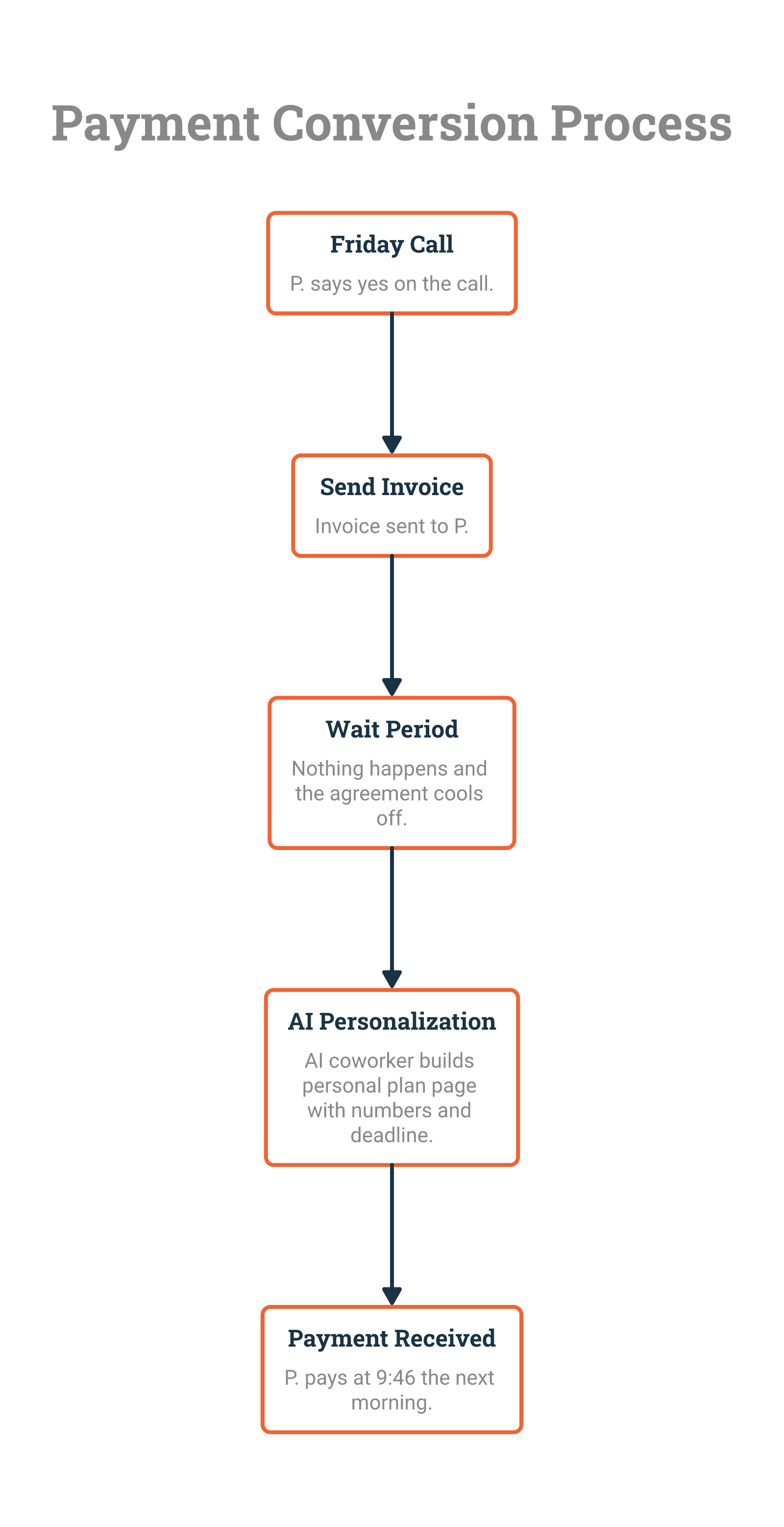
P.'s warm yes, step by step: call, invoice, silence, a personal plan page, payment at 9:46 the next morning.
"The money was in finishing with the people who already said yes."
- J. Massey
Context to strategy to done, in about 30 minutes
I tested how fast this could go with another prospect.
10:59 AM: I recorded a short voice memo about his situation
11:07 AM: the analysis of his situation was done
11:17 AM: his personal page was built
About 11:30 AM: it was sent
12:10 PM: he opened it
That one hasn't turned into a sale. I'm telling you anyway, because speed isn't the point. The point is that the follow-up happened the same morning, while the person still remembered why they cared.
On your own, that page shows up next week if you're lucky. By then they've moved on.
Same morning, while they still remember why they cared.
A human keeps the important replies
The first thing every operator asks me is, "Won't that feel like spam?"
Here's how it's set up:
Anything about pricing, complaints, or someone I know personally comes straight to me
STOP means stop, right away, on every channel
Every first message reads the person's actual history before it goes out
Replies get checked every five minutes, from 8 AM to 11 PM Eastern, seven days a week
The AI coworkers handle the volume. I handle the moments that need a person.
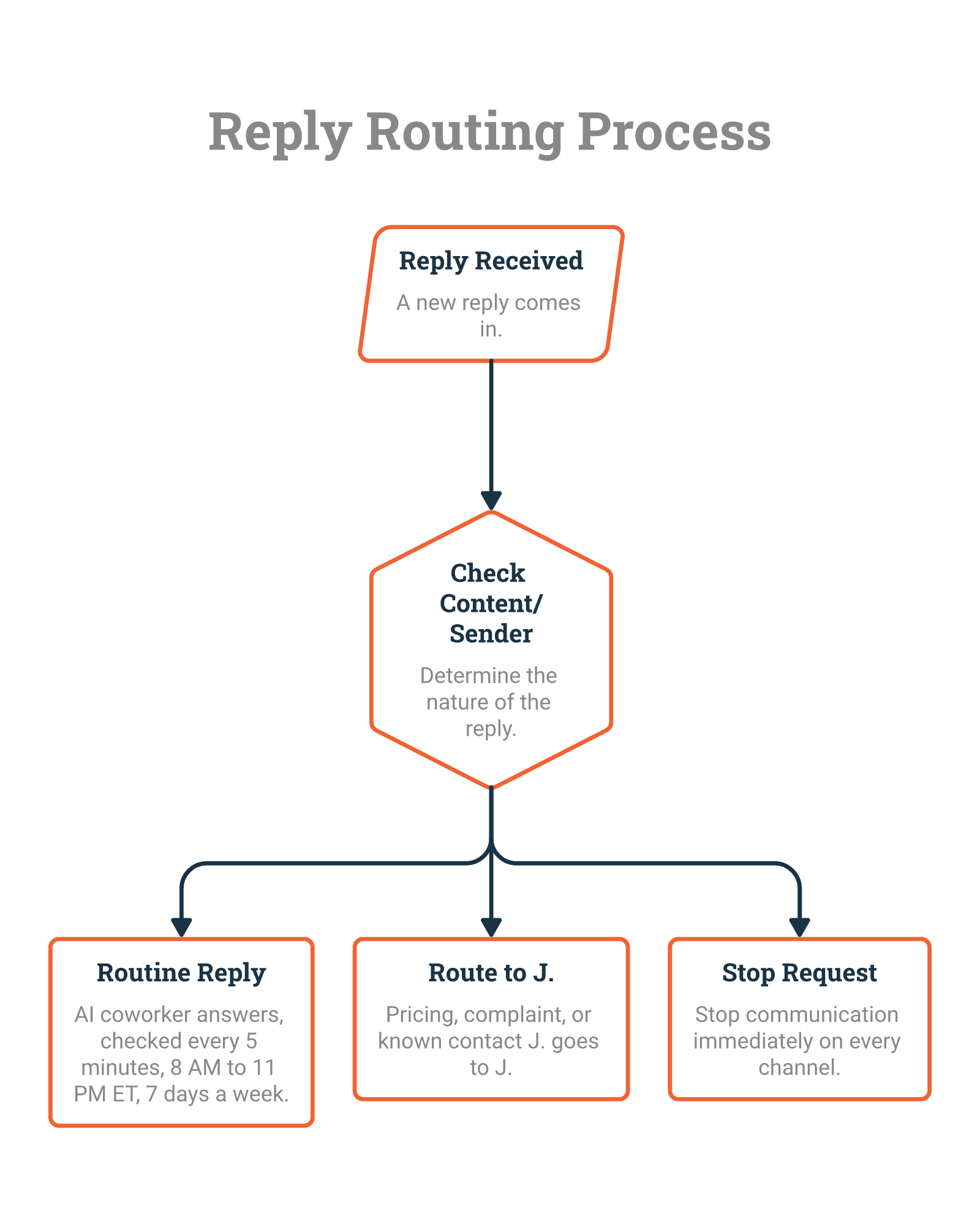
Where every reply goes: routine replies to the AI coworkers, pricing, complaints and people I know to me, and STOP ends contact on every channel.
What went wrong
Now the bad news.
141 people asked us to stop. That's about 7 out of every 100 people we messaged. Our own line to pause and fix things is 2 out of 100. We blew past it.
When I dug in, the messages were fine. The list was the problem. A lot of those texts went to people who bought something from me years ago and hadn't heard from me since. Some of the dates in my CRM were import dates, not purchase dates, so a few texts said "you bought back in 2024" to people who didn't.
So we changed it:
No more texts to past buyers who don't read the newsletter
People who haven't heard from me in a while get an email first, not a text
Every date in a message has to be a real purchase date
Newsletter readers get a message on Substack first
If you take one thing from this edition, take this: the tool will do exactly what you point it at. Point it at people who know you and want to hear from you.
⚡ The math operators skip: Your past guests are already paid for. You spent the ad money and the platform fee to get them the first time. A follow-up to someone who stayed with you and liked it costs pennies next to finding a new guest. The same rule applies, though: only reach out to people who agreed to hear from you.
What it would cost with people
This is my estimate, not something I measured.
If a person spent about 3 minutes reading each record and writing each first message, 1,992 messages is about 100 hours of work. That's two and a half weeks for one full-time setter, before a single reply.
Appointment setters average about $16 to $24 an hour in the U.S.12 So that first pass alone is roughly $1,600 to $2,400 in wages. We spent $1,306 for all of it: the first messages, the replies, the reminders, and the plan pages.
And a person doesn't check replies every five minutes until 11 PM on a Saturday. Two people can't either without burning out.
Not counted in my $1,306: my CRM subscription, the server, and card fees. I'm leaving them out because I'd pay those with or without the AI coworkers.
How to start this week
You don't need 1,992 people. Start with the ones you already have.
Day 1: Pick one list. Past guests, people who asked about a property, or people who said "maybe later." One list only.
Day 2: Write the job. Who gets contacted, the one question you ask first, and what has to come straight to you.
Day 3: Write the stop rule. STOP means stop. Decide it before you send anything.
Day 4: Send to 20 people. Not 200. Read every reply yourself.
Day 5: Count two numbers. How many wrote back, and how many asked you to stop. If more than 2 in 100 said stop, fix the list before you send more.
Day 6: Find your warm yeses. Anyone who said yes and then went quiet gets a personal follow-up with their own numbers.
Day 7: Decide. Keep going, fix the list, or stop.
Ready to find the follow-up you're missing?
On a complimentary one-on-one diagnostic call, we look at your lists, your warm yeses, and the follow-up that keeps slipping. You leave knowing which part an AI coworker could carry and which part should stay with you. If it isn't a fit, I'll tell you.
P.S. Hit reply and tell me: who said yes to you in the last month and then went quiet? I read every reply.
You're reading Cashflow Diary Direct: real numbers, no hype, from an operator who's been in real estate for 18+ years.
This is educational content, not financial, legal, or tax advice. Results are not typical. Small sample: 8 calls, 6 offers and 3 new clients over about two weeks. Follow texting and consent rules where you operate before you message anyone.
• • •
Ready for the next step?
PayScale, "Appointment Setter Hourly Pay in 2026": average base hourly rate $16.08 (last updated May 12, 2026). https://www.payscale.com/research/US/Job=Appointment_Setter/Hourly_Rate
ZipRecruiter data (March 2026), as reported by Leadium, "What Is an Appointment Setter? A Buyer's Guide (2026)": about $24.26 per hour on average in the U.S. https://www.leadium.com/blog/what-is-an-appointment-setter
Sales: BILL invoices and payments plus both Stripe accounts, September 18 to October 7, 2026. Calls: meeting recordings. Messages: the outreach system's send log. Costs: AI coworker usage and texting fees only, from our cost tracker.