


If you're starting your first rental on nights and weekends, follow-up is where deals quietly die. On a complimentary one-on-one diagnostic call, we look at who you should be following up with and what an AI coworker could carry for you. If it isn't a fit, I'll tell you.

The same table at 11pm and 7am. The follow-up doesn't care which one it is.
Hey,
Most people starting out picture the order of things like this.
First you get the property. Then the money comes in. Then, someday, you hire help.
I followed that order for years. On Thursday, September 24, I watched it flip.
We needed follow-up help. We didn't hire anyone. By that night, AI coworkers had sent 198 personal messages, handled the first replies, and put a call on my calendar. I took the call.
I've spent 18+ years in real estate, focused on short-term rentals since 2016, trained more than 10,000 operators through CashFlowDiary, and recorded 704 published CashFlow Diary™ podcast episodes breaking down the deals that work and the ones that don't. Here's exactly what happened, what it would have cost with people, and how you'd write the same job for your first property.
Paid reader tool: The First Hire Job Card
Paid members, annual or monthly, get a fillable worksheet that turns one follow-up job into written instructions for an AI coworker. The article continues below for everyone.
• • •
What happened in one day
We needed an appointment-setting team: someone to reach out one-to-one, answer replies, follow up, keep the CRM clean, book calls, and tell me who needs me.
We didn't hire anyone. We built it with AI coworkers in one day.
By that night:
198 people had gotten a personal text or email (173 texts, 25 emails). Not a blast. One person, one message.
17 had replied
3 asked us to stop (1.5%), and we stopped
The first call was on my calendar
The part I keep thinking about: it was doing the work while we were still building it. Messages went out in the morning. By afternoon, we were adding the follow-up rules. By evening, the booked call had its own prep page, so I walked in knowing who I was talking to and what they'd already said.
The AI credits for the sales build and day one came to roughly $60 to $100. That's our estimate from the account data, not an invoice.
One day is one day. It's a baseline, not a forecast. I'll keep counting.
What the same week would cost with people
No knock on people here. I've hired setters, and good ones earn their pay. This is just the math a beginner never gets shown.
An appointment setter earns about $16 to $24 an hour in the US before commission. PayScale puts the average at $16.08.1 ZipRecruiter data puts it at $24.26.2 Indeed's current figure is $20.07 an hour, plus about $4,400 a year in commission.3
A freelancer to set up the CRM, pipelines and automations runs about $25 to $150 an hour on freelance marketplaces, per a 2026 pricing guide from Marketing Nativo. A fixed-scope build commonly lands around $300 to $2,500.4 GHL Prime puts agency setups at around $1,500 and up.5
Then you recruit, train and wait. Often days or weeks before the first message goes out.
⚡ The math beginners never see: One full-time week of a setter at $16.08 to $24.26 an hour is about $643 to $970. Add a marketplace CRM build at $300 to $2,500 and the first week lands around $940 to $3,470, before commission, payroll taxes or recruiting.124 Our AI credits for the build plus day one: roughly $60 to $100 (our estimate). You still pay for your CRM and texting tools either way, and someone still has to take the calls. Illustrative math, not a quote. Run it on your own numbers.
We did it for about the price of a nice dinner, and it started the same morning.
Why this matters more if you're just starting
Nobody says this to beginners: the hard part of your first rental is the follow-up, not the property.
The landlord who says "maybe next month." The investor who wants to see your numbers. The property manager who never called back. The deal is in the follow-up, and most beginners are doing it alone, at night, after a full-time job.
I've watched this for years. Someone gets a "maybe" on a Tuesday, means to follow up Friday, and by Friday the week has eaten them. Three weeks later the landlord signed with somebody else. Nobody said no. The follow-up just never happened.
That's the job AI coworkers are good at. What we built is a set of written instructions that runs the same way at 7am and at 11pm:
reach out to landlords and investors one at a time
follow up on day 4, day 10, and every 30 days
keep a record of every conversation
hand you the replies that need a human
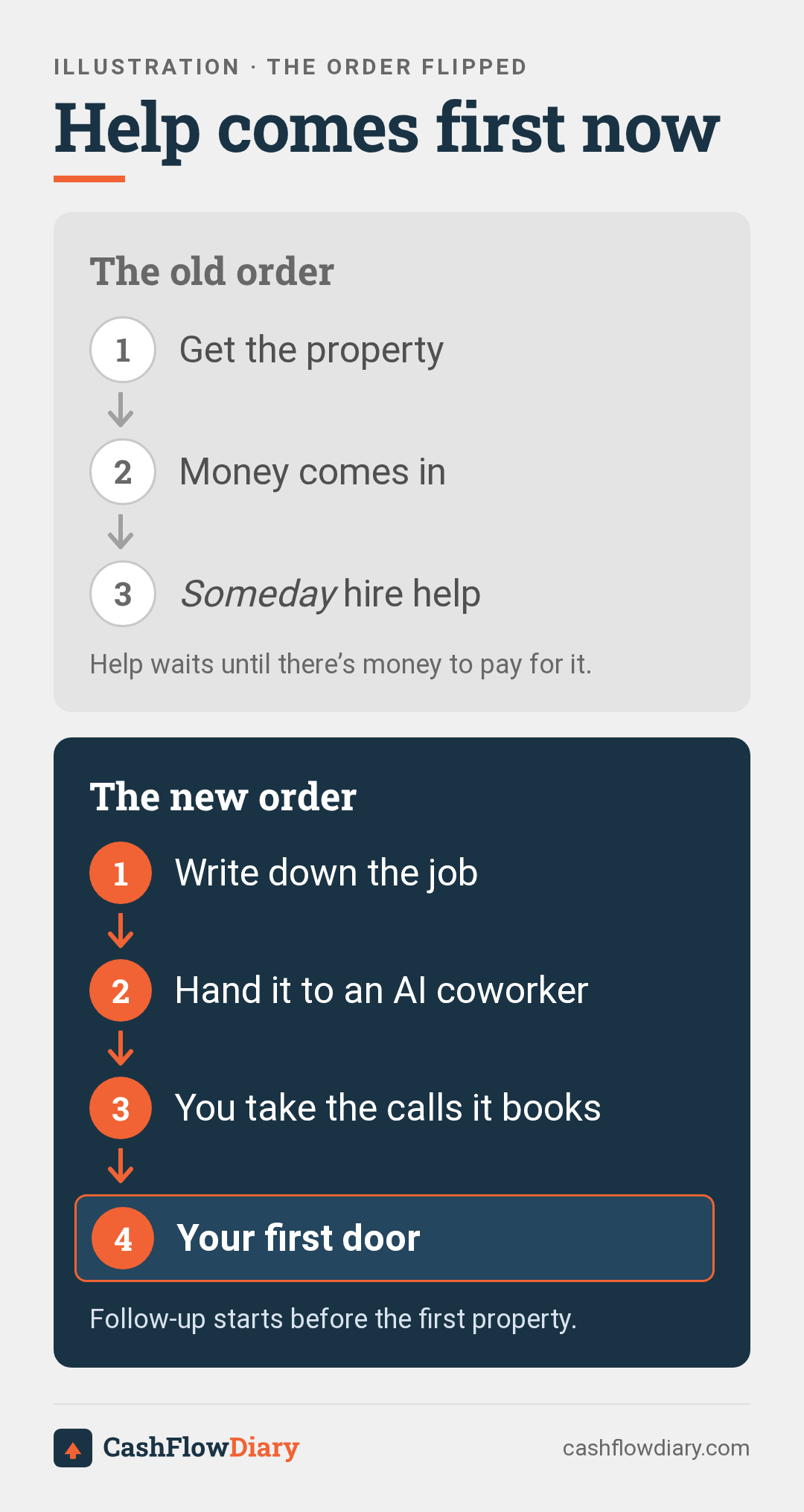
Old order: property, then money, then help. New order: write the job, hand it to an AI coworker, take the calls yourself, get the first door. Conceptual illustration, not a results claim.
💡 Key reframe: You don't have to afford a team before you have a follow-up system. Write the job down first. The follow-up you never get around to is the one that costs you the deal.
How to write the job tonight
You don't need to be technical for this part. You need a notepad and about an hour. This is the same shape as the job we wrote on September 24.
Who you contact. One list, one kind of person. Landlords with a unit that fits, or investors you already know. Not everyone at once.
The first message is a question. Something like "Are you open to a conversation about your unit on Oak Street?" No pitch, no attachment, no offer.
The follow-up schedule. Day 4, day 10, then every 30 days until they answer or say stop. Write the actual words for each one.
What comes to you. Pricing, complaints, anything legal, and anyone you know personally goes straight to you. The AI coworker doesn't answer those.
STOP means stop. One "stop," "no" or "remove me" ends it, on every channel, permanently.
Log everything. Every message goes on that person's record, so you can see the whole conversation before you pick up the phone.
One number per week. Pick one: calls booked. Check it the same day every week.
That's the whole job card. If you can explain it to a new hire, you can hand it to an AI coworker.
What we did NOT let the AI do
This matters, because nobody wants to be the person spamming their market.
No pitch in the first message. The first message asks a question and offers nothing
Anything about pricing, complaints, or people I know personally comes to me
STOP means stop, permanently, across every channel
Every message is logged on that person's record, so nothing is ever "I think we texted them"
Three people asked us to stop on day one. All three came off the list that day, on every channel. That's the rule working, and I'd rather lose a contact than keep someone who asked to go.
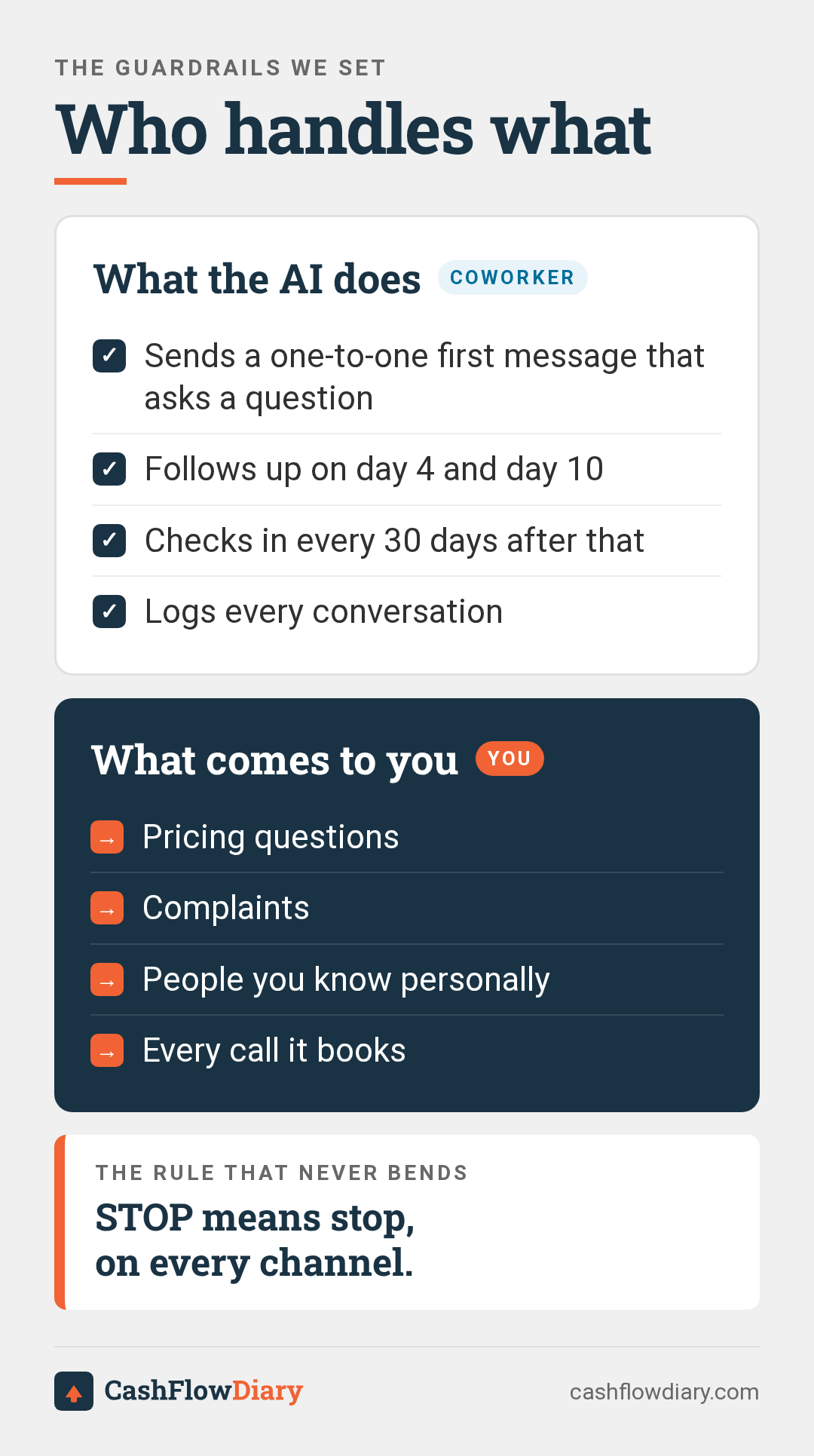
The guardrail split we used: routine follow-up goes to the AI coworker; anything that needs judgment comes to you. Conceptual illustration.
The real lesson
Most AI stories are about doing the same task over and over. This one is different: the AI coworkers helped build the department, and the department was working while it was being built.
If you're starting out, that changes the order:
Write down the job (who you're contacting, what you ask, when you follow up)
Hand it to an AI coworker
Spend your own hours on the calls it books
You don't need to be able to afford a team before your first door. You need the team to get your first door.
Questions people are asking
Isn't this just spam with extra steps? It can be, if you do it badly. That's why the rules come first. One person, one message. The first message is a question. STOP is honored on every channel, right away. On our first day, 3 of 198 people asked us to stop, and all 3 came off the list. If you text anyone, follow texting consent rules and your platform's policies first.
Do I need tech skills? You need to be able to write clear instructions. The hard part is deciding who you contact, what you ask, and what comes back to you. That's thinking, not coding.
What does it cost, and which tools? We used AI coworkers connected to our CRM, which sends the texts and emails and keeps the records. Our AI credits for the build and first day were roughly $60 to $100, by our own estimate. Your cost depends on your tools and your volume. You'll pay for a CRM and texting either way, whether a person or an AI coworker does the follow-up.
Want to see what this looks like for your first property?
If you want help writing the job for your market (who to contact, what to ask, what should come straight to you), book a complimentary one-on-one diagnostic call. If it isn't a fit, I'll say so.
• • •
P.S. Tonight, write down five people you've been meaning to follow up with and the one question you'd ask each of them. That list is your first job card. Everything else is just deciding who sends it.
You're reading Cashflow Diary Direct: real numbers, no hype, from an operator who's been in real estate for 18+ years.
This is educational content, not financial, legal, or tax advice. Results are not typical. Past performance does not guarantee future results. If you text or email people, follow texting consent rules (including the TCPA), anti-spam laws, and your platform's messaging policies, and honor every opt-out.
Ready for the next step?
PayScale, "Appointment Setter Hourly Pay in 2026": average base hourly rate $16.08 (range $13–$21; based on 76 salary profiles, last updated May 12, 2026). Accessed September 25, 2026. https://www.payscale.com/research/US/Job=Appointment_Setter/Hourly_Rate
ZipRecruiter data (March 2026), as reported by Leadium, "What Is an Appointment Setter? A Buyer's Guide (2026)": "About $24.26 per hour on average in the US, per ZipRecruiter's March 2026 figures." Accessed September 25, 2026. https://www.leadium.com/blog/what-is-an-appointment-setter (ZipRecruiter's own page, https://www.ziprecruiter.com/Salaries/Appointment-Setter-Salary, blocked automated access.)
Indeed, "Appointment generator salary in United States" (Indeed's appointment-setter salary page redirects here): average $20.07 per hour and $4,400 commission per year, from salaries in Indeed job postings over the past 36 months, updated September 20, 2026. Accessed September 25, 2026. https://www.indeed.com/career/appointment-setter/salaries
Marketing Nativo, "How much it costs to hire a GoHighLevel expert," August 24, 2026: "25 to 150 USD per hour on freelance marketplaces"; fixed-scope project "300 to 2,500 USD on marketplaces." Accessed September 25, 2026. https://marketingnativo.com/en/hire-gohighlevel-expert/
GHL Prime, "Cost to Hire a GoHighLevel Expert (2026 Guide)," June 20, 2026: agency "one-time setup projects: typical 2026 ranges run from around $1,500 for a focused build to $10,000+." Accessed September 25, 2026. https://ghlprime.com/blog/cost-to-hire-gohighlevel-expert