


Your side hustle shouldn't be a second job.
If your extra income stops the moment you stop working, you built a shift — not a business. On a strategy call we map which income model actually fits your hours, your capital, and your market. No pitch. You leave with the diagnostic either way.

Hey,
Every “side hustle ideas” list on the internet is the same list. Drive for DoorDash. Freelance on Upwork. Open a dropshipping store. Tutor on the weekends.
Here's what none of those lists tell you: almost everything on them is a second job wearing a costume. It pays when you work. It stops when you don't.
So I ran eight of the most popular side hustles through one filter — the only filter that matters if you ever want your income to outgrow your calendar.
One of them replaced my income. It's the reason I'm writing this to you instead of clocking into someone else's schedule.
I've spent 15+ years in this space, trained more than 10,000 operators through CashFlowDiary, and recorded 237+ podcast episodes breaking down the deals that work and the ones that don't. The pattern below shows up in every cycle.
• • •
The Filter That Sorts Every Side Hustle
A side hustle scales when adding revenue doesn't require adding your personal hours. That's the whole test. Hold every option against it and the internet's favorite list gets short fast.
If the only way to make $2,000 more this month is to work 40 more hours, you don't have a business. You have a shift.
💡 Key reframe: You're not choosing between side hustles. You're choosing between income that's rented from your calendar and income that's built into a system.
Seven Hustles, Three Traps
The time trap. Freelancing can reach $8,000 a month and it's still an hourly wage with better branding. Delivery driving nets roughly $12 to $22 an hour after gas and vehicle wear1 — and your car depreciates on someone else's schedule. Tutoring pays $20 to $150 an hour and disappears every summer break. All three stop paying the moment you stop.
The rented-attention trap. Most operators I've watched try dropshipping lost money; the rare winner is renting attention from Meta and TikTok until the algorithm shifts. Print on demand is a creative outlet that occasionally cuts a check — three hours of design work for $4 in lifetime royalties is a common outcome. Affiliate marketing is real, but the ramp is 12 to 24 months of content production before meaningful commissions show up, and most people quit at month four when the check is still $37.
The capital trap. Real estate flipping clears $20,000 to $80,000 per flip when it works. It also needs real capital, a crew you trust, and a market that cooperates for the 90 to 180 days you hold the property. It's a legitimate business — and a full-time job disguised as a side hustle.
A side hustle scales when revenue grows and your hours don't. Seven of the eight most popular options fail that test. — J. Massey
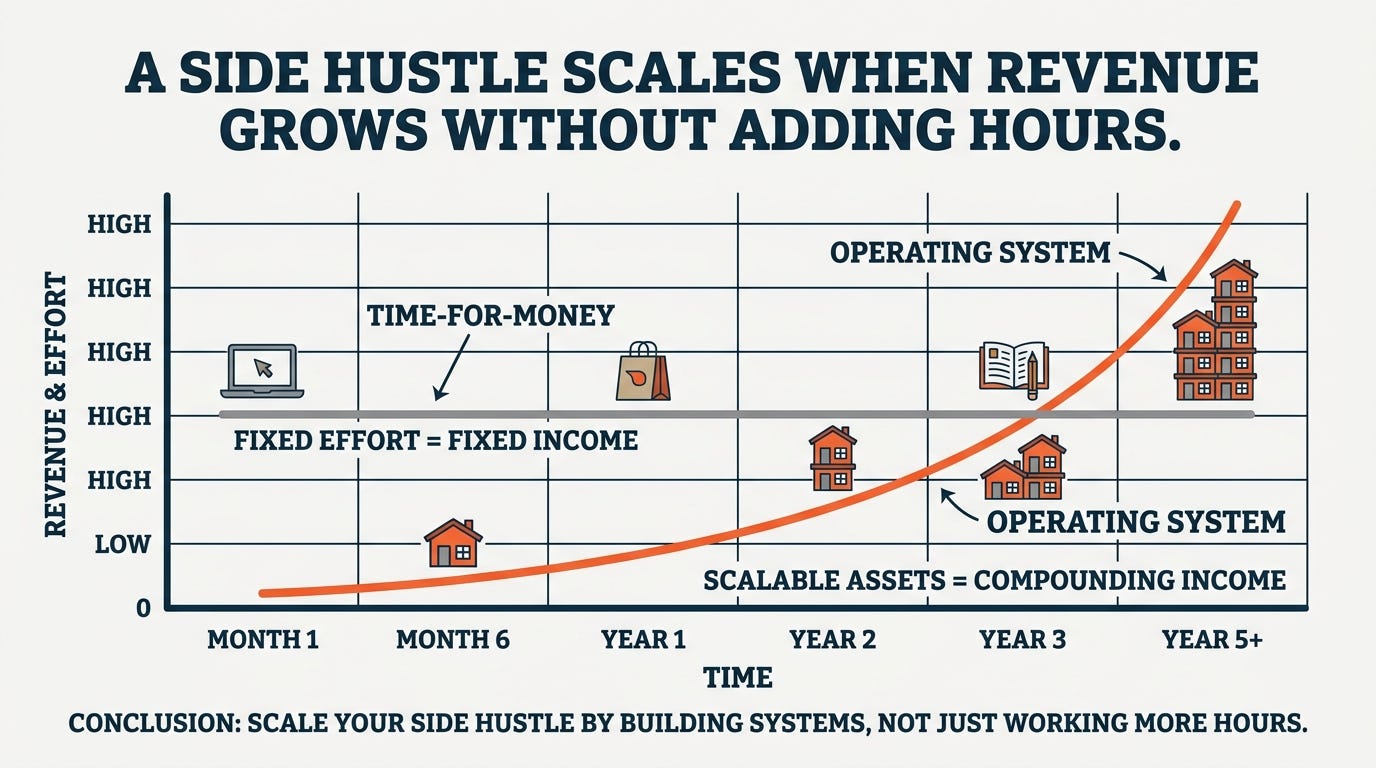
Time-for-money plateaus. An operating system compounds.
The One That Builds an Operating System
Rental arbitrage works like this: you lease a property from a landlord on a standard long-term agreement — with their full knowledge and consent — furnish it, and list it on short-term rental platforms. Guests pay you nightly. You pay the landlord monthly. The spread is yours.
You don't own the property. You don't need a down payment or a mortgage. One stabilized unit produces $500 to $3,500 in monthly profit. And once the first unit runs, the second doesn't double your workload — your calendar adds three or four hours a week while the revenue can double. That's what scaling actually looks like.
⚡ The math operators skip: gross monthly short-term rental revenue must be at least 2.5x the rent before you sign2. Run that number before the lease, not after.
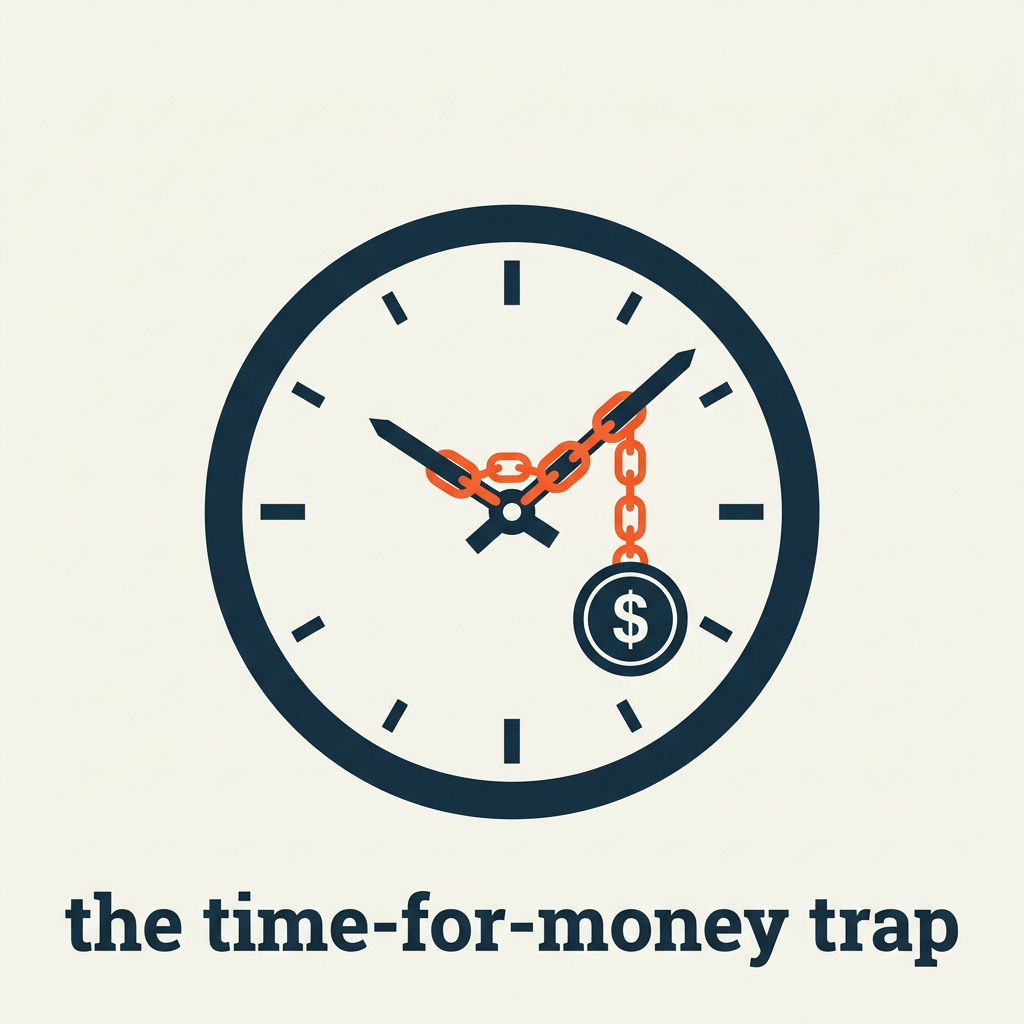
The time-for-money trap: when the clock stops, the coin stops.
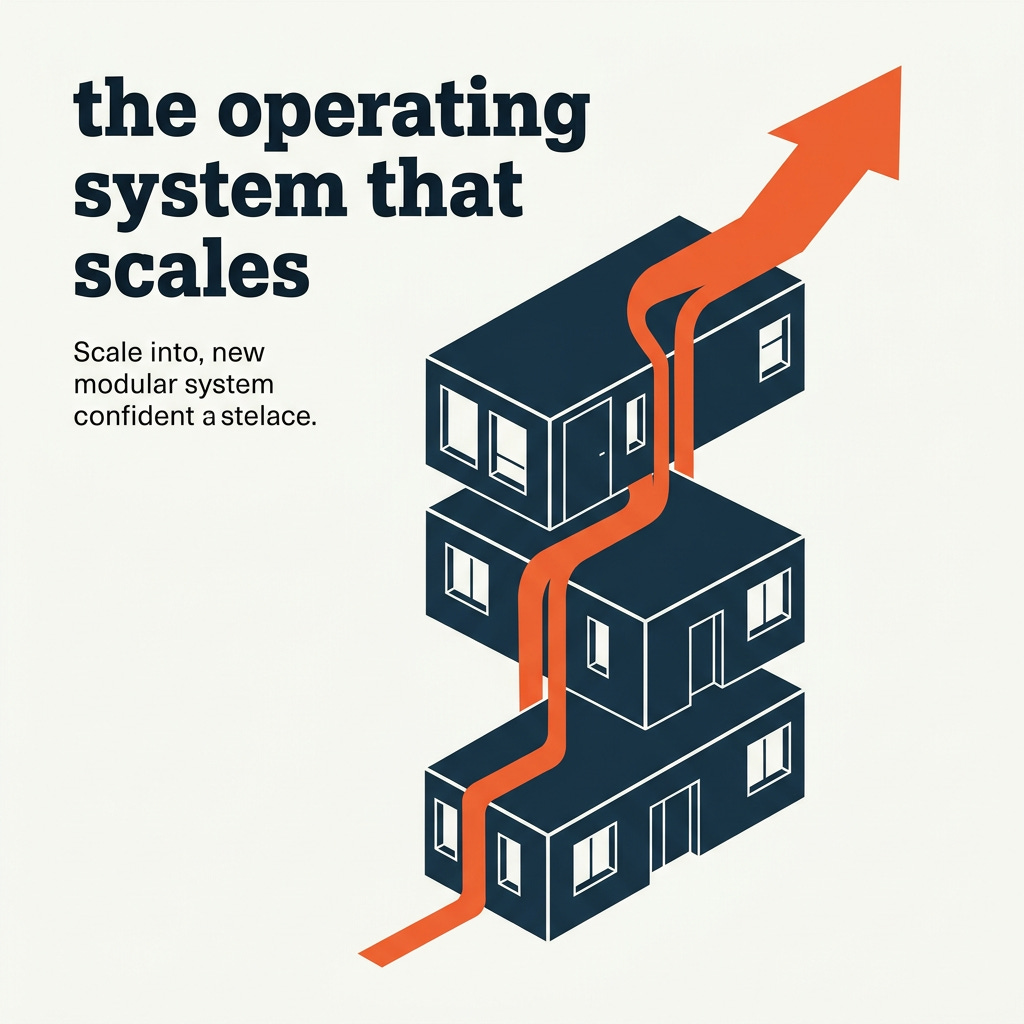
The operating system: add a unit, the system carries it.
What the First 90 Days Actually Look Like
This is the exact sequence I ran on my first unit — the same one I teach now:
Days 1–15 — Pick the market with math. Three drivable markets. Occupancy data, average nightly rates, and one rule: gross monthly revenue must clear 2.5x the rent or I don't touch it.
Days 16–40 — Call landlords. Not text. Not email. Calls. I explained the model, the standards, the longer lease, the on-time rent. Most said no. Two said yes. I took the better location.
Days 41–60 — Furnish smart, not new. Strict budget, used furniture bought well, professional photos, listing copy that sold the neighborhood and the guest experience — not the square footage.
Days 61–75 — Launch low, answer fast. Priced aggressively for two weeks to build reviews. First bookings inside 72 hours. Every message answered in under fifteen minutes.
Days 76–90 — Raise prices, build the system. Reviews in, occupancy above 80%, prices up. Every problem that surfaced became a documented system inside the business.
My first stabilized month cleared $2,400 in profit after rent, utilities, and cleaning. By month four I'd signed the second lease. By year three I was running 34 units. Not every month was a home run — a landlord tried to break a lease, a guest did $3,000 in damage — but every problem became a system. That's the difference between a hustle and a business.
Keep reading:
The Paycheck Trap

Half of Americans live paycheck to paycheck. It's not a money problem — it's a sequence problem.
Common Questions About Rental Arbitrage
Do you need to own property to start? No. That's the structural difference from traditional real estate investing. You operate the unit under a signed lease agreement, with the landlord's knowledge and consent, instead of buying the asset.
How much does it cost to launch a unit? Furniture, setup, photography, and first and last month's rent typically run $3,000 to $8,000 depending on the market and unit size. Buying used furniture well brings the low end down further.
Can it replace a full-time income? At $500 to $3,500 per unit per month in net profit, three to five units at healthy occupancy can produce income in the range of a full-time salary. The timeline depends on your market, your execution speed, and how fast you build the operating system.
Ready to Build Income That Doesn't Need Your Hours?
If one of these eight made you sit up, you already know which one. On a strategy call we look at your market, your capital, and your first-unit math together — and you leave with a plan whether we ever work together or not.
• • •
P.S. The 2.5x rent test has saved more operators than any other single number I teach. If a unit doesn't clear it, walk away. There's always another unit.
You're reading Cashflow Diary Direct — real numbers and real systems from an operator who's still in the game.
Ready for the next step?
Post-expense gig delivery earnings estimates for 2026 range roughly $10–$22 per hour depending on market, platform, and hours, per driver-earnings analyses including UC Berkeley Labor Center gig-pay research.
The 2.5x test comes from my own 34-unit operating history: gross monthly short-term rental revenue divided by monthly rent should be at least 2.5 to leave margin for vacancy, cleaning, utilities, and platform fees before profit.