


Hey,
51% of Americans live paycheck to paycheck right now. The standard advice says the problem is spending — cut the lattes, make a budget, save harder. That advice changes nothing, because the problem was never the money. It's the sequence.
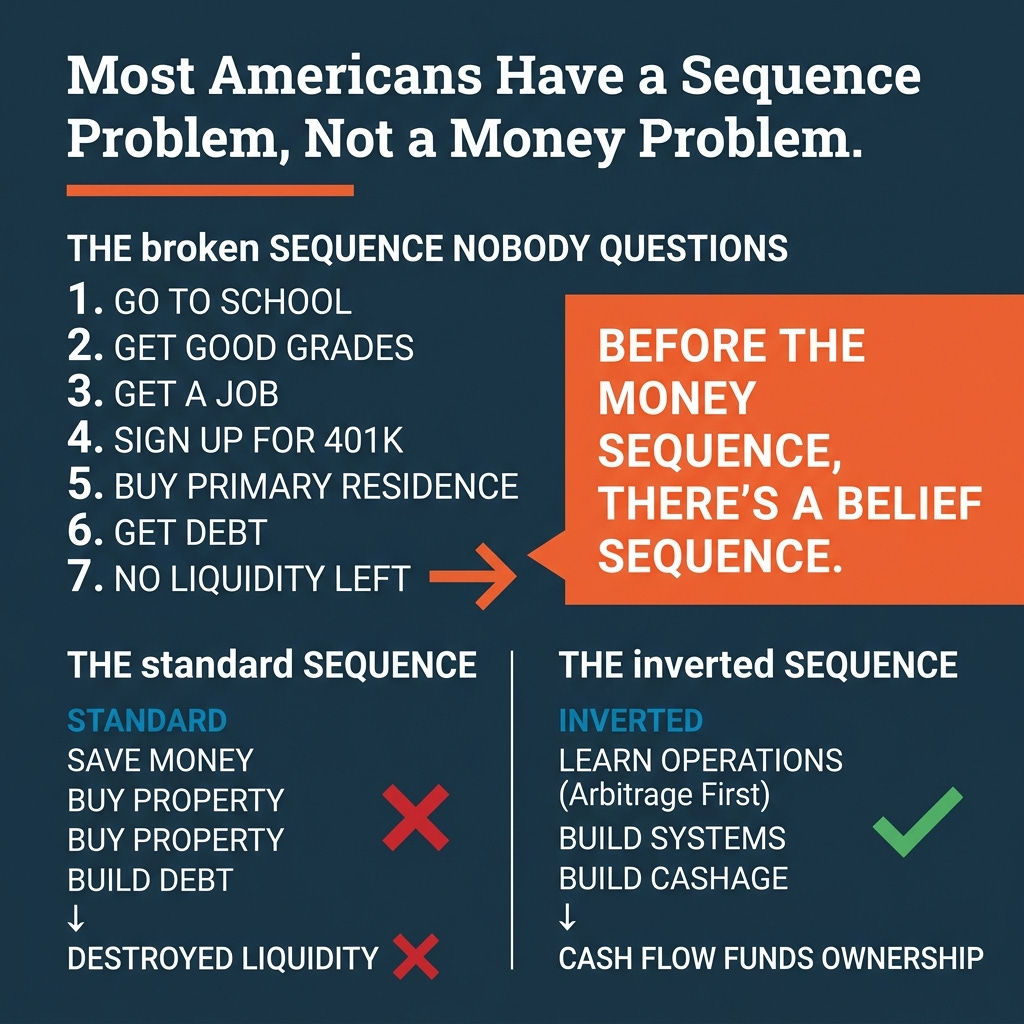
You ran the order you were handed: school, job, 401(k), house, retire. Run those steps in that order and you destroy your liquidity before you ever build a skill that produces income. Then you're on credit cards, trying to keep up, paying for the past instead of building the future.
Two operators look at the exact same opportunity — same math, same market, same starting point. One sees a path. The other sees a trap. The variable was never the opportunity. It was the sequence each one was running.
I've spent 15+ years in this space, trained more than 10,000 operators through CashFlowDiary, and recorded 237+ podcast episodes breaking down the deals that work and the ones that don't. The pattern below shows up in every cycle.
• • •
It's a Sequence Problem, Not a Money Problem
Most people don't have a money problem. They have a sequence problem. The standard path — get a job, save money, buy a property, then figure out how to manage it — destroys your liquidity before you have any skills. By the time you own the asset, you're leveraged, you're learning on the job, and every mistake costs real money because the property is yours.
Here's what nobody explains: to make real estate work you need four ingredients — knowledge, time, money, and credit. Most people stop at "I don't have money or credit" and treat that as the end of the story. You only need to bring one. If you have knowledge and time, you use them to access someone else's money and credit. The ingredient you already have is enough to start.
You only need to bring one ingredient to the table. One.
💡 Key reframe: You don't have a money problem. You have a sequence problem. Fix the order and the trap stops locking.
Why Trading Time for Money Has a Ceiling
Every dollar you earn costs you time. Show up, produce, get paid. The number goes up when you work more, so it feels like progress. But time is finite. Whether you're paid $15 or $150 an hour, there are 24 hours in a day — eight to sleep, two to commute — leaving 10 to 12 to trade. No matter what your hour is worth, the clock caps you.
The real cost shows up when you stop. When your income comes from selling time, taking time off has a price: you don't earn unless you're working. The vacation costs you twice — once for the trip, once for the income you didn't make while you were gone.
Now ask: if the same dollars arrived from assets instead of your labor, what changes? Same income. Different source. That shift alone changes your life before you ever earn an extra dollar.
And the gap is widening. The ratio of median home price to median household income climbed from 3.5 in 1985 to 5.1 in 2025. If you're trying to save your way into ownership from a paycheck, the finish line is moving faster than you are — which is exactly why asset owners pull ahead while income earners fall behind.
"We are born looking like our parents. We die looking like our decisions."
— J. Massey
Invert the Sequence: Arbitrage Before Ownership
Rental arbitrage means you lease a property long-term and rent it short-term. You're not buying. You're operating. Startup is $5,000–$15,000 per unit instead of a $50,000+ down payment — and you learn how to make a property produce cash before you carry the full weight of ownership.
While you lease, you outsource the things that wreck new owners: the HVAC that dies, the roof that leaks, the water heater that fails — the owner's problem, not yours. If the market shifts, you end the lease and move. And you build the real skill: finding the property, pricing it, automating guest comms, running a cleaning system, handling bad guests — all on someone else's balance sheet.
By the time you buy property one, you're not guessing. You know the numbers. You know the operation. The cash flow from arbitrage funded the down payment.
⚡ The math operators skip: Arbitrage runs $800–$1,500 a month per property. Three properties: $2,400–$4,500 a month. That won't replace a six-figure income on day one — but it decouples your time from your money for the first time.

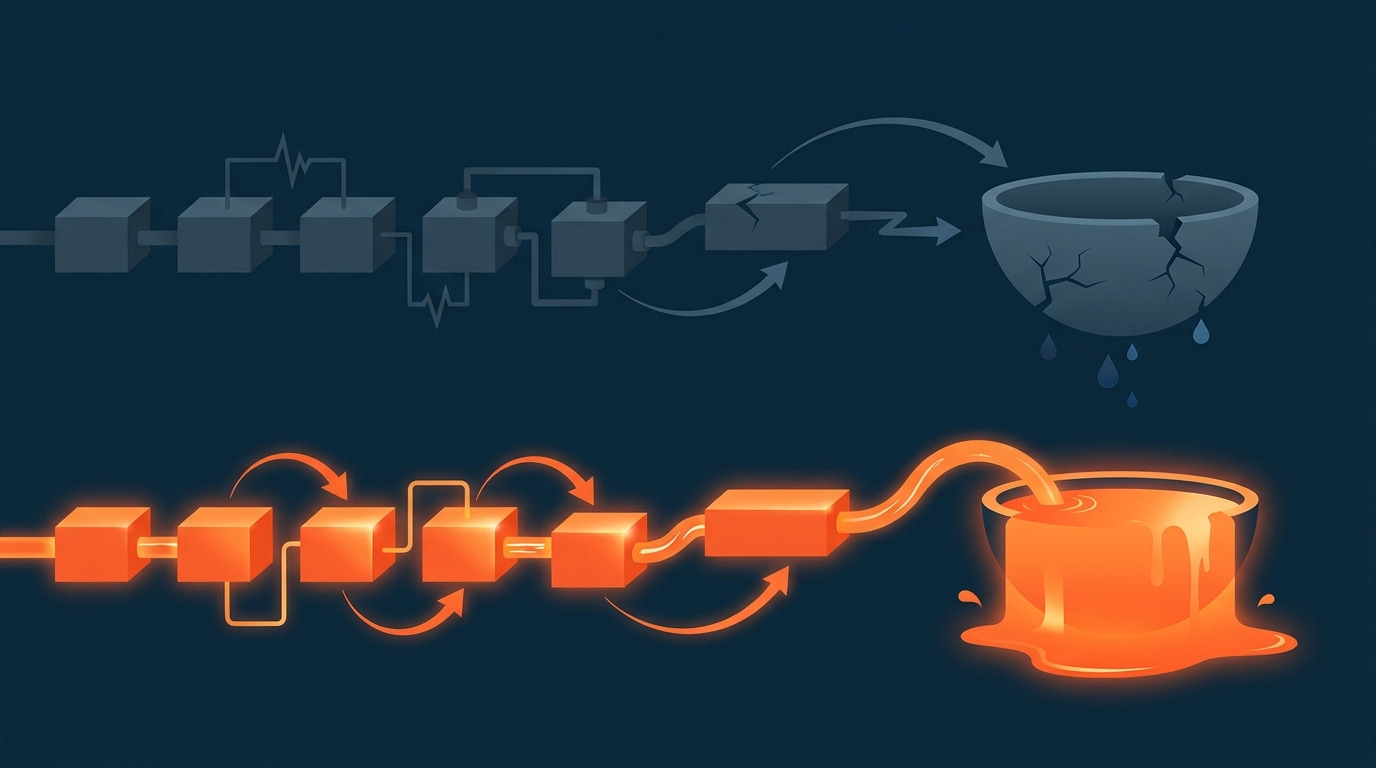
Standard sequence — buy first, learn on the job, and every mistake costs you as the owner.

Inverted sequence — operate first, build the systems, then buy with proven numbers.
The Three-Property Wall
Most operators hit the same wall around the third property. It isn't capital and it isn't operations — it's that you can't run more than two properties out of your head, and most people try to for too long. Comms slip, reviews drop, the cleaning crew quits on a Sunday, and the operator decides scaling was a mistake.
The fix isn't more discipline. It's the system you should have built before property three:
1. Automated guest comms. Pre-arrival, check-in, during-stay, check-out — the system handles it, you approve the exceptions. A weekend to build.
2. Automated review responses with a human gate. The system drafts the reply; you review and send. Two minutes per review instead of twenty. A weekend to build.
3. A Friday 30-minute operations review. Occupancy, pricing, and any flags from the week. Thirty minutes — and it runs as long as you operate.
Common Questions
What is rental arbitrage? You lease a property long-term from an owner and rent it short-term to guests — operating without owning. Startup runs $5,000–$15,000 per unit instead of a $50,000+ down payment.
Why is arbitrage less risky than buying first? It outsources the big-ticket failures — HVAC, roof, water heater — to the owner. You learn operations, pricing, and customer acquisition without the full expense, and if the market shifts you end the lease instead of holding a depreciating asset.
What do I actually need to start? Four ingredients: knowledge, time, money, credit. You only need one. If you have knowledge and time, you use them to access someone else's money and credit.
Ready to Break the Sequence?
Every operator I work with starts here — invert the order, build the systems on someone else's balance sheet, then buy with proven numbers. If you want me to look at your situation and tell you the first move to make, that's what a strategy call is for.
• • •
P.S. Find one property you can lease long-term and rent short-term. Run the numbers. If the spread clears $800 a month after costs and you're under five hours a week on it by month two, you've decoupled time from money for the first time. That's the test. Your outcomes are yours — make the cut.
CashFlowDiary Direct — real numbers, real systems, and the mindset shifts behind them, every week. If this one landed, forward it to one operator who's stuck trading time for money.
Most leases forbid the exact thing arbitrage runs on. The risk you can't hand back to the owner is the owner finding out.