


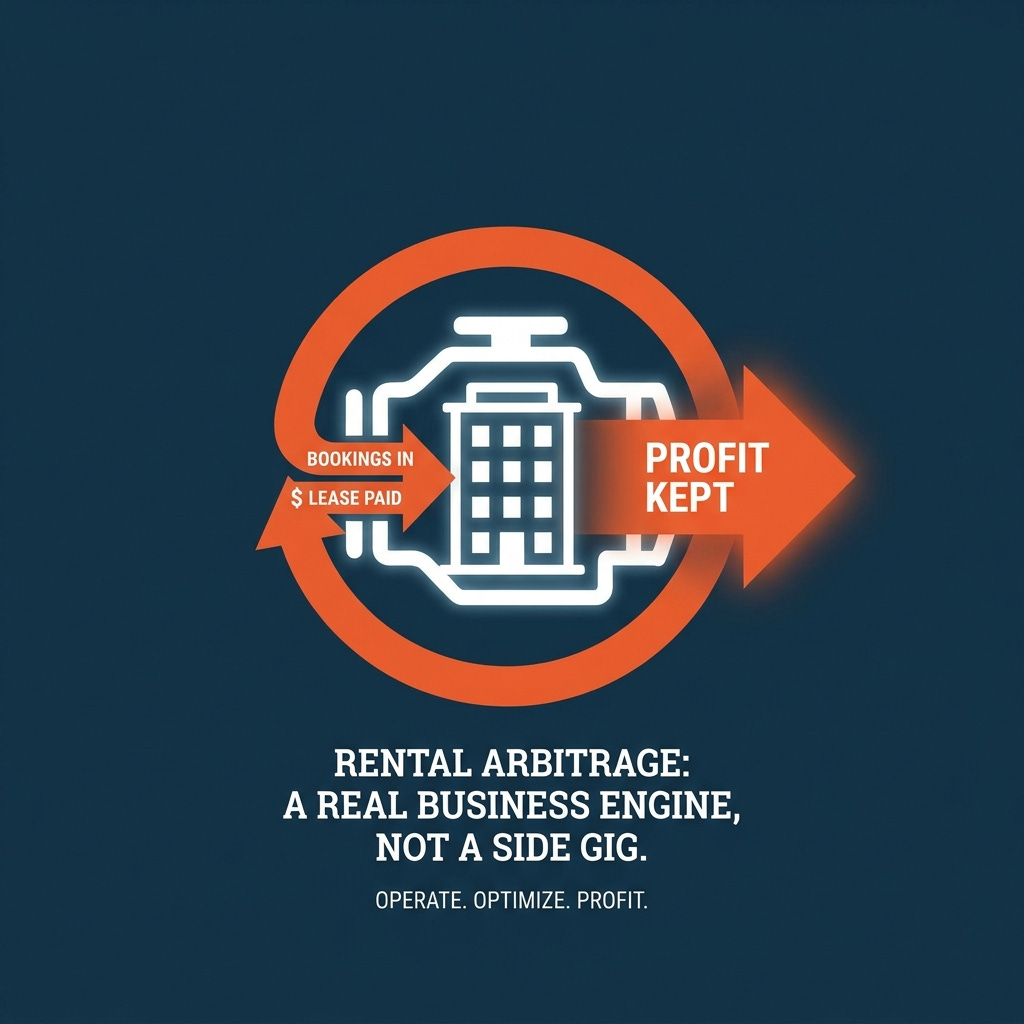
Treating arbitrage like a hobby is the thing keeping it small. A strategy call turns 'should I try one unit?' into an operator's plan for the first one and the next two. No pitch — you leave with the math.
Hey,
Every time I hear someone call rental arbitrage a side hustle, I ask one question: compared to what? Because here's what nobody says out loud — you're already doing arbitrage. You've been doing it your whole life. You just weren't calling it that, and you weren't keeping the profit.
Take the classic example operators love to quote: lease a unit for around $2,000 a month, run it as a furnished short-term rental, and gross roughly $4,200 in bookings — clearing $2,000+ before operating costs, without owning the property. People call that a clever side gig. It's not. It's the same mechanic that drives every wealth-building vehicle there is — including the one most people think is the "safe" choice.
I've spent 15+ years in this space, trained more than 10,000 operators through CashFlowDiary, and recorded 237+ podcast episodes breaking down the deals that work and the ones that don't. The pattern below shows up in every cycle.
• • •
Everything Is Arbitrage — Including Your Mortgage
If you own a home with a mortgage, you're already in an arbitrage relationship. You're just on the wrong side of it. You pay the bank a lease rate — called interest — to occupy a property the bank financed. When the market rises, the bank gets paid first. When it falls, you absorb the loss. That's arbitrage, and you're not the one capturing the spread.
Sit with that for a second, because it rewires how you see your own balance sheet. The bank figured out a long time ago that the money is not in owning the building — it is in controlling the spread between what something costs to hold and what it produces. Arbitrage operators run the exact same play at human scale: control the unit, capture the spread, skip the down payment and the decades of mortgage risk. You are not doing a lesser version of real estate investing. You are doing the part that actually makes the money.
Even the paid-off house isn't the win it's sold as. No mortgage payment — but property taxes forever, zero income position, equity you can't touch without selling or borrowing. A paid-off home isn't an asset working for you. It's inventory sitting idle.
💡 Key reframe: A house that produces no income is a liability dressed in equity. Real estate builds wealth when it produces income — not when you own it, and not when you pay it off.
Why It Gets Called a Side Hustle — and Why That's Wrong
The people who call arbitrage a side hustle are the same people who call entrepreneurship "risky" while working for someone who took the risk. They're not wrong that it's work — pricing, reliable cleaners, guest communication, landlord permission, legal compliance, operational discipline. But that description fits every real business. The word "side" implies the real work happens somewhere else and this income is secondary. That framing is exactly what keeps people small.
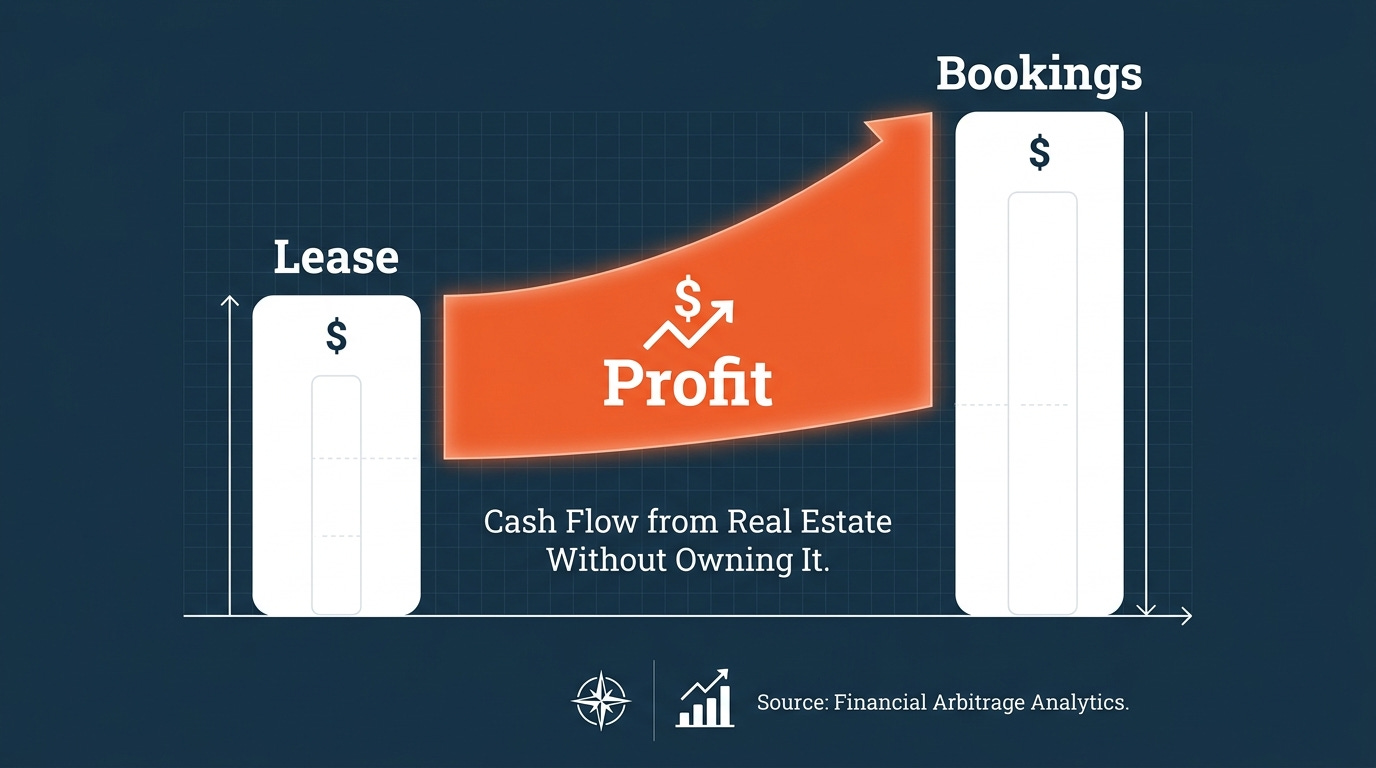
When someone with twelve units clearing $30,000 a month net walks into the room, nobody calls it a side hustle. The strategy didn't change. The volume did. And volume starts with one unit and a decision to treat it seriously.


⚡ The shift operators skip: Stop asking whether the first unit "worked" after 30 days. Start asking what occupancy and ADR it needs to justify the second one. That single change turns a hobby into a portfolio.
The Extended-Stay Edge Most Operators Miss
Here's where real operators separate from amateurs: the platform. Airbnb isn't the only play, and often isn't the best one. Extended-stay guests — traveling nurses, remote workers, corporate relocations, medical families — stay longer, treat the unit better, and require far less overhead. A 30-night stay at $90/night clears $2,700 from a single guest interaction. The same monthly total in weekend rotations means a dozen check-ins, a dozen cleanings, and a dozen chances for something to go wrong.
And the scalability gap compounds. Ten weekend turnovers a month is ten times the cleaning coordination, ten times the guest messaging, ten times the risk of a bad review or a 2am lockout. One 30-day corporate guest is a single handoff. Stack three or four of those and you have a business one person can actually run — which is the whole point. Labor that does not scale is a job you bought yourself; systems that scale are the asset.
The Airbnb-only operator is running a labor-intensive business. The extended-stay operator is running a scalable one — and platforms like Furnished Finder exist specifically for the 30+ day market. There's a real "do well and do good" angle here too: every furnished unit houses someone who needed flexibility a 12-month lease can't offer. That's not a side hustle. That's entrepreneurship — and entrepreneurship was never supposed to feel small.
Houses are for housing people — not for storing money. Real estate creates wealth when it produces income. Period. — J. Massey
The mindset that called this a side hustle? That was the real limitation. It always was.
How to run Unit 1 like an operator, not a hobbyist:
Get it in writing. Written landlord permission to sublease, plus a check that your specific address clears local STR rules. No permission, no deal.
Pick the guest, then the platform. If your market has hospitals, universities, or corporate relocations, lead with extended stay (Furnished Finder) over nightly Airbnb churn.
Set the scoreboard. Define the occupancy and average daily rate this unit needs to justify adding a second. That number — not a vague "did it work" — is your decision rule.
Treat it as Unit 1. Build the systems (pricing, cleaning, comms) once, so Unit 2 plugs into them instead of starting from scratch.
Common Questions
What's the difference between rental arbitrage and subleasing? They're the same thing — arbitrage is subleasing with a short-term-rental business layer on top. The non-negotiable is written landlord permission; without it you're violating your lease.
How many units to replace a full-time income? Depends on your market and target. At roughly $2,000 net per unit per month, three well-run units produce about $6,000/month — many people in the $60–80k salary range replace their income with three to five units run efficiently.
Which platforms work best for extended stay? Furnished Finder leads for 30+ day stays (especially traveling healthcare); VRBO and Airbnb have monthly filters; corporate-housing networks and direct hospital relationships are the highest-margin channels once you have multiple units.
Ready to run your first unit like a business?
If you've been treating arbitrage like a maybe, the fastest way to make it real is to put numbers on it. On a strategy call we'll size your market, pick the right guest and platform, and set the scoreboard for Unit 1 — and Unit 2.
• • •
Keep reading:
The Paycheck Trap

Half of Americans live paycheck to paycheck. It's not a money problem — it's a sequence problem.
P.S. If you own a paid-off house you think of as your best asset, reread section one and reply — I want to hear whether it changes how you see it.
CashFlowDiary — real numbers, real strategy, one shipped idea at a time.
Ready for the next step?