


Confused by financing jargon? A strategy call turns the alphabet soup into a plan for your actual deal. No pitch — you leave understanding exactly how your next purchase gets funded.
Hey,
So you've decided to buy a piece of real estate. Good. Then you hit the wall everyone hits: you don't have the cash to buy a decent one outright. That's not a dead end — it's the entire reason financing exists. And the math behind it is far simpler than the people who profit from your confusion want you to believe.
Let me walk you through a clean, simple deal, end to end, in numbers a sixth-grader could follow. By the end you'll understand the four numbers and the one ratio that sit underneath every mortgage, every seller carryback, and every creative structure you'll ever hear about.
I've spent 15+ years in this space, trained more than 10,000 operators through CashFlowDiary, and recorded 237+ podcast episodes breaking down the deals that work and the ones that don't. The pattern below shows up in every cycle.
• • •
The Problem: You Don't Have $100,000
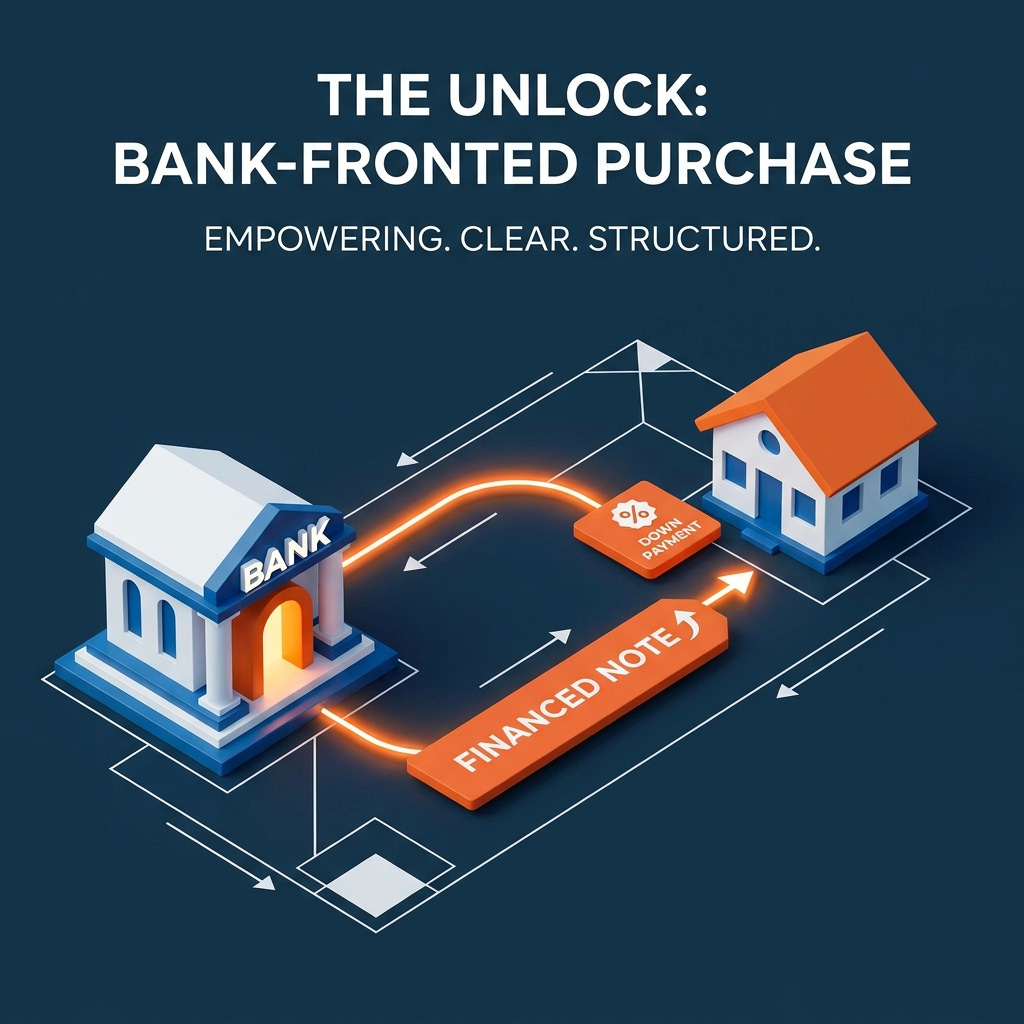
Say the property costs $100,000. You probably don't have $100,000 sitting in your pocket — almost nobody does. This is the exact moment most would-be investors stop, conclude real estate is "for people with money," and walk away. They've misunderstood the game. You were never supposed to bring all the money. The bank brings the money. You bring the deal.

The bank has the $100,000 and wants a safe return on it. You've found a property worth owning. Financing is just the structure that lets those two facts meet. Here's how the numbers actually lay out.
💡 Key reframe: Not having the full purchase price isn't a disqualifier. It's the normal starting position. Financing is the bridge — and learning to build that bridge is the actual skill.
The Deal in One Equation: Price − Down = Note
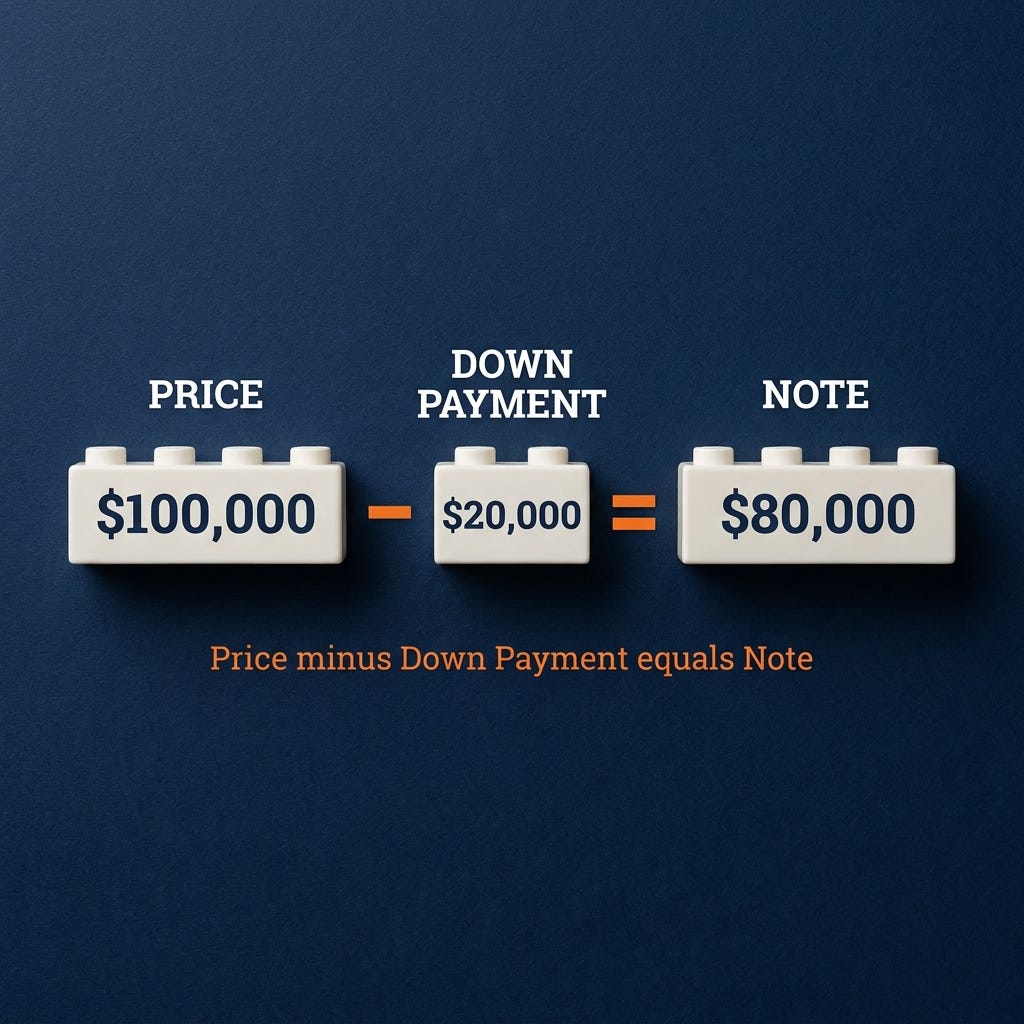
You make a down payment — say $20,000. The bank finances the rest. In exchange, you sign what's called a note (often a mortgage note), usually secured by a trust deed. That note is your promise to pay back the financed portion over time. So the entire transaction reduces to one line:
(Price) $100,000 − (Down payment) $20,000 = (Note) $80,000
That's it. The terms of the note vary state to state and deal to deal, but with monthly payments and interest it typically runs 15 or 30 years. The $80,000 note is the part the bank fronted; your monthly payment is what you hand back, a slice at a time, for the use of their money.
Notice what you got in exchange for that $20,000: control of a $100,000 asset, from day one. You collect the income it produces, you benefit if it appreciates, and you pay the bank back with — ideally — the property's own cash flow. That's the quiet magic of financing. A relatively small amount of your money controls a much larger asset, and the gap between them is where real estate builds wealth. Bring all cash and you own one property; understand the note and you can control several.
The One Ratio That Ties It Together: LTV
There's one more concept worth understanding, especially if you ever sit on the seller side of a deal: loan-to-value, or LTV. You take the value of the note and divide it by the price.
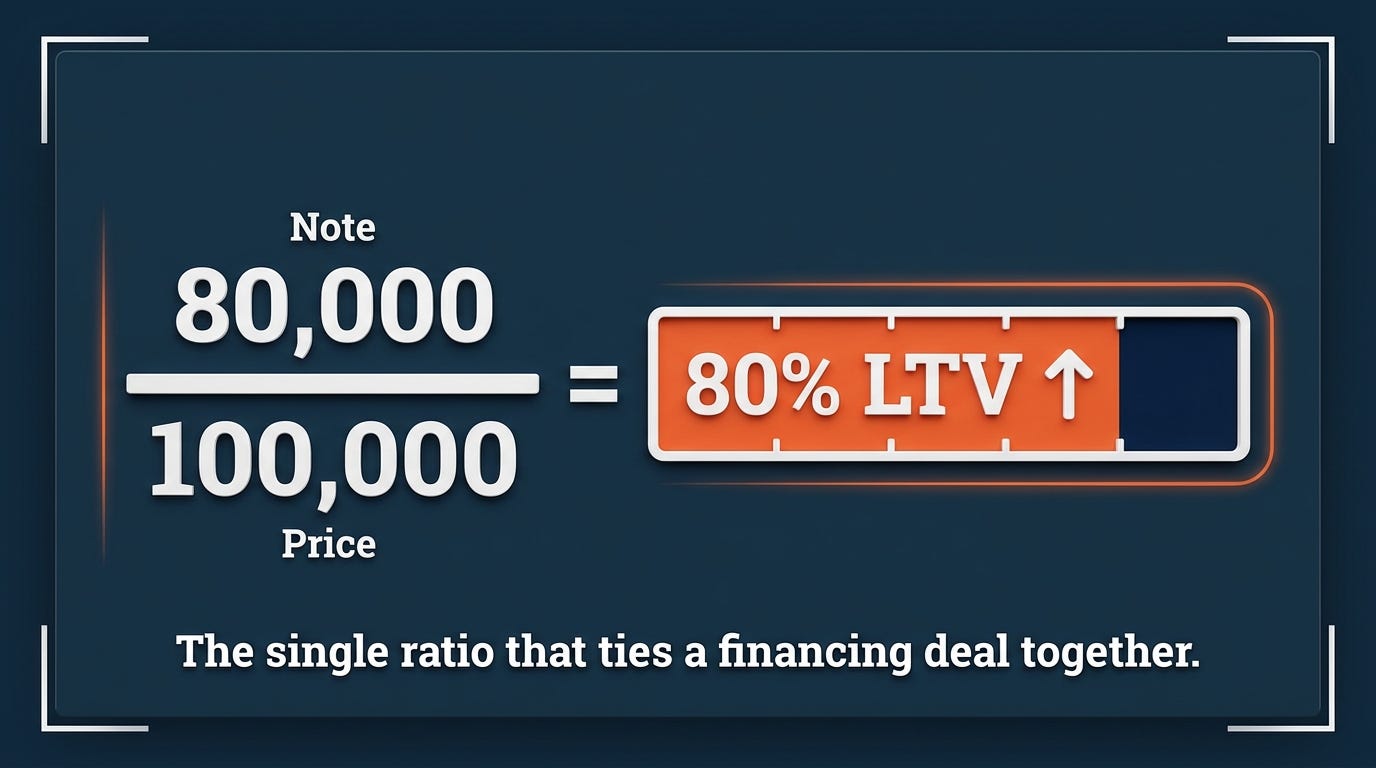
(Note) $80,000 ÷ (Price) $100,000 = (LTV) 80%
An 80% LTV means 80% of the purchase is financed and 20% is your equity from day one. Lenders care about LTV because it tells them how much cushion they have if anything goes wrong — the lower your LTV, the safer their loan. Sellers offering financing care for the same reason. Once you understand LTV, you can read almost any deal a lender or seller puts in front of you and know immediately how exposed each side is.
A quick gut-check on the numbers: a higher down payment means a lower LTV, a safer loan, and usually better terms — but more of your cash tied up in one deal. A lower down payment means a higher LTV, more leverage, and more of your capital free for the next property, at the cost of a bigger note and tighter monthly math. There's no single right answer. The point is that once you can see price, down, note, and LTV at a glance, you're the one making that trade on purpose instead of taking whatever you're handed.
⚡ Why this matters: Price, down payment, note, and LTV are the four numbers under every deal. Master them and seller carrybacks, refinances, and “creative” structures stop sounding clever and start looking like simple variations on the same arithmetic.
Why This Simple Math Is the Whole Foundation
People make real estate financing sound complicated on purpose — it protects their fees and their mystique. But every structure you'll ever encounter is built from these same pieces. A seller carryback is just the seller holding the note instead of a bank. A refinance is swapping one note for a new one on better terms. A “no-money-down” deal is someone else covering the down payment in exchange for a piece of the upside. Same four numbers, rearranged.
That's the real takeaway: you don't need to memorize a hundred financing strategies. You need to understand four numbers and one ratio so deeply that you can see them inside any deal. Once you can, the fear that kept you on the sidelines — that everyone else knows a secret you don't — quietly disappears.
People make financing sound complicated to protect their fees. It's four numbers and one ratio. — J. Massey
You were never supposed to bring all the money. You bring the deal. The bank brings the money.
Common Questions
What's the very first step? Educate yourself and make a plan. Learn this simple math, research your local market and its rules, and talk to people who've actually closed deals. Confidence comes from understanding the structure, not from having a pile of cash.
How much money do I really need? Often less than you think. Beyond a traditional down payment, creative financing, partnerships, and lease-arbitrage models let people start with minimal upfront capital. The down payment is one path, not the only one.
What is LTV again, in one line? The note divided by the price. $80,000 ÷ $100,000 = 80%. It tells you how much of the deal is financed versus how much is equity.
Ready to fund your next deal?
If the math finally makes sense and the fear is loosening its grip, the next step is applying it to a real property and a real number. On a strategy call we'll take a deal you're looking at and run the price, the down payment, the note, and the LTV together — so financing stops being a mystery and starts being a tool.
• • •
Keep reading:
The Paycheck Trap

Half of Americans live paycheck to paycheck. It's not a money problem — it's a sequence problem.
P.S. Take a property you've been eyeing and write out the four numbers — price, down, note, LTV. Reply with them and I'll tell you what the deal is really saying.
CashFlowDiary — real numbers, real strategy, one shipped idea at a time.
Ready for the next step?