


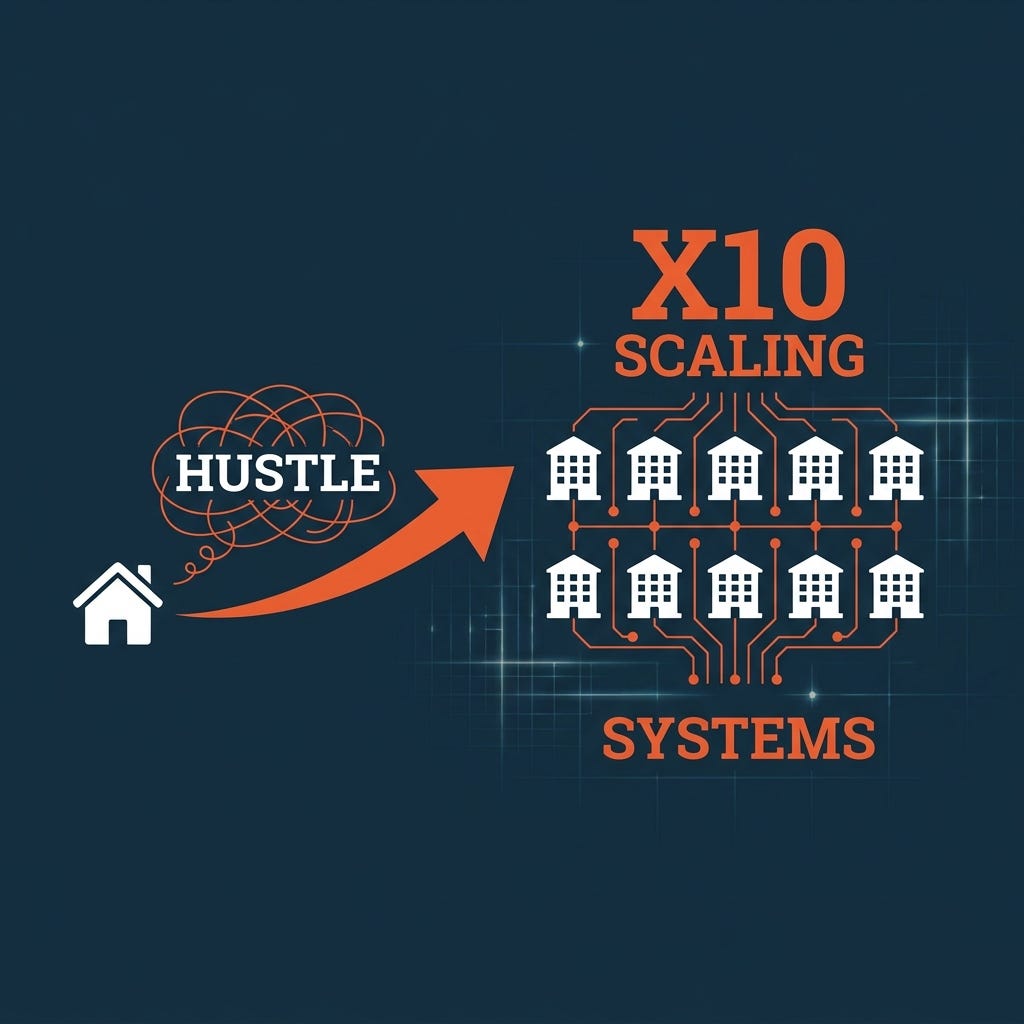
Stuck around three units and feeling the ceiling? A strategy call maps the exact systems and hires that take you from 3 to 10 without burning out. No pitch — you leave with the sequence.
Hey,
The jump from 1 to 3 short-term rentals usually works through sheer personal effort. You manage everything yourself, you learn by doing, and the returns are good enough to justify the hours. Then you try to go from 3 to 10 — and the thing that got you here actively stops working.
Here's the moment it breaks: a guest messages about a broken lock at 9pm on a Friday while you're at dinner, your cleaner texts that she's sick for tomorrow's three turnovers, and a pricing change you meant to make last week never happened. At one unit, you absorb all of that. At five, it's a pileup every single week. The work didn't get harder — it got parallel, and one person can't run parallel.
That jump is fundamentally different. It requires a business, not a side hustle: systems that run without you, a team you trust, and a capital plan that compounds. Most operators who stall at three or four aren't lazy or unlucky. They're trying to run ten units with the toolkit that worked for one.
I've spent 15+ years in this space, trained more than 10,000 operators through CashFlowDiary, and recorded 237+ podcast episodes breaking down the deals that work and the ones that don't. The pattern below shows up in every cycle.
• • •
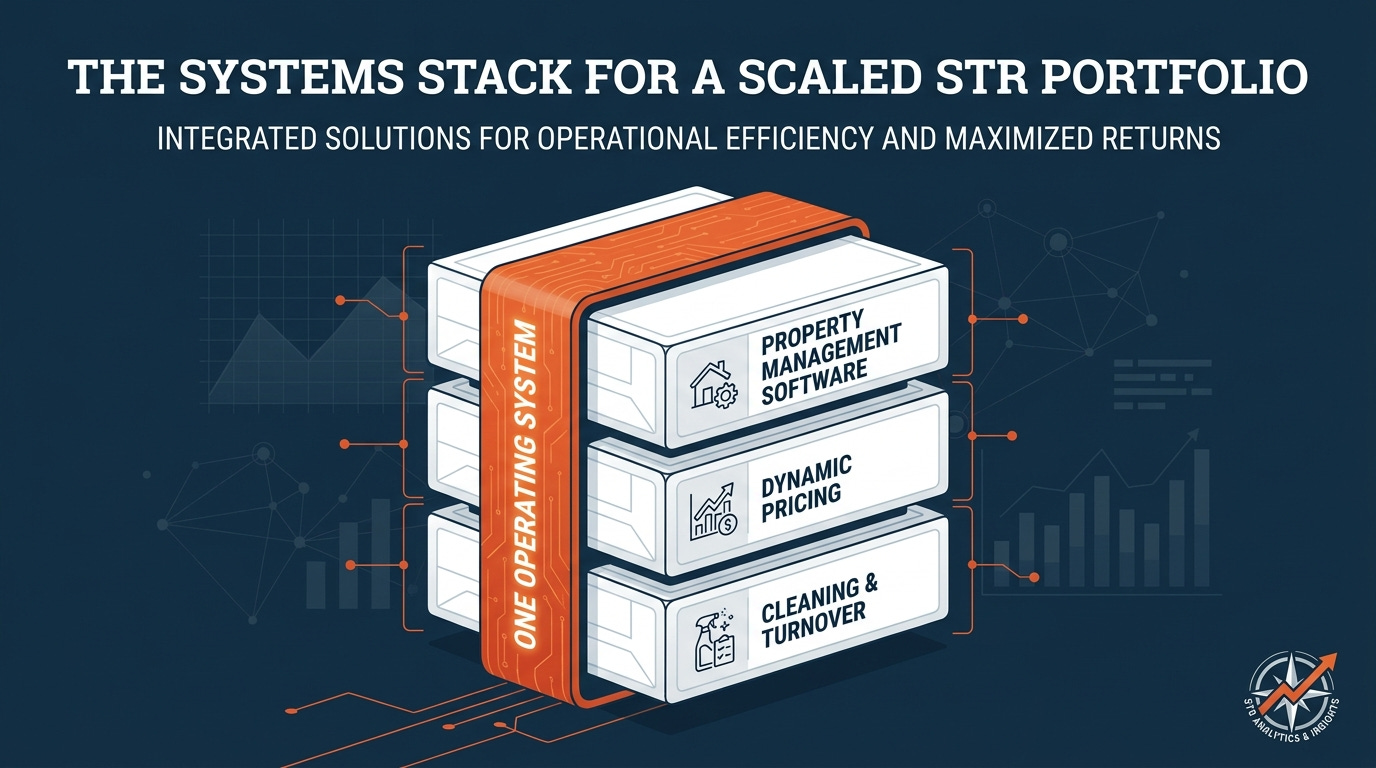
The Systems Stack for 10+ Units
Three pieces of infrastructure separate operators who scale from operators who cap out:
Property management software. At 3+ units you need one central calendar and messaging hub. Hospitable (formerly Smartbnb) handles 1–20 units well; Guesty and OwnerRez are built for operators pushing past 20. Choose for the direction you're heading, not the size you are today.
Dynamic pricing. PriceLabs connects to your software and adjusts every listing automatically. At ten units, managing pricing by hand is a 15–20 hour-a-week job you will not keep up with. Automated pricing isn't a nicety at scale — it's table stakes.
Cleaning and turnover. Your cleaning team is the most critical operational relationship you have. Scaling requires a head cleaner who can train and manage others, a standardized quality checklist, and a backup network for double-booking days. Operators who fail to scale almost always name cleaning reliability as the bottleneck.
💡 Key reframe: At one unit, you ARE the system. At ten, the system has to exist outside your head — or every new unit just adds weight to the same overloaded person.
The Hiring Sequence That Actually Works
Most operators hire in the wrong order. They bring on a VA first — it's cheap and the cost savings feel visible — then a cleaner once the operational pain gets loud. That sequence keeps you as the bottleneck. The order that actually enables scale is the reverse of what feels intuitive.

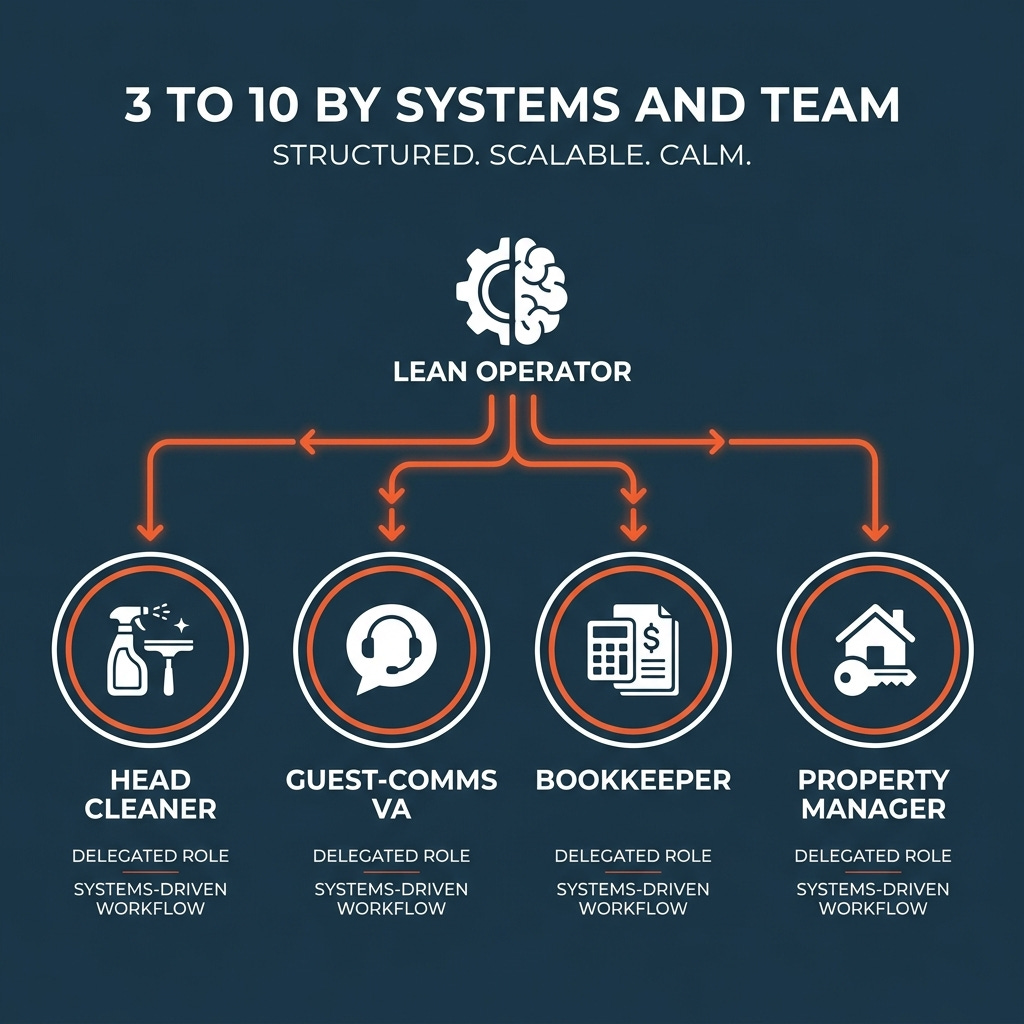
Head cleaner / turnover coordinator first. This is your operational foundation — the single relationship that most often makes or breaks scaling.
Part-time guest-communication VA second. Recovers 10–15 hours a week and takes the inbox off your phone.
Bookkeeper third. Financial visibility is a prerequisite for any smart acquisition decision — you can't scale what you can't see.
Property manager fourth. Only once you have documented systems to hand off. Hire this role too early and you're paying someone to improvise.
One more thing about the team, because it is where most operators flinch: every hire on this list pays for itself in reclaimed time long before it shows up as a line item you resent. The head cleaner protects your reviews. The VA gives you back the evenings. The bookkeeper tells you the truth about each unit. The manager hands you back the role of owner instead of operator. You are not adding cost. You are buying back the capacity to acquire the next three units.
⚡ The sequence operators skip: Cleaner before VA, systems before manager. Hire the easy delegations first and you stay the operations lead by default — the hard parts never leave your plate.
Capital Strategy for Growth
The fastest sustainable growth model is the least glamorous one: use cash flow from existing units to fund the next unit — furnishing deposits if you're doing arbitrage, down payments if you're acquiring. Operators who try to scale purely on outside investor capital before their systems are proven fail at a strikingly high rate. Prove the model on your own units first. Then — and only then — bring in outside capital to accelerate something that already works.
The jump from 3 to 10 isn't a bigger version of what got you to 3. It's a different business. Build it like one. — J. Massey
Operators who fail to scale almost always cite cleaning reliability as the bottleneck. The constraint is rarely capital. It's systems.
Common Questions
Which software should I start with? Hospitable for 1–20 units; Guesty or OwnerRez if you're clearly building toward 20+. Pick for your direction, not your current count, so you're not migrating mid-scale.
What's the first hire? A head cleaner / turnover coordinator — not a VA. Turnover reliability is the foundation everything else stacks on.
How do I fund the next unit? Reinvest cash flow from existing units first. Prove the system, then layer in outside capital to accelerate — not to compensate for an unproven model.
This is also why financial visibility comes before your fourth unit, not after your tenth. Without a real P&L — cleaning, fees, supplies, maintenance, software, the pro-rated cost of replacing a water heater — you're flying on gross revenue, which is a vanity number. Operators who scale on vanity metrics discover the holes only when a slow month exposes them. The ones who scale on real numbers know exactly which unit earns its keep and which one to cut.
Ready to build the system that gets you to ten?
If you're feeling the ceiling around three or four units, the fix isn't working harder — it's installing the stack and hiring in the right order. On a strategy call we'll map your systems, your next hire, and the capital plan to get from where you are to ten.
• • •
Keep reading:
You're Not Saving Money by Doing It Yourself

A VA costs $15 an hour. You're “free.” So you keep answering every guest message yourself — and quietly capping your business at three properties.
P.S. If you're stuck at three units, reply with your single biggest bottleneck — cleaning, pricing, or time. I read every response, and the answer usually points straight at your next hire.
CashFlowDiary — real numbers, real strategy, one shipped idea at a time.
Ready for the next step?