


Hey,
Most people talk themselves out of real estate with one sentence: “I don’t have money or credit.”
I’ve heard it in person, on calls, and in my inbox more times than I can count. It sounds like a fact. It feels like a wall. And it ends the conversation before the first property ever gets sourced.
Here’s what 15 years of watching who actually builds cash flow — and who keeps studying instead — taught me: that sentence isn’t a wall. It’s a different door.
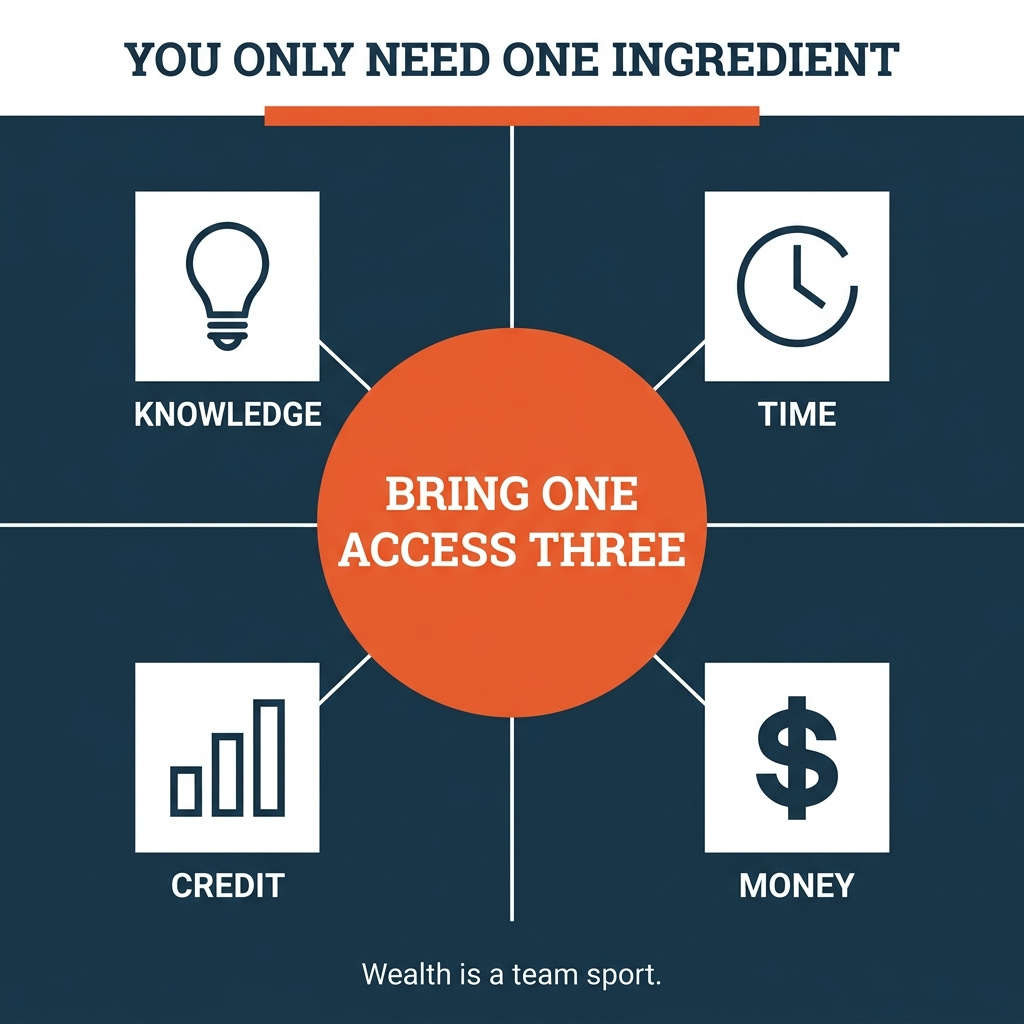
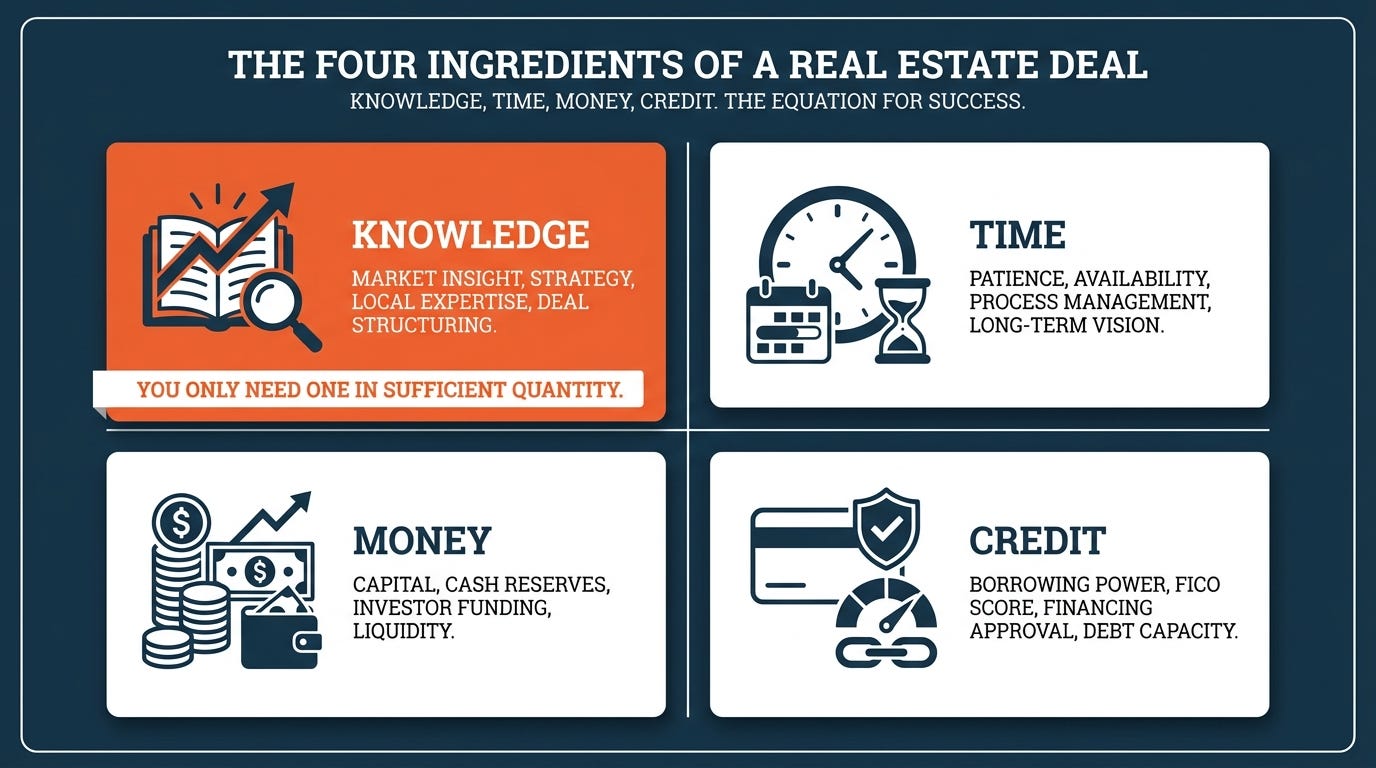
Real estate needs four ingredients to close: knowledge, time, money, and credit. You don’t need all four. You need one of them in sufficient quantity, and the willingness to structure a deal where the other three show up.
Most people never hear that part. They were told real estate takes money, so they wait until they have money. Meanwhile the operators closing deals around them are bringing time, or knowledge, or a willingness to do the work nobody else will — and partnering for the rest.
I’ve spent 15+ years in this space, trained more than 10,000 operators through CashFlowDiary, and recorded 237+ podcast episodes breaking down the deals that work and the ones that don’t. The pattern below shows up in every cycle.
• • •
“No money or credit” ends the wrong conversation
When an operator says “I don’t have money or credit,” they’re treating a contributing factor like a determining factor.
A contributing factor makes the path harder. A determining factor makes the path impossible. Those are not the same thing — and confusing them is exactly what keeps most people on the sidelines.
The determining factor in real estate isn’t money. It’s this: do you have at least one ingredient in sufficient quantity? If you have no knowledge, no time, no money, and no credit — yes, the door is closed. But almost nobody is actually in that position. Most people who say “I have nothing” are sitting on two ingredients they never bothered to count: knowledge and time.
The four ingredients every deal needs
Every real estate transaction — a rental arbitrage agreement, a wholesale deal, a property purchase, a partnership — needs the same four things:
Knowledge. You know how to find deals, structure offers, run properties, or deploy systems for cash flow.
Time. You have hours to source, analyze, execute, and manage.
Money. Capital for down payments, deposits, reserves, or funding.
Credit. Access to financing, or the ability to sign on debt.
All four have to be present for a deal to close. They do not all have to come from you.
That one distinction is the whole game. If you have knowledge and time, you use those two to reach someone else’s money and credit. Sitting on idle capital instead? You use your money to reach someone else’s knowledge and time.
You only need to bring one
Here’s how each ingredient opens the door:
If you have knowledge — structure deals for capital partners, consult for operators who need systems, wholesale properties to buyers who have money but no deal flow.
If you have time — run operations for owners who want cash flow without the day-to-day, manage rental arbitrage agreements, execute on someone else’s capital while you learn the skillset.
If you have money — fund deals sourced by operators with knowledge, invest in turnkey properties run by people with time.
If you have credit — sign on financing for deals structured by partners, co-sign for operators who have time but no loan access.
Rental arbitrage doesn’t need money or credit. It needs knowledge of how to structure a master lease and time to manage the property. You bring those two. The landlord brings the asset. The guests bring the revenue.
Wholesaling doesn’t need money or credit either — it needs knowledge of how to find deals and time to work the pipeline. You bring those two; the buyer brings the capital. Consulting doesn’t need money or credit — it needs knowledge of systems and time to deploy them. You bring those two; the client brings the revenue and the properties. The sequence changes. The entry point shifts. The equation still works.
Money and credit aren’t gates. They’re ingredients you reach by bringing what you already have in sufficient quantity.
Sufficient quantity doesn’t mean world-class. It means enough to create value for someone who’s missing it.
You know how to find off-market rentals and you have 20 hours a week? A capital partner who wants cash flow but no time to source deals will fund your first property for equity or a revenue split. You know how to automate guest communication and pricing? An operator with three properties and no systems will pay you to fix what’s broken. You have $50K sitting in savings earning half a percent? An operator with knowledge and time but no capital will structure a deal where your money funds the down payment and you split the cash flow.
💡 Key reframe: The ingredient you bring doesn’t have to be rare. It has to be valuable to someone who’s missing it.
⚡ The move most people skip: They try to acquire all four ingredients solo before they start. The operators who actually build portfolios start with one and partner their way to the rest.
Wealth building is a team sport. The four ingredients don’t all come from you — they all have to be present.
The 30-day move
You don’t need a year of preparation. You need one honest inventory and one conversation.
Week 1 — Name your one ingredient. Not the one you wish you had. The one you have in sufficient quantity right now: knowledge, time, money, or credit. Be specific about the evidence.
Week 2 — Find who has what you’re missing. Local investor groups, STR operator forums, wholesaling networks. Lead with what you bring.
Week 3 — Structure the split before the first deal. Put the value exchange in writing — who brings what, who gets what, and what happens if someone stops delivering their ingredient.
Week 4 — Execute the smallest version. One arbitrage lease, one wholesale assignment, one consulting engagement. Proof beats planning every time.


Common questions about starting with one ingredient
Do I really need money to start in real estate?
No. You need one of four ingredients. If you have knowledge and time, you reach money through partnerships. Rental arbitrage and wholesaling both start with zero capital of your own.
What if I don’t have any of the four right now?
Then start with the two that don’t cost anything to build: knowledge and time. Study operations, shadow an operator, or offer to manage someone’s property to learn the systems. You acquire your first ingredient, and then you have something to bring to the table.
Do partnerships always fall apart?
They fall apart when the value split is vague or undocumented. They work when each party’s ingredient is clear and the deal is in writing before the first dollar moves. Structure first, trust second.
Ready to find your one ingredient?
If you’re not sure which ingredient you’re holding — or how to structure a deal where the other three show up — that’s the exact conversation I have with operators every week. We map what you bring, who you need, and the deal structure that makes it work.
• • •
P.S. The next time “I don’t have money or credit” shows up in your head, finish the sentence differently: “…so here’s the door I’m walking through instead.” That one swap is the difference between studying real estate and doing it.
CashFlowDiary — real numbers, real deals, and the systems that turn one ingredient into cash flow. Forwarded this? Subscribe here.