


The market isn’t shrinking. It’s separating the operators with systems from the ones without.
Hey,
I’ve been running STR operations since before the gold rush started. I watched the amateur era unfold in real time — anyone who listed a property and answered messages could make money.
That era is over. And the data isn’t subtle about it.
I’ve spent 15+ years in this space, trained more than 10,000 operators through CashFlowDiary, and recorded 237+ podcast episodes breaking down the deals that work and the ones that don’t. The pattern below shows up in every cycle.
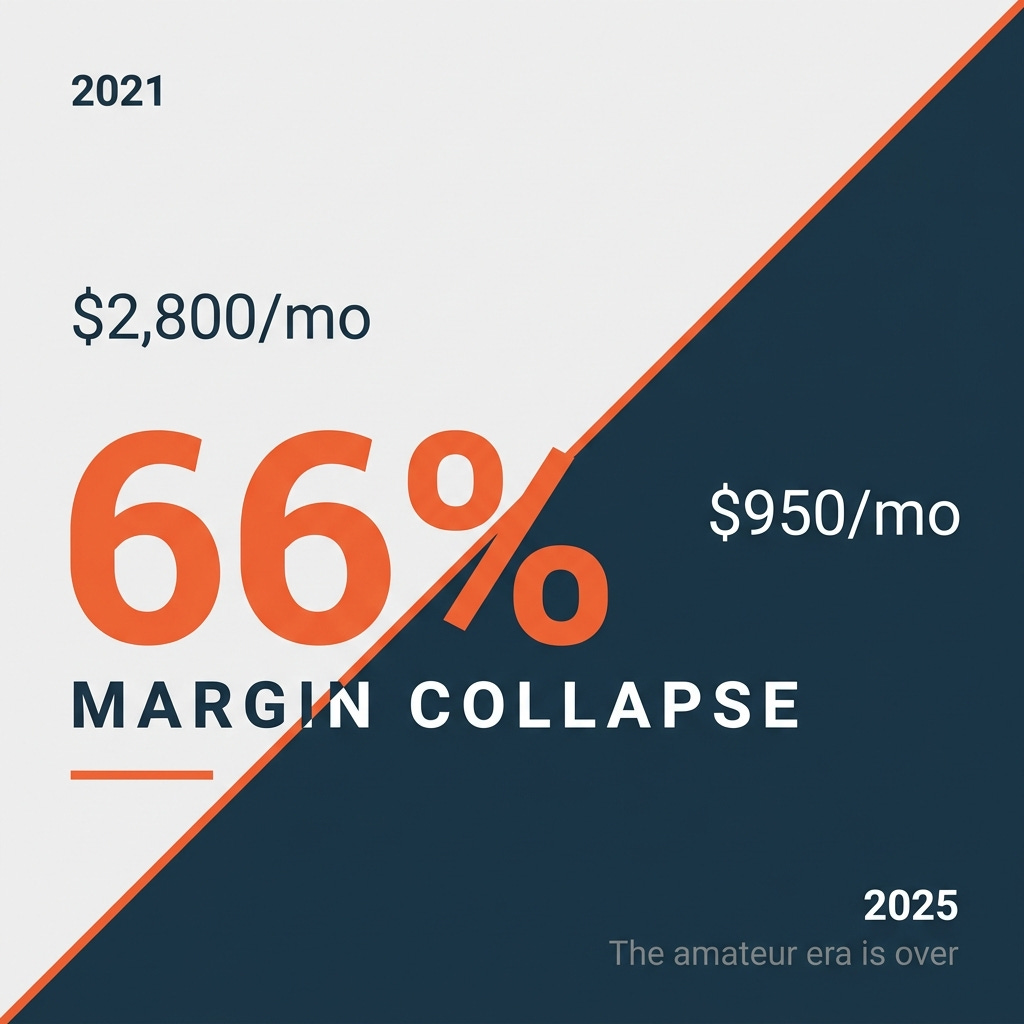
The math that worked in 2021 doesn’t work in 2025. That’s not opinion — that’s the data talking. The same Nashville property that produced $2,800 in monthly profit in 2021 produces $950 today. That’s a 66% margin collapse. And 22% of hosts now plan to exit entirely.
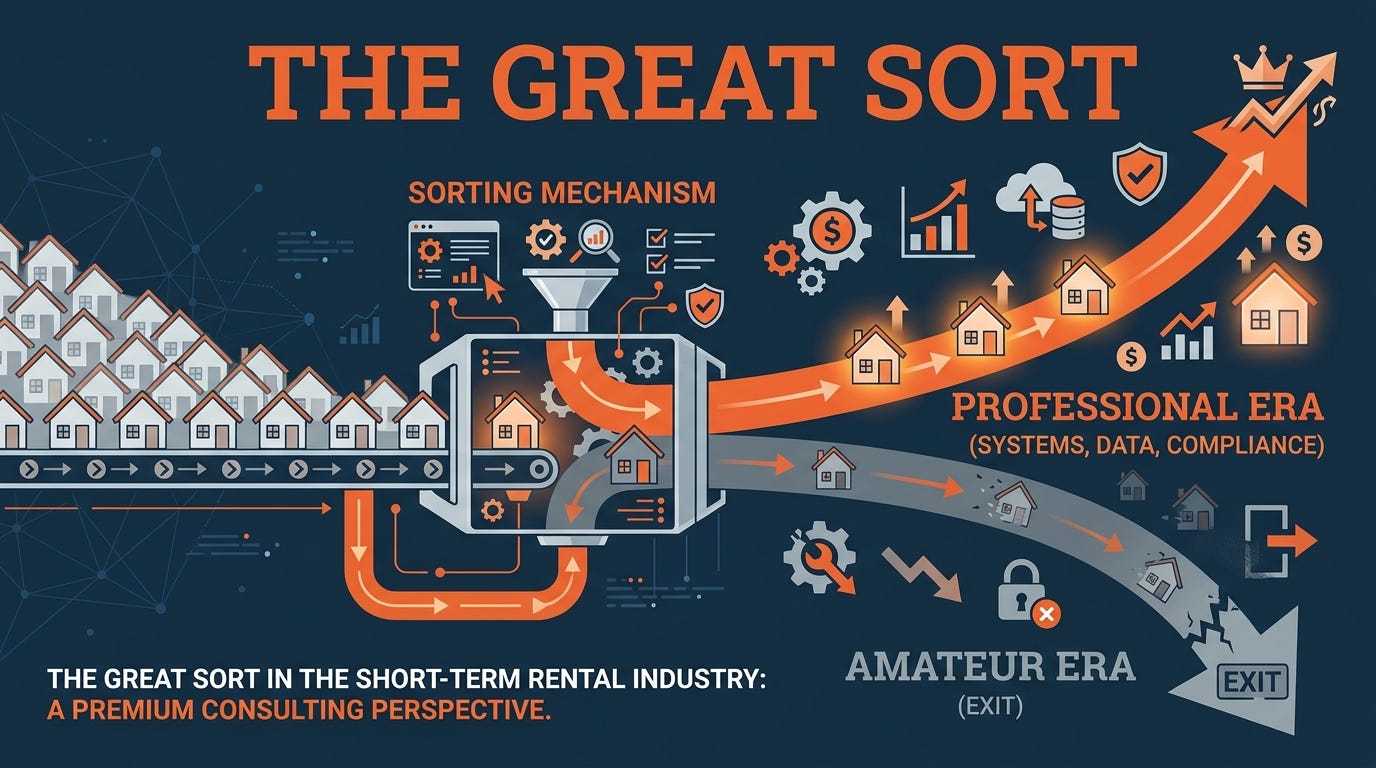
But “everyone’s losing money” is the wrong read. The operators still standing aren’t working harder. They’re running different systems. Three data points show exactly how the industry is sorting.
• • •
The Squeeze Is Structural, Not Cyclical
When operators sit down with me on the first call, most think they have a pricing problem or a marketing problem. They don’t. They have a unit-economics problem.
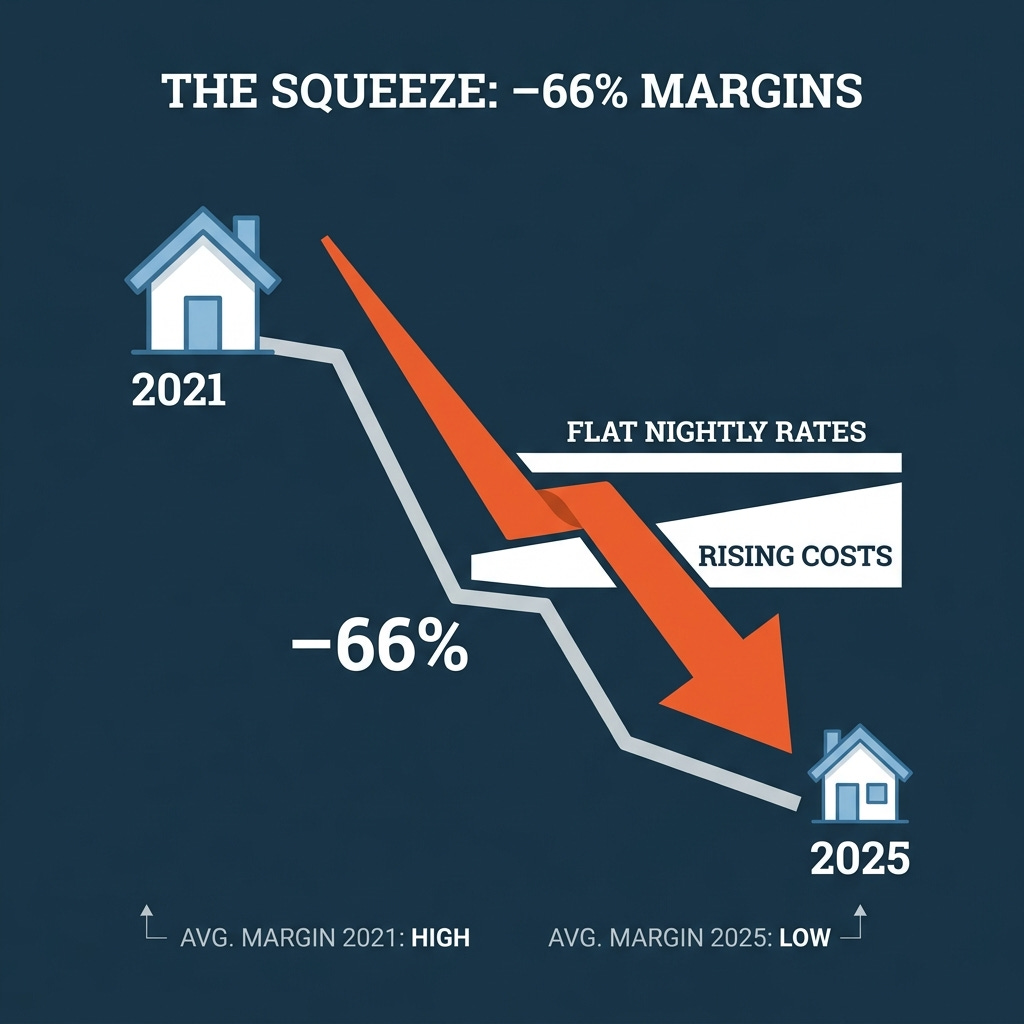
Supply rose 25% globally. Operating costs climbed 35–45% across the board. Cleaning alone surged ~25% since 2021. Nightly rates stayed flat or fell. Operating expenses now eat roughly 50% of STR revenue — versus 35% for long-term rentals. Paid occupancy dropped from 54% in 2022 to 47% in 2024.
This isn’t a dip you wait out. It’s a reset.
The operators who adapted are using dynamic pricing and driving incremental revenue through upsells and fees — managers in softening markets like Atlanta are pulling up to $147 per listing per month in extra income from upsells alone. They track occupancy, ADR, and review score like a CFO tracks a P&L.
💡 Key reframe: The margin collapse is structural, not cyclical. Operators who track unit economics like a CFO and run revenue-generating systems survive the compression. Operators who treat it as a temporary dip exit.
Why NYC’s Ban Backfired
New York City banned short-term rentals to fix housing affordability. It did the opposite.
Manhattan’s median rent crossed $4,000/month for the first time on record. Hotel ADR hit $524 a night — a 50%+ year-over-year jump. Citywide vacancy stayed flat at 1.9%. Airbnb availability dropped over 90% — and affordability never improved.
Before the law, Airbnb listings were under 1% of the city’s housing supply. The causal link between STRs and unaffordability was overstated from the start. The real winners weren’t residents — they were hotel chains, the loudest backers of the restrictions.
The operational lesson matters more than the politics: compliant, registered operators got grandfathered in. The ones who ignored registration got wiped out.
Regulation didn’t kill the operators. It sorted the compliant from the careless.
⚡ The math operators skip: 100% bonus depreciation came back in 2025. On a $500,000 property, a cost-segregation study can identify $150,000+ in short-life assets you write off in year one. On a $600,000 property with 30% short-life basis, that’s a $180,000 first-year deduction — against your W-2 income, because STRs with sub-7-day average stays are non-passive under IRC Section 469. Long-term rentals don’t qualify.
The Tax Window Nobody’s Using
The One Big Beautiful Bill Act, signed July 4, 2025, permanently restored 100% bonus depreciation for qualifying property acquired after January 19, 2025. Before that, the benefit had phased down to 40%.
Here’s what it means in practice: operators who deploy cost-segregation studies are pushing taxable income to near zero while still generating positive cash flow. The operators who don’t know this exists leave six figures on the table.
In buyer’s markets like Austin, creative financing stacks on top — seller financing at 4.5% with 10% down changes the entire cash-flow equation. The tax advantage and the financing advantage compound.
This window won’t stay open forever. It’s open right now.
Who Survives the Sort
The operators exiting right now aren’t failing because they didn’t work hard enough. They’re exiting because they ran the wrong systems in the wrong sequence — bought before they understood unit economics, scaled before they automated, ignored compliance until the rules tightened.
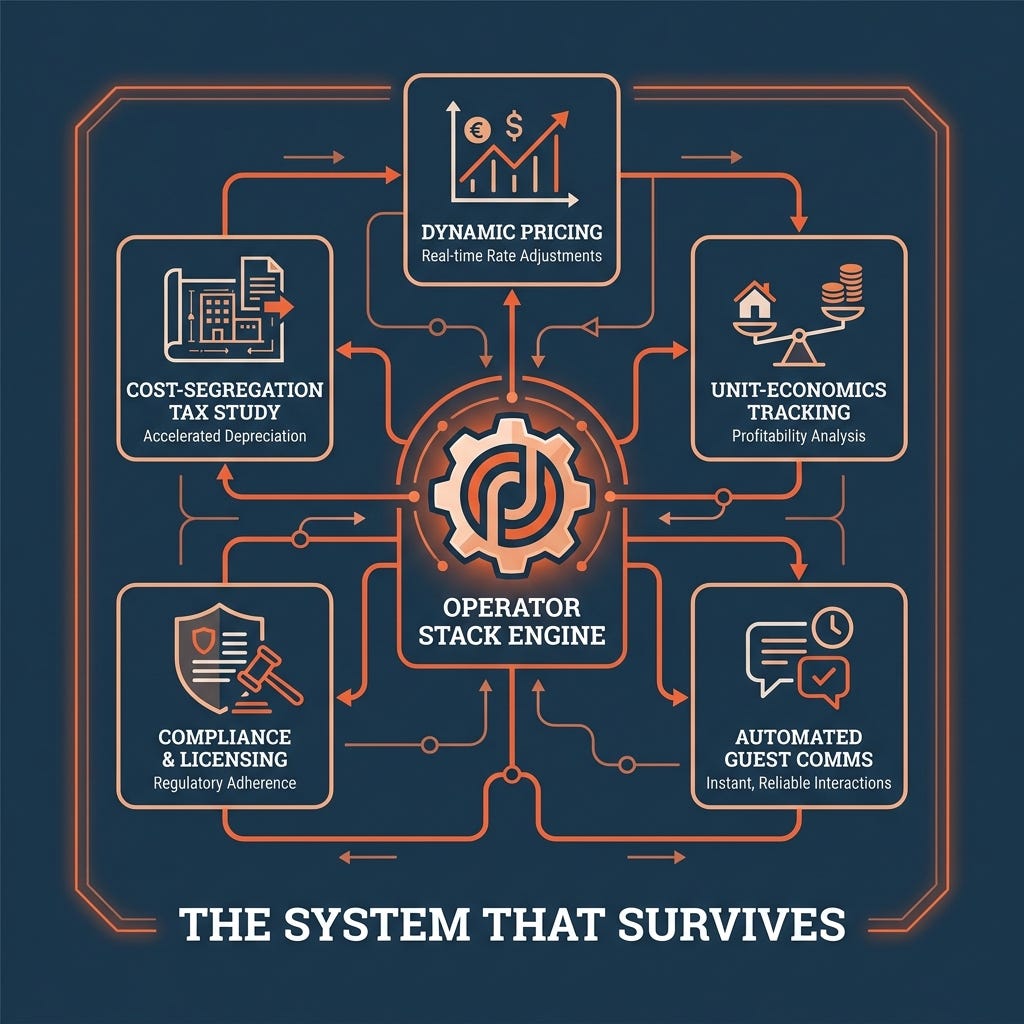
The operators still standing built systems first. They automated guest comms, deployed dynamic pricing, tracked unit economics, stayed compliant, and used cost segregation to cut tax liability.
They didn’t out-hustle the competition. They out-system the competition.
So here’s the move, in sequence:
Pull your unit economics — every property. Calculate occupancy, ADR, and operating-expense ratio. Any property below 50% occupancy or above a 50% expense ratio has a structural problem. Diagnose the cause, then fix the system or exit the property.
If you’re acquiring in 2025, call a tax advisor about cost segregation before you close. The deduction window is open now. Don’t close the deal and discover the opportunity in April.
If your city is weighing STR rules, get compliant today. Registration, licensing, insurance. The operators who wait get wiped out. The ones who move first get grandfathered in.
Here’s the whole thing in two frames:
The squeeze: 25% more supply, 35–45% higher costs, flat rates — a 66% margin collapse for operators without systems.
The system that survives: pricing, unit economics, automation, compliance, and tax architecture running as one engine.
Ready to land on the right side of the sort?
If your margins are compressing and you’re not sure whether it’s a pricing problem or a structural one, that’s exactly what the strategy call is for. We pull your unit economics, find the systems gap, and map the tax and compliance moves that decide who survives this cycle.
• • •
P.S. The amateur era rewarded anyone who listed a property and answered messages. The professional era rewards operators who build systems, track data, stay compliant, and understand the tax architecture. The margins compressed, the rules tightened, the tax window opened — all at once. That’s not a market dying. That’s a market sorting. Make sure you’re on the right side of it.
CashFlowDiary — real numbers, real systems, and the operating architecture behind portfolios that actually scale. Reply anytime; I read every one.