


The question you ask when something breaks decides whether you build the system or carry the weight.
Hey,
I’ve sat across the table from operators at every stage. The ones who stalled at three properties. The ones who hit ten and kept building. The ones who thought they wanted to scale and discovered they didn’t.
The difference was never capital. It wasn’t market timing. It wasn’t even operational skill at the start.
It was how they metabolized failure.
I’ve spent 15+ years in this space, trained more than 10,000 operators through CashFlowDiary, and recorded 237+ podcast episodes breaking down the deals that work and the ones that don’t. The pattern below shows up in every cycle.
• • •
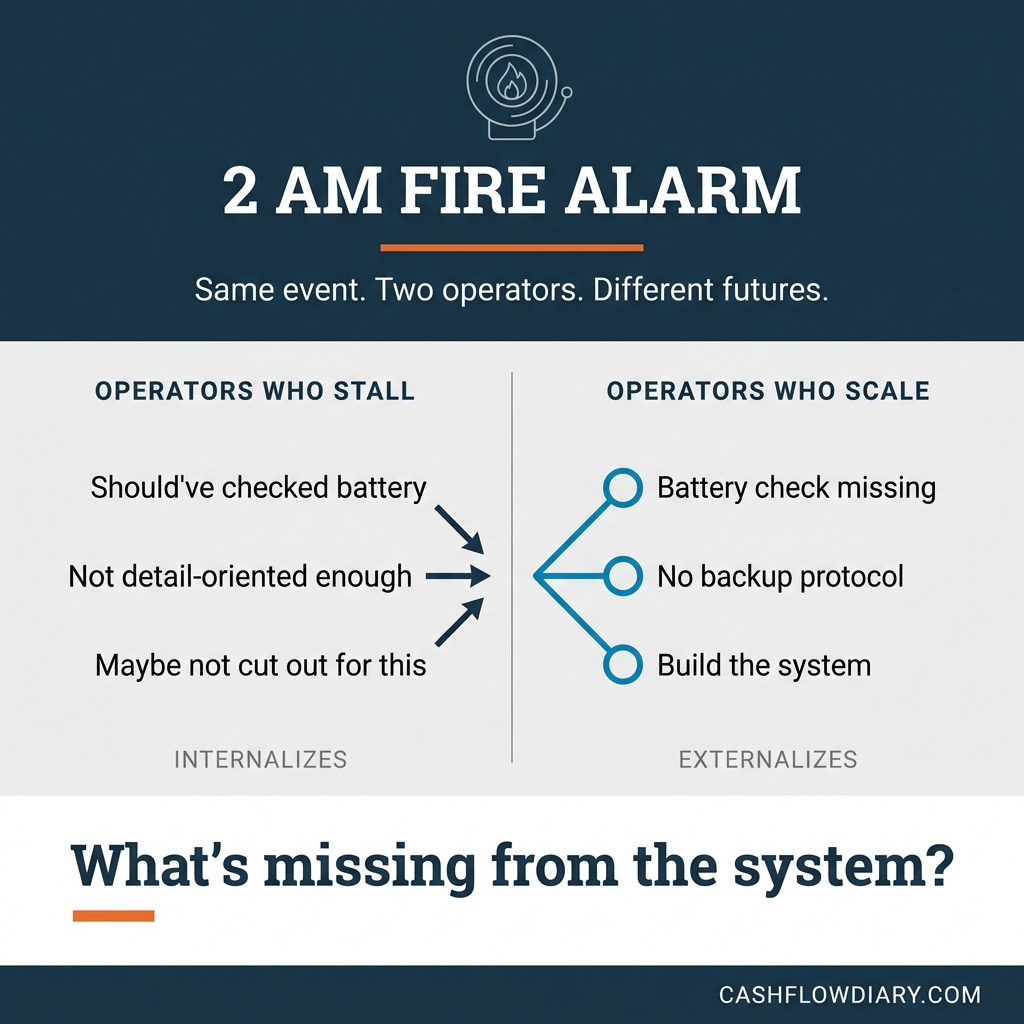
The 2 AM Fire Alarm Test
The fire alarm goes off at 2 AM. Guest calls. Panicked. You walk them through resetting it. You apologize. You send a bottle of wine in the morning. The review still comes back three stars.
Here’s where operators split into two populations.
The ones who stall internalize it. They replay the event looking for the character flaw. I should’ve checked the battery. I’m not detail-oriented enough. Maybe I’m not cut out for this. The failure becomes evidence about who they are.
The ones who scale externalize it. They see an event that produced data. The battery check isn’t in the turnover checklist. We don’t have a backup protocol for middle-of-the-night calls. The wine is reactive — what’s the proactive move? The failure becomes a systems diagnostic.
Same fire alarm. Same three-star review. Completely different cognitive load. The first operator carries that weight into property four, five, six. The second ships a checklist update Monday morning, and three months later that failure mode doesn’t exist anymore.
A Failure Is an Event, Not a Person
This isn’t a mindset issue. It’s a structural misdiagnosis that compounds.
At property three, you blame yourself for the breakdown instead of building the system that prevents it. At property seven, you’re still the bottleneck because you never trusted a system to carry what you thought only you could handle. At property ten, you’re exhausted and convinced scaling was the mistake — when the real mistake was running ten properties out of your head instead of building the architecture that lets ten properties run themselves.
A failure is an event. It’s not a person. — the line I repeat to every operator who hits the wall
When you treat failure as an event, you can study it. You extract the variable that broke, test a fix, verify it worked, and move on. When you treat it as evidence about yourself, the data is contaminated with identity — and you spend your energy defending the conclusion instead of fixing the system.
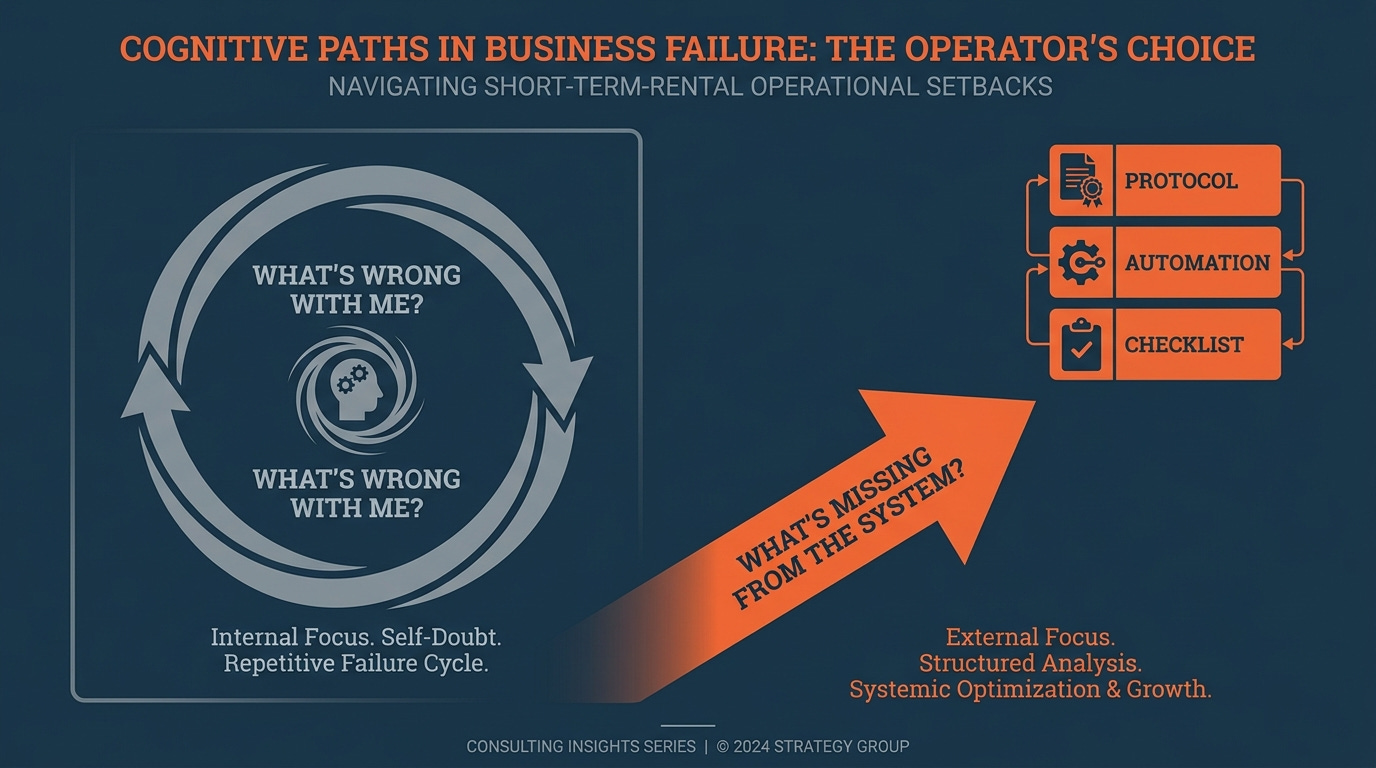
Two questions. One traps you in a loop. The other points you at the fix.
The Four-Question Debrief
Here’s what the operators who made it past ten properties do that the stalled operators don’t: they debrief every failure the same way. No moral weight. No character analysis. Just structure.
What happened? Name the event. Guest called at 2 AM. Fire alarm. Three-star review.
What was supposed to prevent it? A battery check during turnover. If that check existed, did it fail? If it didn’t exist, why not?
What changes? Add battery replacement to the turnover checklist. Set a quarterly audit across all properties. Build a middle-of-the-night protocol so the guest gets a response in under five minutes without you waking up.
What’s the test? Run the new checklist for 90 days. Track the fire-alarm calls. If the number drops, the system works. If it doesn’t, diagnose again.
That’s it. Four questions. No therapy. The operators who stall skip the debrief or turn it into a referendum on whether they’re good enough. The operators who scale treat it like a bug report: something broke, here’s the patch, here’s how we verify it shipped.
💡 Key reframe: You don’t have thicker skin than the operators who stalled. You have a cleaner relationship with what a failure means. That’s a skill you can build — not a personality you’re born with.
The Department You’re Quietly Underfunding
The same misdiagnosis — mistaking an operational issue for a character issue — shows up in how operators structure the business itself. Most treat the customer-experience department as an expense: the team that handles complaints and smooths over problems. The budget conversation is always how little can we spend here?
That’s the same mistake. Customer experience isn’t an expense. Staffed correctly, it’s a revenue department.
⚡ The math operators skip: Claims collections recover $15K–$40K a year per property when someone knows how to work the process instead of eating the cost. Trained upsells (early check-in, mid-stay cleaning, grocery stocking) leave $8K–$12K per property on the table every year when nobody’s offering them. And a five-star property books 30–40% more often than a 4.3-star property in the same market.
Same department. Completely different financial outcome depending on whether you diagnose its function as “cleanup crew” or “operational intelligence that generates cash flow.”
How to Rewire the Pattern in 30 Days
If you recognize yourself in the first group — the operators who internalize failure — here’s the path out. One move per week.
Week 1 — Stop debriefing alone. Inside your own head, every failure looks like evidence about you. Bring in a peer, a consultant, or a co-founder and run the four-question debrief with someone who isn’t emotionally attached to the outcome. They’ll see the systems gap you’re too busy defending yourself to notice.
Week 2 — Track categories, not events. Don’t keep a list of everything that went wrong. Keep a list of the systems that don’t exist yet. “Guest-communication breakdown” is a category. “Fire alarm at 2 AM” is an event. Build for categories; the events stop recurring.
Week 3 — Set the 48-hour rule. When something breaks, you get 48 hours to feel however you feel. After that, the only question that counts is what’s the system fix? You’re not suppressing the emotion — you’re containing it so it doesn’t contaminate the debrief.
Week 4 — Reclassify customer experience as revenue. Calculate what claims recovery, upsells, cross-sells, and review conversion are worth across your portfolio annually. Then staff and train the team to hit those numbers. You’ll see the ROI inside the next 90 days.
You don’t scale by being better at handling failure. You scale by building systems that make most failures irrelevant — and treating the ones that slip through as diagnostics, not verdicts.
Here’s the contrast in one frame:
The stall: carrying the operational weight of ten properties plus the emotional weight of ten properties’ worth of self-doubt.
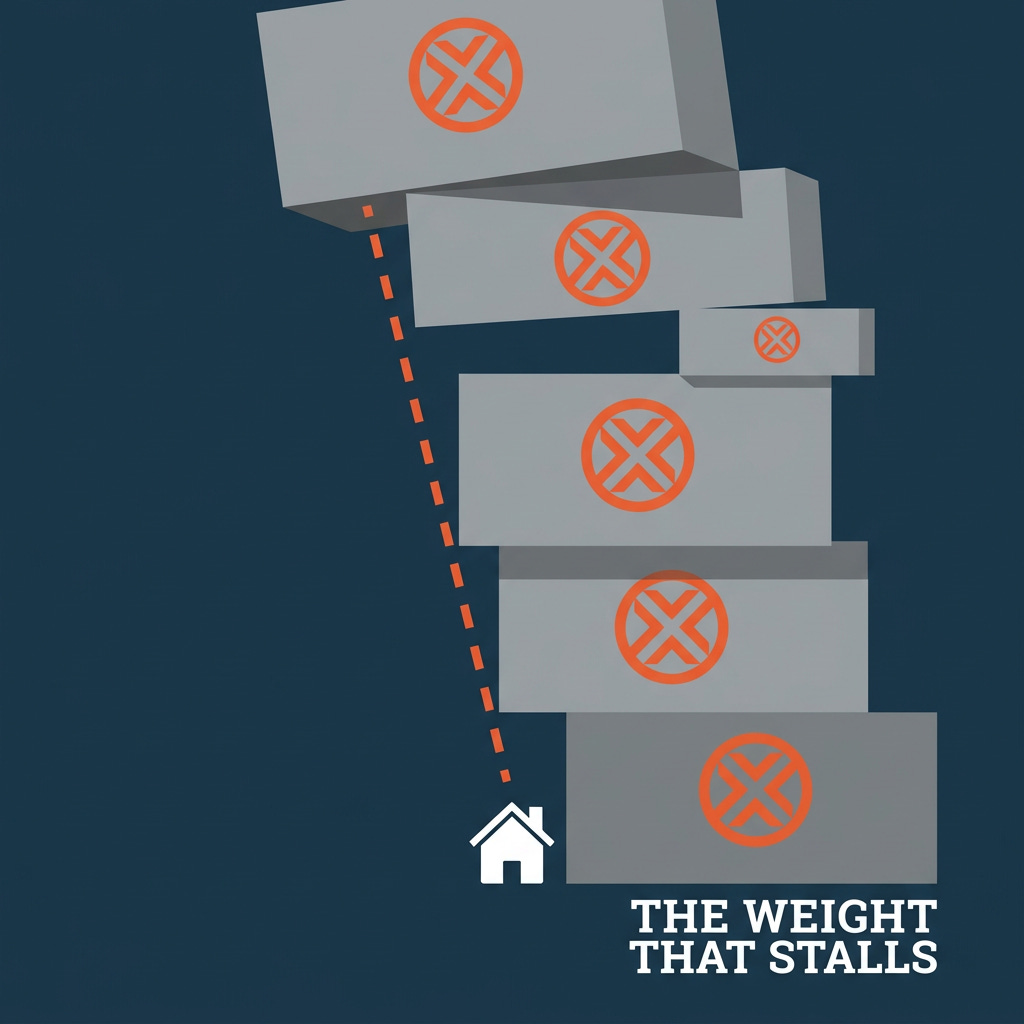
The scale: the same operations, the same breakdowns — minus the second load. That absence is what creates the capacity to keep building.
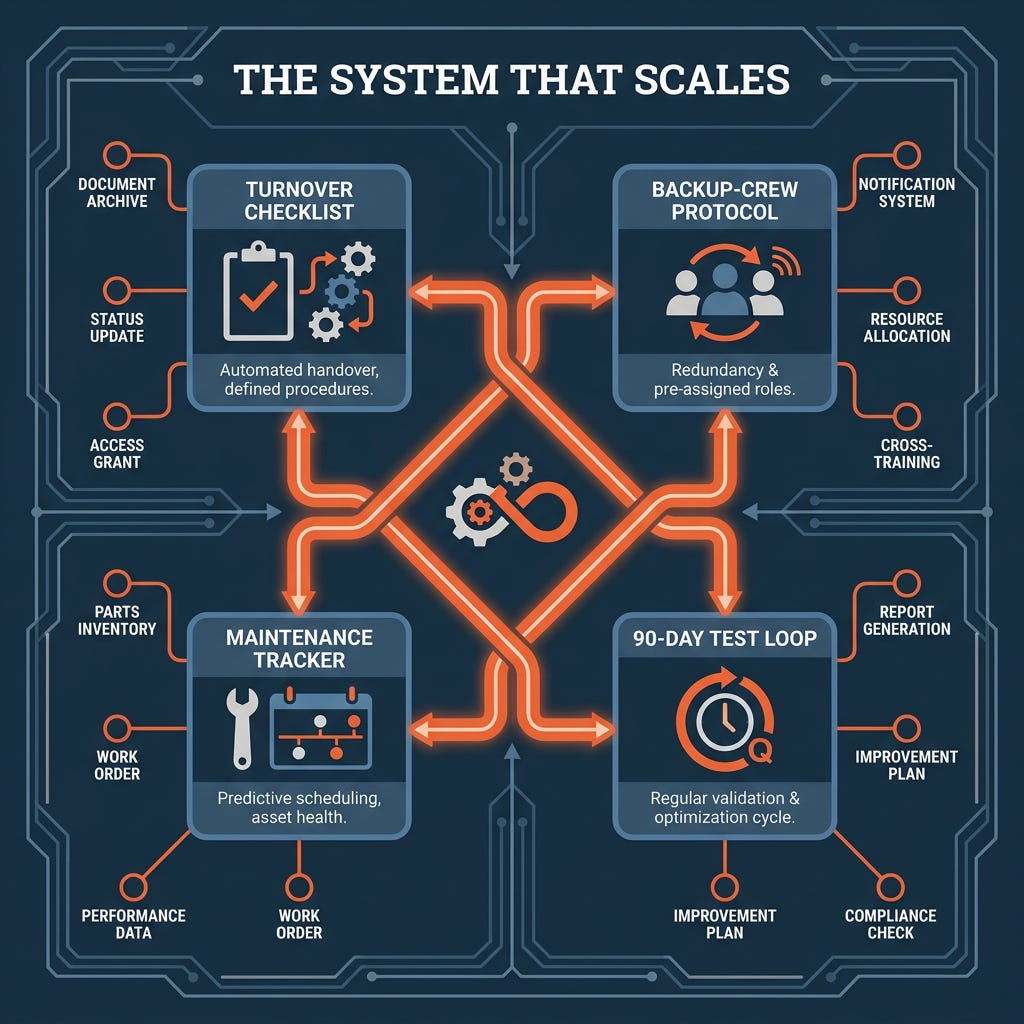
Ready to build the architecture that scales past ten?
If you’re carrying the weight instead of building the system, the fastest way out is a second set of eyes on the gaps you’re too close to see. That’s exactly what the strategy call is for — we run your operation through the debrief and map the systems that turn your next failure into a one-time patch instead of a recurring tax.
• • •
P.S. The operators who scale past ten properties didn’t get there by handling stress better. They built a different cognitive architecture — they separated the event from the identity, and they built systems instead of trying harder. The work was the same. The breakdowns were the same. The question they asked when something broke was not. That’s the entire game.
CashFlowDiary — real numbers, real systems, and the operating architecture behind portfolios that actually scale. Reply anytime; I read every one.