


Your slowest month deserves its own pricing plan. If you price the off-season the way you price peak season, you either leave nights empty or fill them at rates that don't cover the dip. On a complimentary one-on-one diagnostic call, we map where your calendar is leaking. If it isn't a fit, I'll tell you.

An empty calendar can put an attractive rental under pressure. Editorial illustration, not a property forecast.
Hey,
If your market has an off-season, plan for it before the calendar slows. A quieter month is a reason to investigate, not an automatic instruction to cut every rate.
A pricing plan that fits peak months may not fit quieter weeks. When bookings slow, a blanket discount is tempting. But filling a night below its incremental cost adds work without improving cash flow. Start with the calendar and your costs, not a percentage picked under pressure.
I'd focus on three decisions: review prices week by week, test an additional guest segment before you need it, and measure the booking pace. These are planning steps, not a promise that every empty night can be sold.
I've spent 18+ years in real estate, focused on short-term rentals since 2016, trained more than 10,000 operators through CashFlowDiary, and recorded 704 published CashFlow Diary™ podcast episodes breaking down the deals that work and the ones that don't. Here's the planning process I'd use to examine a slower season.
Paid reader tool: Off-Season Test Card
Paid members, annual or monthly, get a six-page worksheet to document a pricing test, check booking contribution and set a stop rule. The article continues below for everyone.
• • •
The Off-Season Is an Unpriced Signal
Airbnb says its Smart Pricing tool adjusts nightly prices based on demand, using factors about the listing and its area. Hosts can set minimum and maximum prices and override individual dates.1 That is a tool you can use, not evidence of a universal seasonal occupancy swing. Build the plan around your property's actual booking history.
The failure mode is treating the whole off-season as one flat block instead of a curve. Within a four-month "slow" stretch there are still relatively stronger weeks — a holiday, a local event, a school break — sitting inside it, priced the same as the dead weeks around them.
Airbnb also lets hosts set custom prices for selected nights and offer weekly or monthly discounts. Its guidance says pricing and availability settings work together; offering a monthly discount requires allowing longer stays.2 Use those controls to test a specific change. They do not guarantee more revenue. Compare net contribution, not occupancy alone.
Fix the granularity first. Everything else in this issue builds on that.
A calendar that charges the same rate on the slowest Tuesday and the busiest Saturday of the month isn't a pricing strategy. It's a rate you picked once and stopped looking at.
- J. Massey
💡 Key reframe: price each week inside the slow season against its own demand. One flat off-season rate hides the stronger weeks and underprices them.
Reprice on a Real Calendar, Not a Gut Feeling
Start with up to two years of your own booking data, if available. Track occupancy, average daily rate (ADR), and lead time: the gap between booking and arrival. Compare booking pace at the same point before arrival. Lead time is a clue, not a test that isolates price from demand.
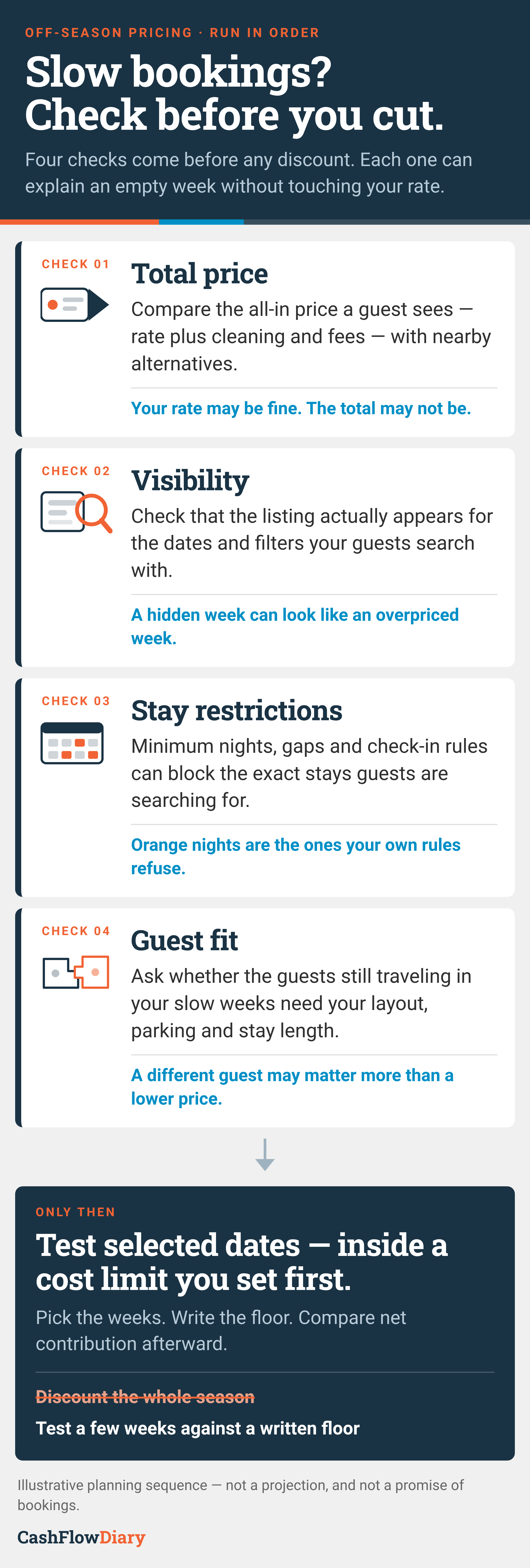
Run the four checks before you touch a rate — then test selected dates inside a cost limit you set first. Illustrative planning sequence, not a projection.
If a week is behind its usual booking pace, check comparable total prices, listing visibility, restrictions, and local events before changing rates. A small price test may help you learn; a different guest segment may be worth testing too. Neither low occupancy nor lead time alone tells you why guests have not booked.
Build the Second Demand Source Before You Need It
Consider demand beyond vacation travel: relocations, traveling professionals, or local-business visitors. Treat each as a hypothesis. Ask whether those guests need your location, layout, parking, and stay length. A segment's name is not proof that demand exists in your market, or that your property is a fit.
Start outreach before the season turns so you have time to learn. Before accepting longer stays, check local tenancy rules, your lease, insurance, and platform terms with the appropriate professionals. A longer stay does not bypass restrictions. Set a rate only after accounting for utilities, service costs, and the nights you may displace.
⚡ The math operators skip: compare an extended stay with a set of shorter bookings using expected net contribution. Subtract cleaning, utilities, fees, acquisition costs, and likely vacancy from each scenario. Fewer turnovers can save money, but a discount can erase that saving. Run your numbers before choosing.
The Four-Week Build (Run This Before Your Next Off-Season)
Week 1: Review available occupancy, ADR, and lead-time data. Mark slower weeks and write down which price, visibility, or guest-segment question to test.
Week 2: Rebuild your calendar's seasonal pricing rules around actual weeks, not one flat off-season block.
Week 3: Stand up one non-tourist demand channel — extended-stay rate, local-business outreach, or an events-calendar tie-in.
Week 4: Set a repricing trigger (a lead-time threshold or occupancy floor) so the calendar adjusts itself instead of waiting for you to notice a slump.
MPI: The One Number That Tells You If Your Property Is Working

For every 10 nights your neighbors sell, how many do you sell? The answer is probably worse than you think.
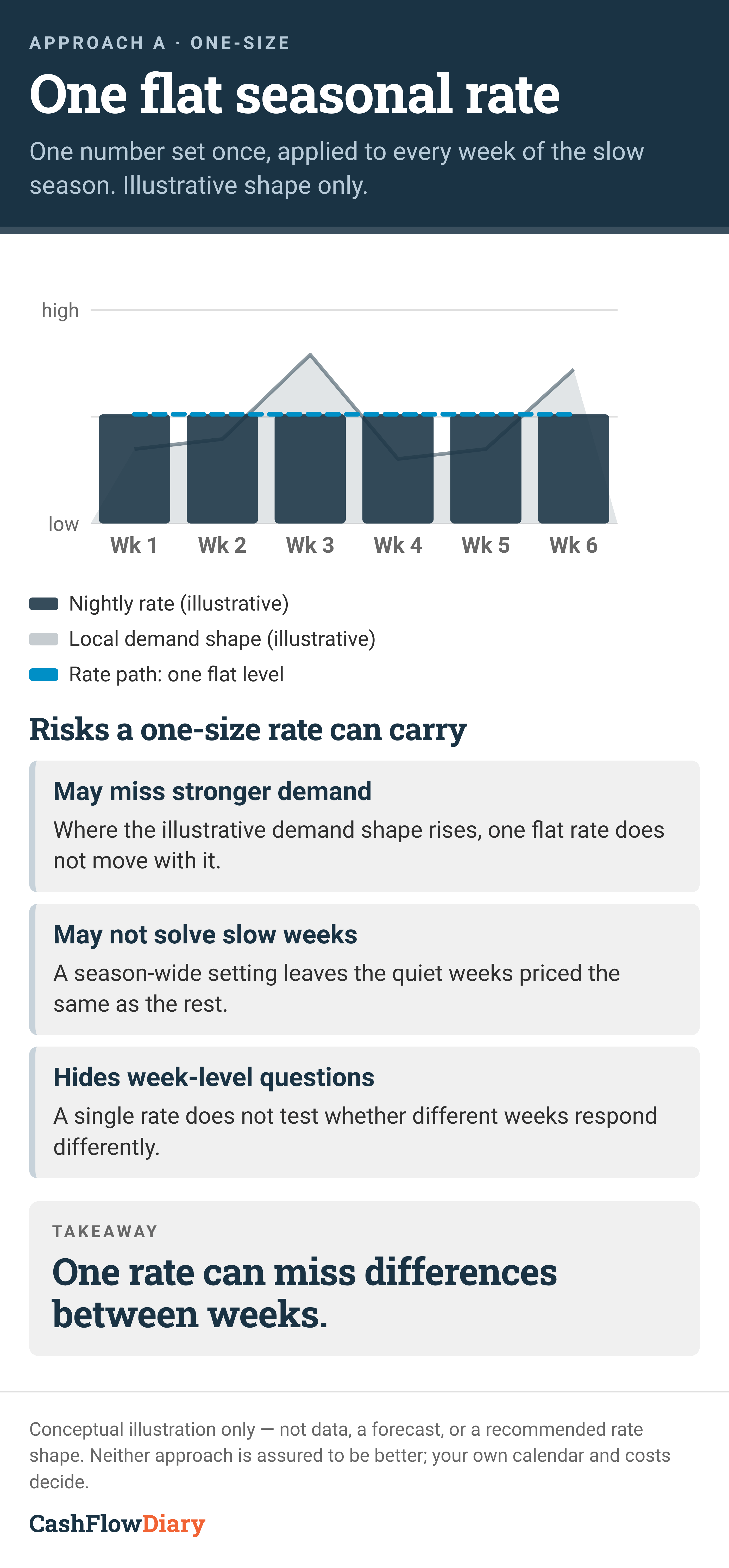
Approach A — one number applied to every week of the slow season. Conceptual illustration, not data or a forecast.
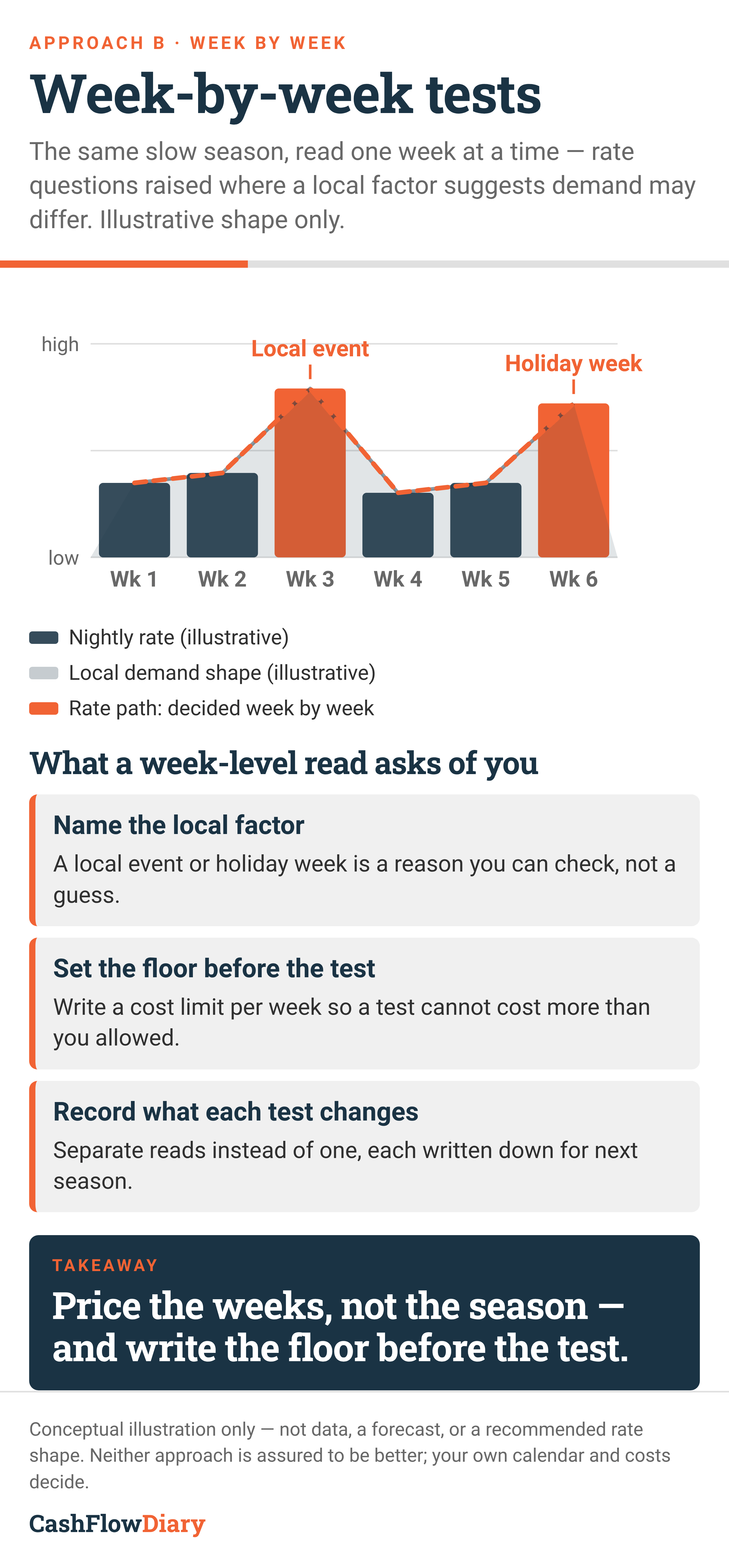
Approach B — the same season read one week at a time, with a written floor before any test. Conceptual illustration, not data or a forecast, and not a recommended rate shape.
Common Questions From Operators
Isn't discounting the fastest way to fill an empty calendar? It may help if price is the obstacle, but it cannot guarantee bookings. Check visibility, restrictions, and comparable total prices first. Then test selected dates within your cost limits rather than discounting the whole season.
How far out should I build the second demand channel? Before the season turns, not during it. Extended-stay and local-business channels take weeks to warm up; starting them mid-slump means you're building the fix and living the problem at the same time.
What if I cannot find viable off-season demand? Avoid buying occupancy at a loss. Review whether quieter dates suit necessary maintenance or preparation, and budget for continuing fixed costs. An empty week still costs money; the question is which available choice limits the loss without creating a bigger problem.
Do I need new software to run this? Check the exports and reports you already have. If lead time is missing, calculate the days between booking and check-in from reservation records. A spreadsheet can hold the comparison. Buy another tool only after identifying a specific data or execution gap.
Ready to Stop Guessing at Your Off-Season?
If you want a second set of eyes on your calendar, book a complimentary one-on-one diagnostic call. We'll look at which weeks are price-sensitive and which need a different guest entirely. If it isn't a fit, I'll say so.
• • •
P.S. — Pick three slow weeks from last year. Compare their booking pace, total prices, and restrictions with nearby alternatives where data is available. Write down one change to test and the cost limit you will not cross. Do not ask one number to explain the whole calendar.
This is educational content, not financial, legal, or tax advice. Results are not typical. Past performance does not guarantee future results. Confirm current rules and platform policies before changing your pricing or booking settings.
Ready for the next step?
Airbnb Help Center, 'Use Smart Pricing to automatically adjust your prices based on demand,' accessed September 11, 2026. It describes demand-based adjustments, host-set price ranges, and custom date overrides. It also warns that discounts can take the guest price below the Smart Pricing minimum. https://www.airbnb.com/help/article/1168
Airbnb Resource Center, 'Using Airbnb pricing tools,' updated July 14, 2025; accessed September 11, 2026. Describes custom nightly prices and weekly/monthly discounts, and says availability settings must allow the longer stays offered. These are feature descriptions, not evidence of a specific revenue lift. https://www.airbnb.com/resources/hosting-homes/a/using-airbnb-pricing-tools-707