


Zero bookings on a listing priced under market. The rate wasn't the problem — the checkout screen was. On a strategy call we'll map where your own listings are quietly losing guests before they book. No pitch. You leave with the diagnostic.

The Catskills tiny home at the center of this case study — 100 private acres, direct waterfront access, and zero October bookings before the fix.
Hey,
Picture a listing that's cheap, ranks well, and still won't book. That's what a Catskills-area tiny home looked like on September 15th: priced under the market's 25th percentile, sitting at the top of search, zero of 31 October nights on the calendar.
Every instinct says drop the price further. That instinct would have been wrong.
I've spent 18+ years in real estate, focused on short-term rentals since 2016, trained more than 10,000 operators through CashFlowDiary, and recorded 704 published CashFlow Diary™ podcast episodes breaking down the deals that work and the ones that don't. This is one of those breakdowns — and it's the clearest one I've seen this year for what actually causes a “good listing” to sit empty.
• • •
The Listing That Broke the Obvious Playbook
An automated employee I run — an “Occupancy Growth Manager” — checks every listing I operate five times a day and week: a 7am gap scan, a Monday scoreboard, a nightly drift check, a Thursday demand watch, a Wednesday listing review. On September 12th, it flagged the tiny home at roughly 8% occupancy through the whole summer.
The normal move here is: cut the rate. So for three straight days, that's what the scan tested. Three straight days, the answer came back the same: nothing left to cut. The rate was already under the 25th percentile of the market. Cutting further wasn't the lever.
That's what pushed the search somewhere else — the guest's total bill, not the nightly rate. And there it was: fees ran 24-60% of what a guest actually paid at checkout.1 Linen fee, resort fee, extra-guest fee, stacked on top of an already-thin rate — plus zero reviews since a recent relisting.
The rate looked cheap. The checkout screen was expensive. Nobody was lying to the guest; the listing just quietly cost more than it advertised, and guests noticed before they ever messaged.
A calendar that looks priced right on the search page and still gets zero bookings isn't a pricing problem. It's a bill problem — and most hosts never check past the nightly rate to find it.
— J. Massey
What Changed, in One Day
On September 15th, three moves went in together:
Kill the junk fees. Linen, resort, and extra-guest charges dropped to zero. Only the cleaning fee stayed.
Raise the base rate on purpose. Base went from $141 to $150, floor from $87 to $99 — protecting margin now that the fee income was gone.
Discount inside the pricing tool, not the platform. A 10% cut went on all 31 open October nights inside the pricing engine itself, not as an Airbnb-side promotional discount.2 That distinction mattered: an Airbnb-side promo on this exact listing, that same week, misfired on a sister property and raised its price instead of lowering it.
💡 Key reframe: the automation ruled things out first and solved the problem second. Three days of “nothing left to cut” is what redirected the whole investigation toward the bill.
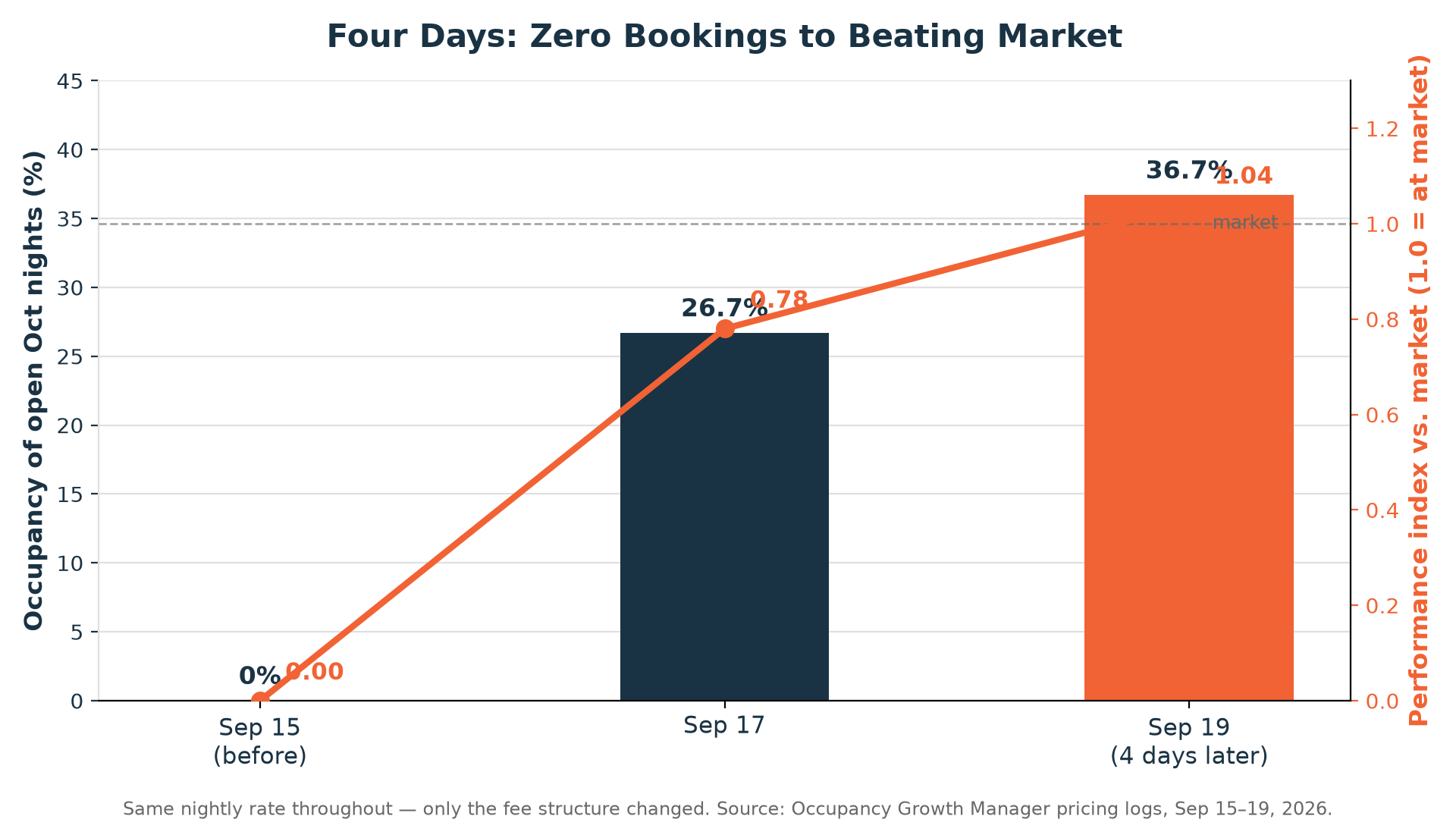
Same nightly rate the whole time. Only the fee structure changed — and the listing went from zero bookings to beating market in four days.
The Four Days That Followed — and What It Cost
Sep 15 (before): 0 of 31 Oct nights booked, under 25th percentile vs. market, performance index ~0. Sep 17: 26.7% occupancy, 34.3% vs. market, performance index 0.78. Sep 19: 36.7% occupancy, 35.2% vs. market, performance index 1.04 — beating market.
Three new reservations landed in the first 48 hours. A listing that had zero bookings for the entire month went to four nights booked before the week was out.
⚡ The math operators skip: the total guest bill plus listing trust moved this listing — the nightly rate never changed direction. The discount stayed inside the pricing tool specifically so the price floor stayed enforceable.
Here's the part most case studies skip: the real bill.
Querying the automation's own account directly (not a guess) put the credit cost of this specific investigation and fix at roughly $66 — $22 of that is an exact, isolated number for the thread where the fix was decided and executed; the rest is a documented range because two pieces of the analysis ran inside a longer conversation that also covered unrelated work that week.
Compare that to what a person would have cost to catch the same thing: an analyst doing the same daily gap-scanning and rebuilding the guest's all-in bill against comps runs $1,450-$4,500 at consultant rates for the 17-30 hours the work actually took. A full-service property manager, charging 20-25% of revenue, would likely have trusted the pricing tool's own suggestion to cut the rate further — the wrong move.
That's roughly a 35:1 cost ratio in the automation's favor. And the revenue at stake wasn't small: an estimated $2,300-$2,700 of October income was about to go unbooked on one small unit before the fix landed.
One honest caveat: the bookings that followed landed inside a week with real demand of its own — a college homecoming weekend, a reunion, fall foliage season. Treat the fix as a contributor alongside that demand, not the sole cause of it.
The One-Quarter Version, If You Run More Than One Door
Week 1: instrument the check. Whatever's currently “priced right” on paper: pull the guest's all-in total, not just the nightly rate, and compare it to two comps.
Week 2: separate the levers. If occupancy is weak and the rate is already competitive, stop touching the rate. Look at fees, photos, and reviews instead — the guest already saw the price and still said no.
Week 3: discount inside the tool, never the platform. A platform-side promo changes what the platform thinks your price is. A pricing-tool discount changes what the guest pays without moving your floor.
Week 4: put a number on what it would have cost you to miss it. Not to brag — to know whether the check paid for itself. If it didn't, you're checking the wrong thing.
Common Questions
Why not just lower the nightly rate again? Because it was already tested and ruled out. Three straight days of “nothing left to cut” told the automation the rate wasn't the lever — the total guest bill was.
Is a 35:1 cost ratio typical? No. It's specific to this listing, this fix, and this week's demand. Treat it as one documented example, not a universal multiple.
Could I catch this manually? Yes, if you check every listing's all-in guest total against comps on a schedule and act on what you find. Most operators don't have the hours to do that below a few hundred doors — that's the actual gap this closes.
Ready to See What Your Own Listings Are Quietly Costing You?
Start your free STR Systems Diagnostic — no pitch on the call, you leave with the diagnostic either way.
• • •
P.S. — The tiny home in this story sits on 100 private acres with direct waterfront access — the kind of listing that looks like it should sell itself. It didn't, until someone (or something) checked the actual bill a guest pays, not just the number on the search results page. That's usually where the real leak is.
Disclosure: Results are not typical. Past performance does not guarantee future results. Educational purposes only — not investment, legal, or tax advice.
Fee share calculated from the listing's own itemized checkout breakdown (linen, resort, extra-guest fees vs. total guest price) captured by the Occupancy Growth Manager's pricing logs, September 2026.
Airbnb Help Center, ‘Use Smart Pricing to automatically adjust your prices based on demand,’ accessed September 2026 — describes host-set price ranges, custom date overrides, and platform-side promotional discounts as a distinct mechanism from a pricing tool's own internal discount. https://www.airbnb.com/help/article/1168