


Hey,
Something is happening in New Jersey that I want you to understand — because it’s not just a New Jersey story.
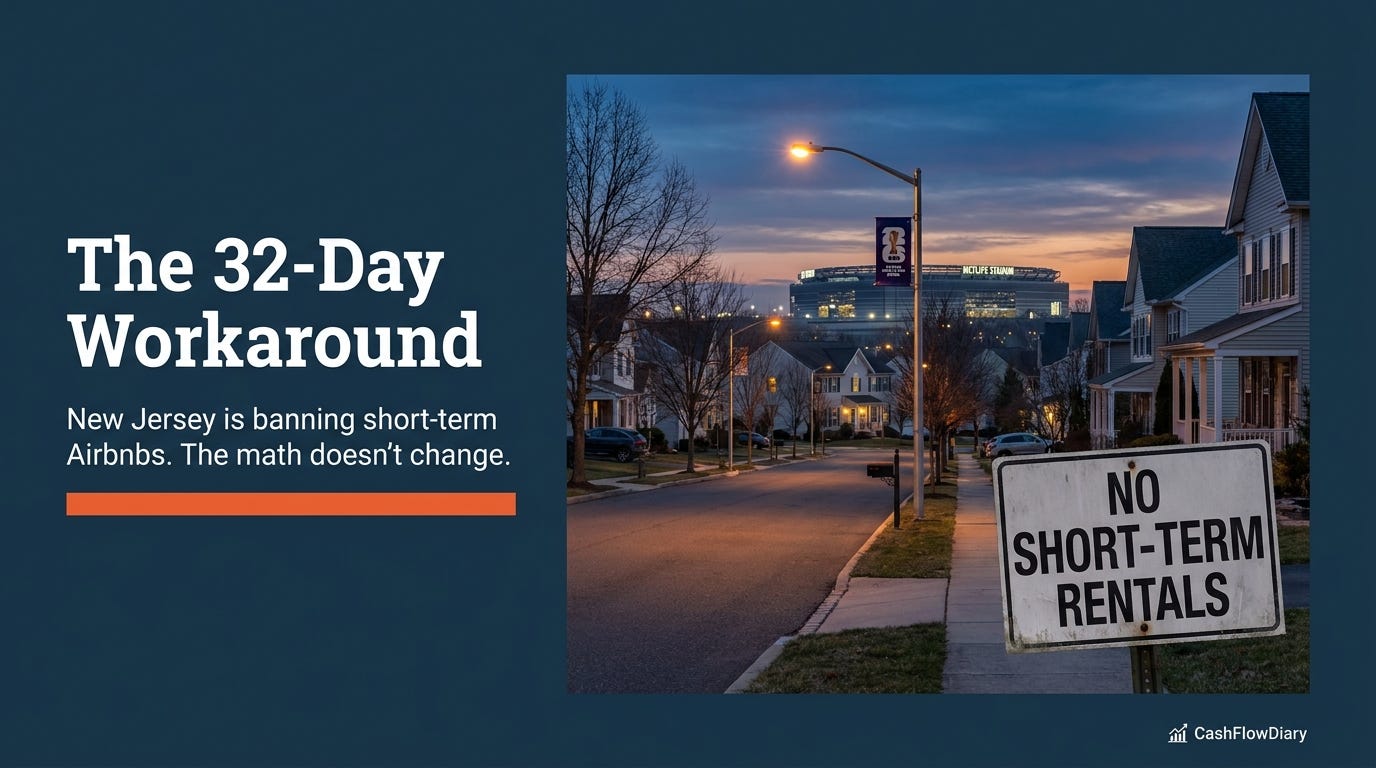
It’s a story about what happens when 75-plus towns ban short-term rentals six weeks before the biggest tourism event ever held in North America.
The Setup
The Mountainside Borough Council voted unanimously on May 14 to introduce an ordinance banning every short-term rental of 30 days or fewer, with fines up to $2,000 per day. The second reading is set for June 2.
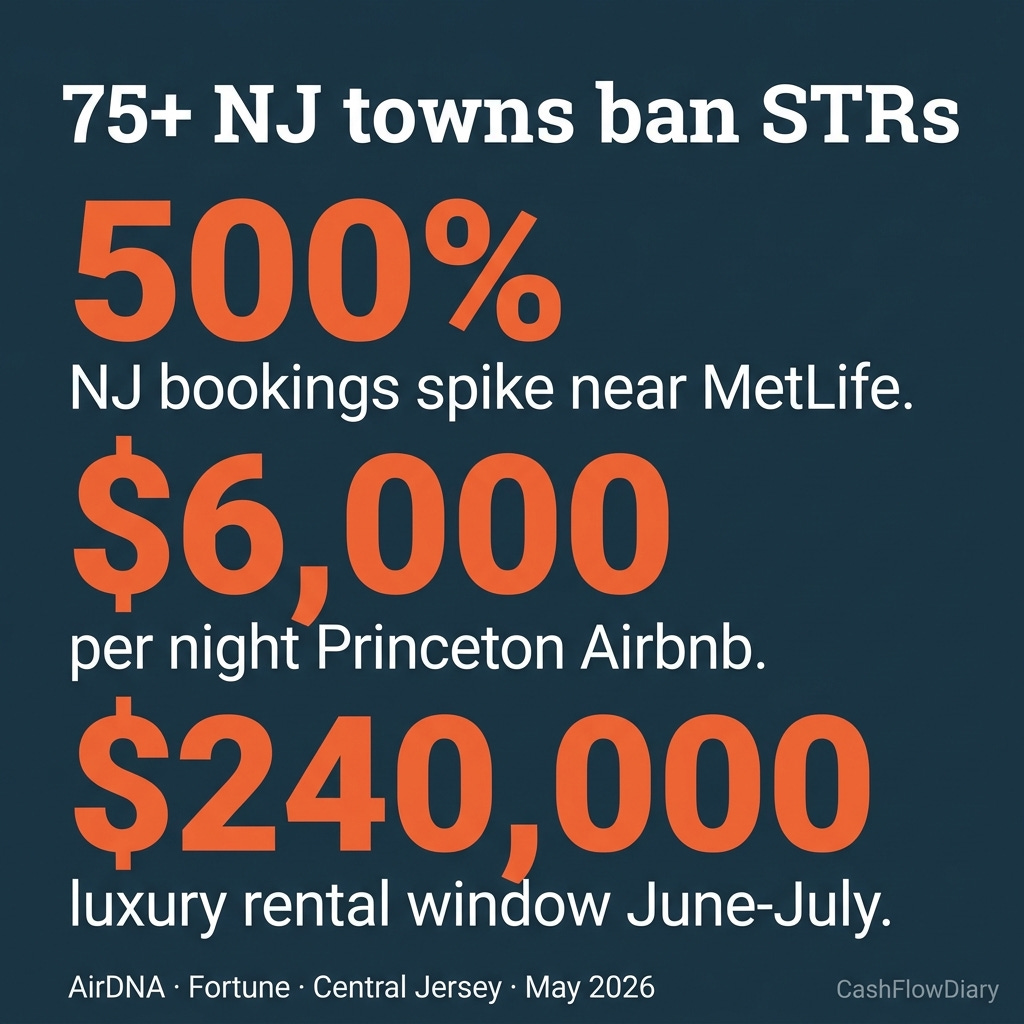
Kearny — three miles from MetLife Stadium — expanded its 2017 ordinance in March. More than 75 New Jersey municipalities now prohibit short-term rentals outright.
The 2026 FIFA World Cup kicks off June 11 at MetLife. The math doesn’t care about the ordinances.
The Number
Here is the part nobody is reporting: the Mountainside ordinance prohibits rentals of 30 days or fewer. A 31-day reservation is, on its face, fully compliant.
A World Cup fan group stays five nights. A $10,000 reservation that uses the property for five nights but pays for 31 covers two to four months of mortgage. To the ordinance: compliant. To the tax code (NJ TB-81R): still occupancy-taxable until day 90.
The 2026 World Cup will be the biggest travel event in short-term rental history.
— Jamie Lane, Chief Economist at AirDNA (February 2026)
The interesting part is the second half: “Don’t expect to earn $1,000 per night.” Lane is forecasting massive demand AND massive supply. Two different risk vectors. Conflating them is how operators get caught.
The 60-second video version:
https://youtube.com/shorts/ADRMW9uUiv8
💡 The math: A 31-day reservation pays for 31 days but the World Cup fan group uses the property for 5. $10,000 covers 2-4 months of mortgage. Ordinance-compliant. State tax: still occupancy-taxable until day 90.
Why This Matters for You
Here’s what the data shows across cities that introduced restrictions like these:
Maui, HI — STR phase-out projected $900M in visitor spending loss
New Orleans, LA — $1.6 billion in unrealized annual economic activity from restrictive STR regulation
Anaheim, CA — eased restrictions after platform lawsuits exposed the cost
Clifton, NJ — temporarily relaxed STR rules ahead of the 2026 World Cup citing budgetary needs
Hoboken, NJ — drafting regulations instead of bans, acknowledging Jevons paradox directly
The reversal cycle is observable in real time, not theoretical.
The Framework
If your STR underwriting requires the World Cup to show up exactly as projected, your underwriting was wrong before the World Cup was announced. Event-driven STR revenue is upside, not baseline.
Bans don’t stop demand. They reroute it. Plan for the route, not the headline.
I wrote the full breakdown — every data point, the cautious-investor checklist, and the 18-24 month reversal-cycle map.
Free download — the full 8-page CFD briefing PDF with the Jevons primer, the 75-municipality map, and the cautious-investor checklist:
This is the kind of analysis that changes what’s possible for STR operators. Not reaction. Preparation.
The window to be in the room with numbers — before your city votes — is always shorter than you think.
— J.
Sources
Mountainside ordinance vote — TAPinto Mountainside (May 14)
AirDNA forecast — Jamie Lane, AirDNA Chief Economist (Feb 2026)
NJ transient occupancy tax — TB-81R
Maui $900M projection — Rent Responsibly
Hoboken regulates-not-bans — Gothamist
P.S. — The Mountainside story doesn’t end with June 2. Watch what the 75-plus towns do in 18-24 months once the lost-revenue analyses circulate. That’s where the second-wave entry points show up. Read the full analysis →