


Is your baseline costing you money? Book a free strategy call — one conversation, no pitch. We find what your operation should be producing and your exact next move. You leave with the diagnostic in hand.
Hey,
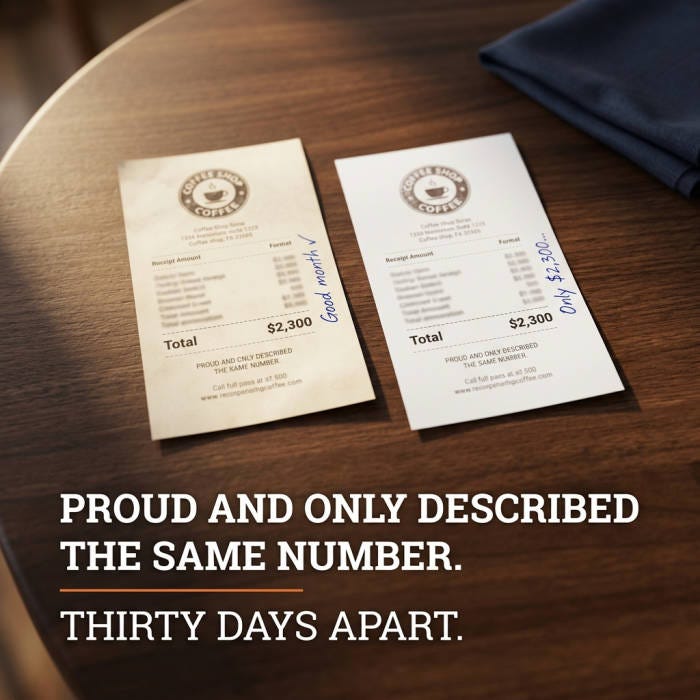
A month ago, one of my clients ran the numbers on his single short-term rental. $2,300 came in. He told me with pride. The number felt like proof the operation was working.
This week, same property. Same number. $2,300.
This time, he said “only.”
Same unit. Same market. Same listing. Same guest flow. Nothing about the property changed in thirty days — but the way he measured it did. And that one shift opened $400+ in immediate adjustments1 before we hung up the phone.
I've spent 15+ years in this space, trained more than 10,000 operators through CashFlowDiary, and recorded 237+ podcast episodes breaking down the deals that work and the ones that don't. The pattern below shows up in every cycle.
• • •
The Same Number, Thirty Days Apart
A month ago, $2,300 was the win. This week, $2,300 was the floor he was already planning to move past. The realization he named on the call: “I was always leaving money on the table. I was satisfied with less before.”
“Proud” and “only” described the same number. Thirty days apart. No market shift, no new amenity, no pricing overhaul in between — just a different standard doing the measuring.
The shift wasn't effort. He didn't work harder. He recalibrated what the operation should produce — and the moment that landed, the old result stopped feeling like success. The gap was never performance. The gap was the standard he was measuring against.
Why Satisfaction Works Like a Ceiling
Most operators don't have a revenue problem. They have a baseline problem — and the two look identical from the inside, which is exactly why it goes undiagnosed for years.
You're not underperforming relative to what you think the property should produce — you're performing exactly in line with it. The issue is the baseline is set too low, and you can't see it, because you keep hitting it.
“Operators performing to their baseline aren't failing. They're succeeding at the wrong target.”
— J. Massey, CashFlowDiary
Contentment with less is invisible until someone shows you the table you've been leaving money on. You thought you were doing well. You were. But “doing well” was the ceiling, not the floor.
The client didn't need to work harder. He needed to see what $2,300 represented: not a win, but a data point showing where the gaps were. Once he saw that, the pride turned into a prescription. The same number that used to close the conversation now opened it.

How Recalibration Shows Up First
Later in the same call, he walked me through a guest interaction. Mid-sentence, he offered to throw in free laundry service. Then he stopped himself.
“Wait. That should be a paid add-on.”
He corrected it in real time. The recalibration was already operating live.
That's how it always starts. When your baseline shifts, you catch yourself offering things for free that used to feel generous but now look like revenue walking past you. You stop saying “pretty good month” when the math says average. You stop defending results you used to celebrate. The internal frame adjusts first — then the operation follows it.
💡 Key reframe: The language flips before the revenue does. When you stop saying “pretty good month” and start asking “what did this number leave on the table?”, the baseline has already moved. Revenue typically follows within 30 to 60 days2.
⚡ The math operators skip: Free add-ons that feel generous are revenue walking past you. One repriced laundry service, two listing tweaks, and a repriced extra added $400+ per month — same property, same hours worked.

The 7-Day Baseline Reset
You don't need a new property. You need a new floor. The recalibration doesn't require more hours — it requires seeing the same operation differently, then letting the language change pull the operations behind it. Here's the reset I walk operators through:
Days 1-2 — Write down the number you're proud of. Whatever you say with satisfaction when someone asks how the operation is going. That's your current baseline, on paper.
Days 3-4 — Audit every freebie. List everything you give away that a guest would pay for: early check-ins, laundry, late checkouts, extras. Each one is a line item, not a kindness.
Day 5 — Reprice the add-ons. Pick the two easiest conversions and put a price on them today. Don't redesign the whole operation — move two line items.
Days 6-7 — Set the new floor. Take last month's number, add the repriced items, and write THAT down as the new minimum. The old win is now the floor you diagnose against.
Your baseline is a decision you keep making by default — and default decisions compound. Same family as this one:
We Die Looking Like Our Decisions

Your outcomes aren't your circumstances — they're your beliefs, and the alternatives you refuse to cut away.
Common Questions About Baseline Recalibration
How do I know if my baseline is set too low?
If you're consistently proud of a number but haven't diagnosed what it's leaving on the table, it probably is. The test: would someone running the same property in the same market with a higher standard call your win a floor?
Does this require more work hours?
No. The client added zero hours. He repriced a laundry add-on, adjusted two listing assumptions, and stopped giving away extras. Recalibration changes what you do with the same capacity, not how much time you spend.
Is this mindset or systems?
Both. It starts as a frame shift and immediately becomes operational: pricing, add-ons, guest communication. The mindset produces the system adjustment — in that order.
What if I'm already optimizing pricing and occupancy?
Optimization within a low baseline still produces low results. If you're optimizing to hit $2,300 and treating it as success, you're optimizing to the wrong target. Recalibrate the target first — then your optimization has a higher ceiling to work toward.
Ready to Find Your $2,300?
Write down the result you're proud of right now. Then ask: recalibrated, is that a win — or a floor? If the answer is floor, one conversation maps what your operation should actually produce. No pitch. You leave with the diagnostic.
• • •
One more thing before you go: what result are you proud of right now? What number do you say with satisfaction when someone asks how the operation is going? Write it down. Then ask: recalibrated, would I still call this a win — or a floor? If the answer is floor, you found your $2,300. The number isn't the problem. Celebrating it instead of diagnosing it is.
P.S. The property didn't change. The expectation did — and everything downstream followed: pricing, add-ons, guest comms, reviews. The $2,300 stayed the same for exactly one more month. After that, it moved. Yours will too.
You're receiving this because you subscribed to CashFlowDiary — real numbers, real systems, real estate. Eighteen years of deals, broken down weekly.
Ready for the next step? Here's exactly what working together looks like:
Work with J.
Eighteen years of deals. 10,000+ operators trained. One conversation to map your next move.
Itemized on the call: a repriced laundry add-on, two listing-assumption corrections, and one extra moved from free to paid.
The typical lag we see across client operations — language shifts in days, operations in weeks, revenue inside 30-60 days depending on booking lead time.