


Hey,
Sixteen people asked about one of our properties and never booked.
I used to treat that like weather. Somebody asks, somebody leaves, you answer the next message. Then we went back through the inquiry history on that property, counted every one that didn't book, and sorted them by reason.
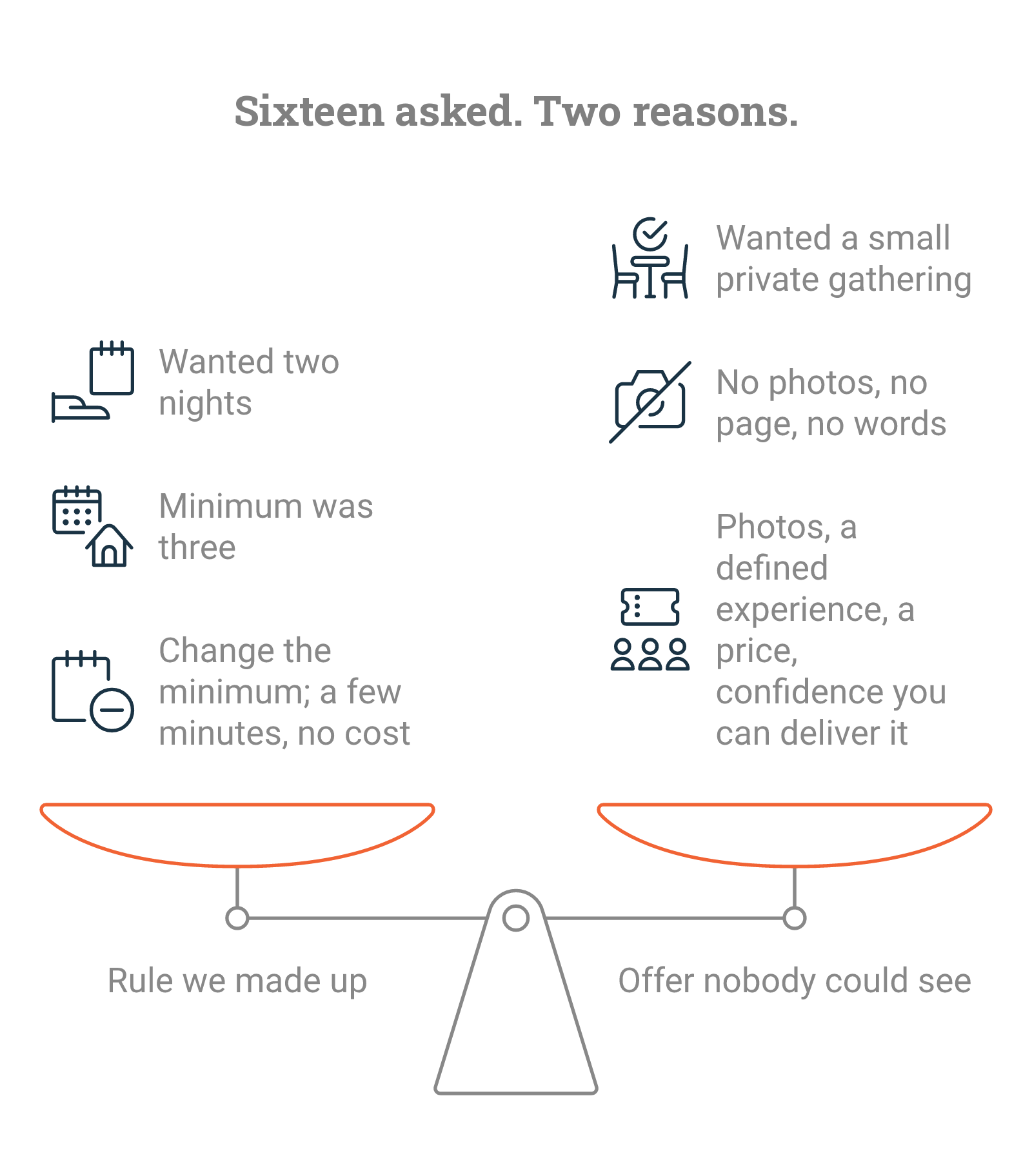
Sixteen people. Two reasons. And one of them cost nothing to fix.
Neither reason ever showed up in a review or a complaint. Below are both of them, and the two-hour audit you can run on your own inquiries this week.
If your rental has the same leak, I'll find it with you. 25 minutes, no charge, and no is a fine answer.
I've spent 18+ years in real estate, focused on short-term rentals since 2016, built a list of more than 10,000 short-term rental operators through CashFlowDiary, and recorded 705 published CashFlow Diary™ podcast episodes breaking down the deals that work and the ones that don't. The pattern below shows up in every cycle.
• • •
The rule we made up
Some of those sixteen guests wanted two nights. Our minimum was three.
Nobody objected to the price. Nobody complained about the property. Our settings said three nights, so the booking system turned those guests down for us while we slept, and nobody on our side ever saw it happen.
We changed the minimum. It took a few minutes.
What bothers me is how invisible it was. Nobody ever wrote to say the minimum was too long. The rejection happened inside a settings page, one guest at a time, for months. Without the recount, that rule would still be turning people away today.1
💡 Your booking rules are a sales team you never interviewed. Minimum nights, check-in windows, blackout dates and cancellation terms each send some of your demand away, and none of them reports back.
On Airbnb that rule sits under Trip length in your calendar's availability settings, and you can set a different minimum for each check-in day.2 So the fix doesn't have to be all or nothing. You can loosen the minimum on the days where guests keep asking and keep it everywhere else.
Before you rush to copy us, one caution. A shorter minimum can mean more cleans for the same nights, a stranded single night, or a stay your city's rules don't allow. Check those first. Our three-to-two change fit one property. Your log decides yours.
The offer nobody could see
The rest of the sixteen wanted something smaller than the full weekend event we were selling. A small private gathering.
We can host that. The property can do it. But nobody could see it. There were no photos of a small event in the space, no page describing it, no words for it anywhere on the site.
So a guest asking about a small gathering was reading a website that only talked about big ones, looking at photos of one kind of use. And they decided, reasonably, this isn't the place.
We lost those bookings for a marketing reason.

"The property could do it. The website never showed it."
- J. Massey, CashFlow Diary podcast, Season 4, Episode 2
Your inquiry log is your product roadmap
Guests keep asking for things slightly off from what you advertise. When that happens, there are two honest answers.
Either you can't deliver it, the answer is no, and that's fine. Or you can deliver it and you never showed it, and then the lost booking is on you.
For our small gatherings, four pieces were missing, and the order matters: photos of the offer happening, a defined experience, a price, and confidence you can deliver it the way you described it.
The log changed how we brief a photographer too. Our last professional shoot gave us handsome pictures of the wrong story, because nobody handed the photographer the questions guests actually ask. The next shot list comes straight from those questions, on the same budget.
And we're not waiting for perfect. Every photo we own was taken in summer, and it's already fall, with winter next. Usable photos this season beat a flawless shoot that lands after the season is gone.
We caught ourselves arguing about food tastings and menu options for those small gatherings. That conversation didn't matter yet. No photo, no defined experience, no price, no sale.
⚡ Paying for more traffic before you fix the leaks buys more people to tell you no. Same minimum stay, same half-finished offer, bigger bill.
This week's two-hour audit
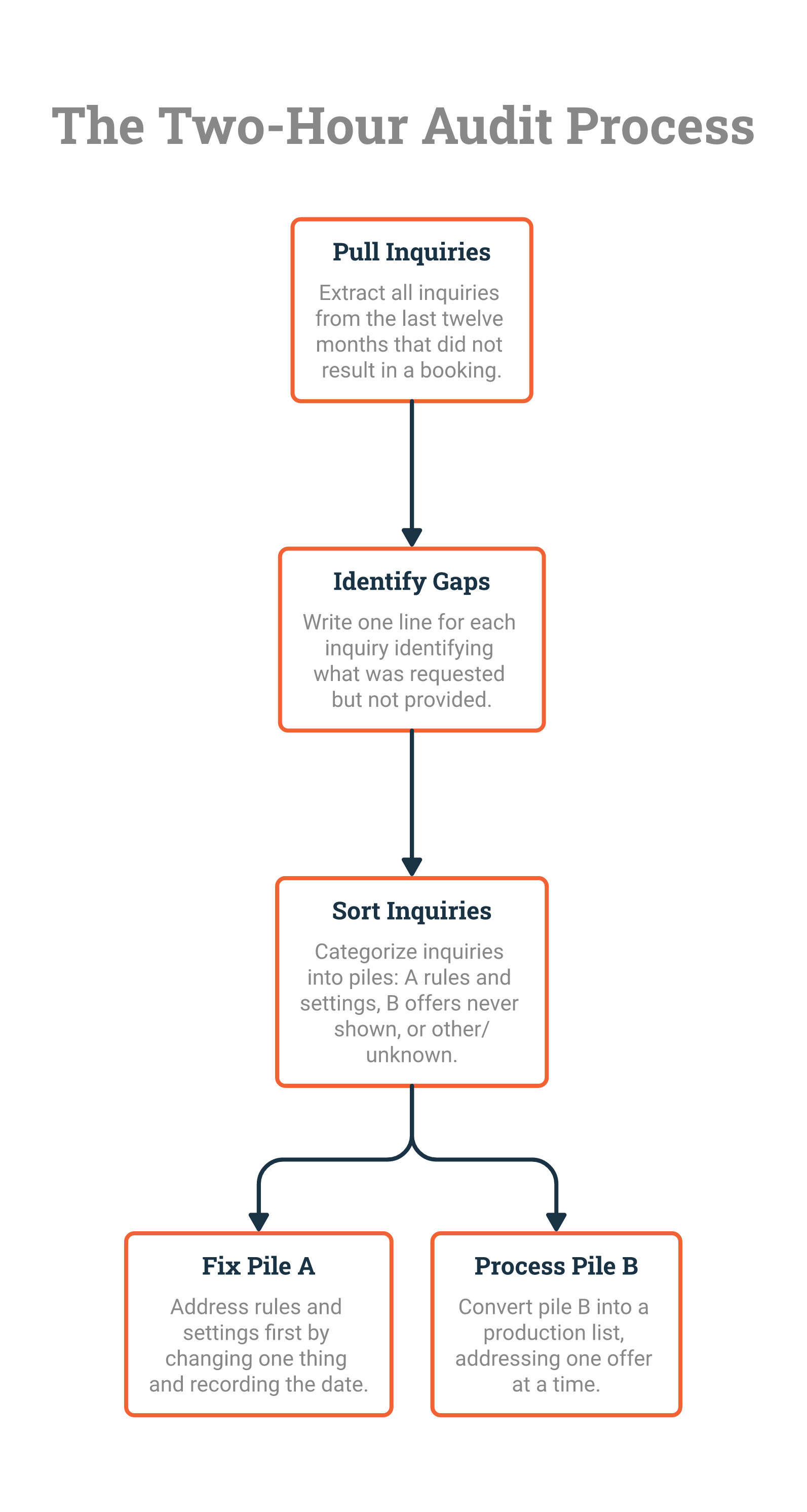
Set aside two hours. Then:
Pull every inquiry from the last twelve months that didn't book. Platform messages, emails, texts, calls and form fills. Log each guest once, even if they asked three ways.
Write one line for each. What did they ask for that you didn't give them? Use their words where you have them, and mark what you're guessing.
Sort the lines into piles. Pile A is rules and settings. Pile B is offers you could deliver but never showed. Anything else goes in other or unknown, and you leave it there.
Fix pile A first. It's usually a settings change. Check your costs, your cleaner's capacity and your local rules, change one thing, and write down the date.
Turn pile B into a production list. Photos, defined experience, price, delivery confidence, one offer at a time, starting with the one that showed up most.
Leave guest names and phone numbers out of it. You need the request, not the person.
What goes on each line matters more than the tool. Write the inquiry date, the dates and nights they wanted, the group size and what the stay was for. Then the unmet request, in the guest's own words if you have them. Then one honest label: did the guest say it, or are you guessing? "We only need two nights" is evidence. Silence after you sent a price is a guess, so it goes in unknown. Last, the change you'll try, the date you made it and what happened next, including any new cleaning cost or setup work.
Then wait until the inquiries that came in after the change have had time to book or not, and compare bookings from inquiries against a similar stretch last year. Change one thing at a time, so you know what moved.
Paid members get the Lost-Inquiry Log worksheet with this edition. A notebook works too: one line per guest, written the same way every time.
Keep reading: The full #699 article: How to Audit Lost Airbnb Inquiries Before You Buy More Traffic
Common questions about lost inquiries
How many inquiries do I need before this is worth doing? There's no minimum. We learned enough from sixteen to change a setting and start a production list. A small count finds patterns worth testing. It can't prove a result.
Should I just lower my minimum stay? Only if your log shows guests asking for shorter stays and the shorter stay works for your cleaning costs, your team, your calendar and your local rules.2
What if guests never told me why they left? Log them as unknown. Look for repeated questions your listing doesn't answer, and fix those, without pretending you know why each person left.
Ready to find your own leak?
Sixteen inquiries, two reasons, one of them free. Block the two hours this week, sort your own log, and fix the first pile before you spend another dollar on traffic.
• • •
P.S. Bring three rough numbers to a complimentary one-on-one diagnostic call: what you net, your manager's cut and your booking-site fees. You'll leave with your first move either way.
- J.
Educational content, not financial advice. Results not typical.
From the CashFlow Diary podcast, Season 4, Episode 2, "Airbnb Minimum Stay: The Setting That Turns Guests Away While You Sleep."
Airbnb Help Center, "Set minimum and maximum nights" (airbnb.com/help/article/880), on trip-length settings; Airbnb Resource Centre (UK), "Updating your availability" (airbnb.co.uk/resources/hosting-homes/a/updating-your-availability-708), which says trip lengths must follow local rules and regulations. Checked Oct 15, 2026.