


Hey,
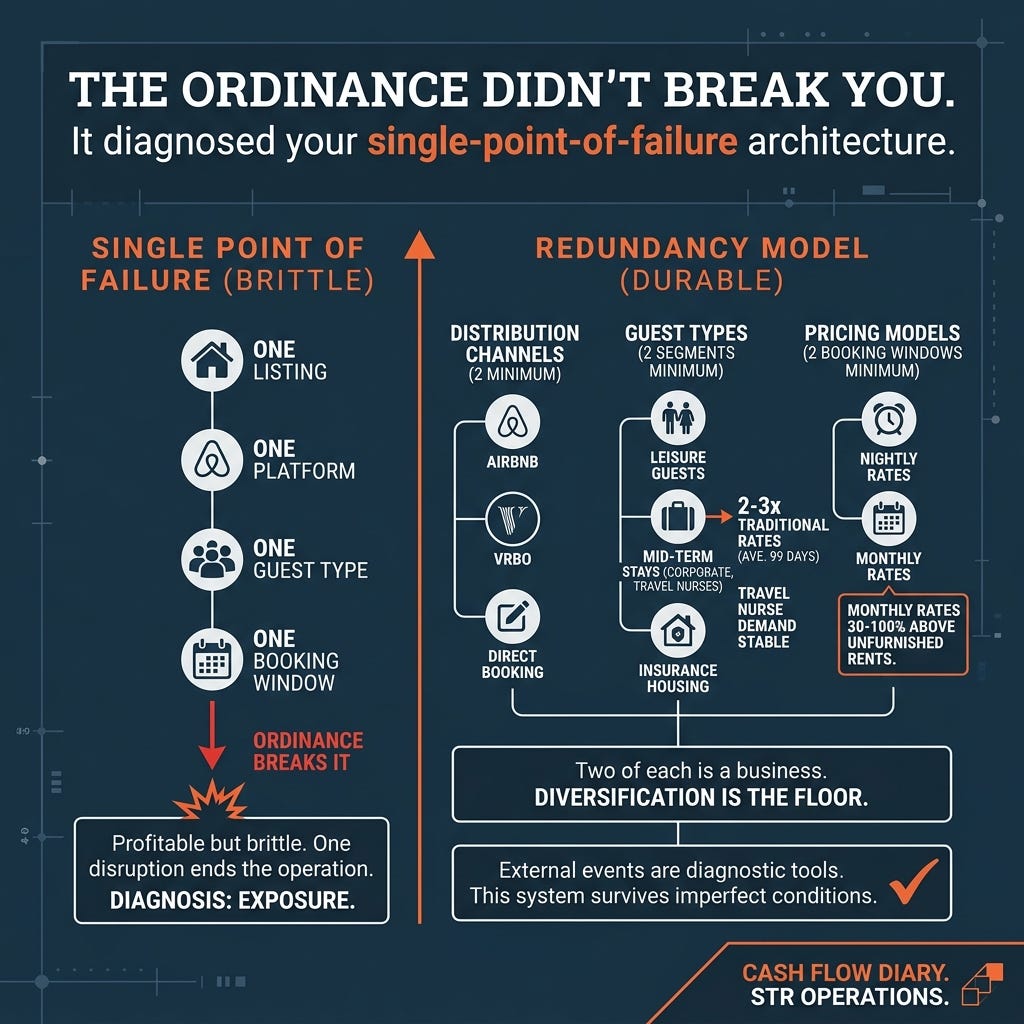
The ordinance didn't break your business.
It ran the audit you kept postponing — the one that would have shown you a business with no floor underneath it.
After watching this play out twice now — first with COVID, now with the regulatory wave hitting markets from Barcelona to New York to every mid-sized city where a council member just discovered Airbnb — the pattern is clear: regulation doesn't kill STR operators. Single-point-of-failure architecture does.
The Setup
In 2024, Barcelona announced it would eliminate every short-term rental license in the city by November 2028. New York City's enforcement of strict STR rules in late 2023 caused average booked prices to fall 24.89%. Spain hit Airbnb with a €56 million fine in 2025 for non-compliant listings. The regulatory wave isn't theoretical anymore — it's mid-impact.
Most operators I consult with respond with some version of the same script. Panic. Blame the rules. Threaten to exit the market. Argue at city council meetings. Wait for the ordinance to get watered down. None of that is wrong, exactly, but it misses what's actually happening underneath.
A smaller group quietly adjusts and keeps operating through every cycle. They're not luckier, better-connected, or more clever at lobbying. They built differently. The difference between those two groups isn't politics — it's architecture.
The Number
Here's the math that should be running behind every operator decision right now. A recent client whose property operates under a hybrid STR-plus-mid-term-rental structure hit $136,732 in annual revenue. The STR-only projection for the same property was $98,800.
That's a 38% revenue premium driven almost entirely by filling off-peak calendar gaps with corporate and insurance relocation tenants. Corporate housing generates 2-3x traditional rental rates with average stays of 99 days per guest, in a $12 billion global market projected to grow 6.5% annually through 2029.
Profitable and durable are not the same word.
— J. Massey · CashFlowDiary
A listing can print $4,000 a month for 18 straight months and still be one ordinance away from zero. Margins don't equal a floor. Diversification does. If 80% of your revenue comes from one platform serving one guest type, you don't have a business. You have exposure dressed up as a revenue stream.
💡 Regulation doesn't create fragility. It reveals what was already there. Fix the diagnosis and the next disruption becomes a variable you adjust for — not an extinction event.
• • •
The Pattern
I've watched this pattern run twice now, and the structure is identical both times. In March 2020, COVID shut down travel in 72 hours. Operators relying exclusively on vacation guests from out-of-state went dark immediately. The calendar emptied. The revenue stopped. No amount of hustle fixed it because the model had no alternate delivery method.
The operators who survived didn't out-work the shutdown. They had already built other ways to fill the calendar — mid-term stays, traveling nurses, insurance housing, corporate relocations. They switched who they served and kept the lights on. The same architecture is what separates today's quiet adjusters from tonight's panicked sellers.
External events are diagnostic tools. That's all they ever were.
— J. Massey
COVID didn't create brittle operations — it exposed them. Regulation isn't creating fragility either — it's revealing it. The operators panicking right now and the operators who panicked during COVID are running the same one-input, one-output architecture. The day that single path gets blocked, the operation stops.
Why This Matters for You
If you operate even one short-term rental, pull your last 12 months of bookings before the next ordinance lands and answer these five questions:
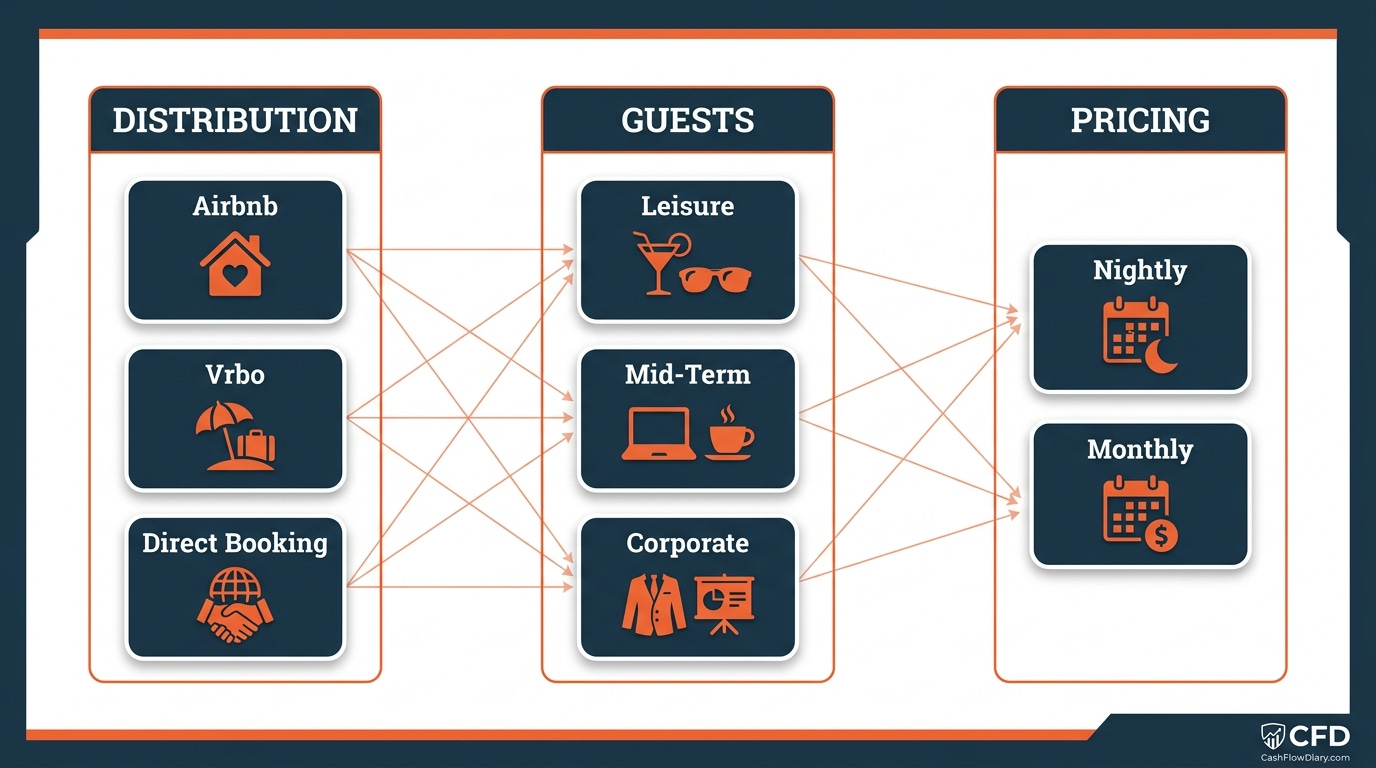
Platform concentration: What % came from a single platform? Over 70% = platform risk. Build the second channel now — Vrbo, direct booking site, or corporate housing network.
Guest-type concentration: What % came from a single guest type? Over 70% = guest-type risk. Identify the second segment your property can serve — mid-term stays, traveling nurses, insurance housing, corporate relocations.
Pricing-model concentration: What % came from nightly bookings only? Over 70% = strategy risk. Add the monthly booking option. Test the hybrid model with one property first.
Market concentration: How many cities? One city's ordinance can take out the whole portfolio. Geographic diversification across markets with different regulatory environments stabilizes overall income.
Cash floor: If your highest-revenue channel went dark Friday, would Saturday still book? If the honest answer is no, you don't have a floor — you have a ceiling that hasn't fallen yet.
One of each is a hobby with good months. Two of each is a business. The threshold isn't ambition — it's math.
• • •
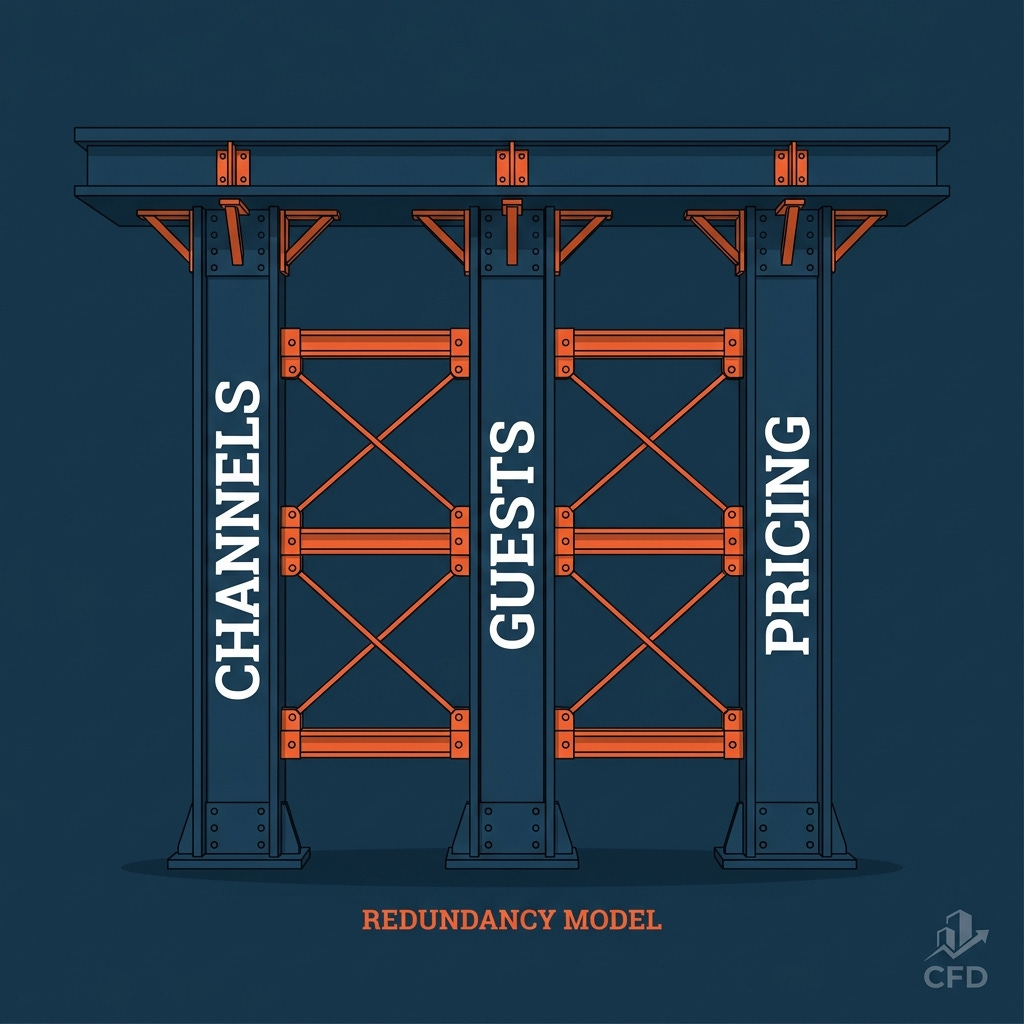
Single Point of Failure vs Redundancy Model

The Framework
Fighting the ordinance is fighting the symptom. Your single-point-of-failure architecture is the disease. Win the regulatory fight tomorrow and the next disruption still takes you out — different cage, same lock. The operators who survive long-term aren't the ones who win every regulatory battle. They're the ones who build businesses that don't depend on winning.
Redundancy isn't about pessimism. It's about probability. The chance one channel stays open forever is low. The chance two channels both close at the same time is lower. The chance three channels serving three guest types all disappear simultaneously approaches zero. That last number is the floor you're building.
⚡ The cost of building redundancy is margin you give up in the good years. That cost IS the insurance premium. Operators who refused to pay it during COVID paid the full uninsured price. Same is happening now.
Week one: Pick the second distribution channel. Set up the listing. Get it live. Don't optimize yet — just expose the calendar to a second algorithm.
Week two: Identify the second guest type your property can serve. Research the intake process for corporate housing, traveling-nurse platforms, or insurance relocation. Build the initial funnel.
Week three: Add the monthly pricing option. Update your booking settings on both platforms. Test the hybrid nightly-plus-monthly model with one property — keep the other on nightly-only as a control.
Week four: Run the audit again. Pull the prior 30 days of bookings. Measure the concentration shift. Adjust. Pick the next bottleneck.
The full breakdown — with the specific corporate housing intake script, the dynamic pricing framework I run on every listing, and the hybrid model that protects margins through regulatory cycles — is on the site. And if you want to map your portfolio against this framework one-on-one, I open a few Strategy Call slots each week.
The ordinance is coming. The platform policy will change. The algorithm will shift. The next pandemic will hit. Different trigger, same outcome — operators with redundancy adjust and keep operating, operators without it panic and blame the disruption.
Build the redundancy now. That's the only fight worth running this year.
— J.
Sources
Barcelona to eliminate STR licenses by November 2028 — Hospitality Net
NYC booked prices fell 24.89% after STR enforcement — MyLighthouse
Corporate housing generates 2-3x traditional rental rates — West Coast Home Stays
Multi-platform OTA management benefits — Expedia Group research
Full article: Single Point of Failure — Why Regulation Isn’t the Problem
P.S. — Most operators audit when the ordinance hits. Smart ones audit when the ordinance hasn't been written yet — and they make the changes that take 90 days to compound long before they need them. The framework is in the full article above. Read the full analysis →