


Hey,
Most operators reach for the same lever when they want more revenue: raise the nightly rate. It's the obvious move, and it's also the riskiest one. Push the rate and you're gambling that guests still book at the higher number. Sometimes they do. Sometimes the calendar goes quiet and you've traded occupancy for a headline price you never actually collect.
There's a quieter lever that doesn't touch the rate at all.
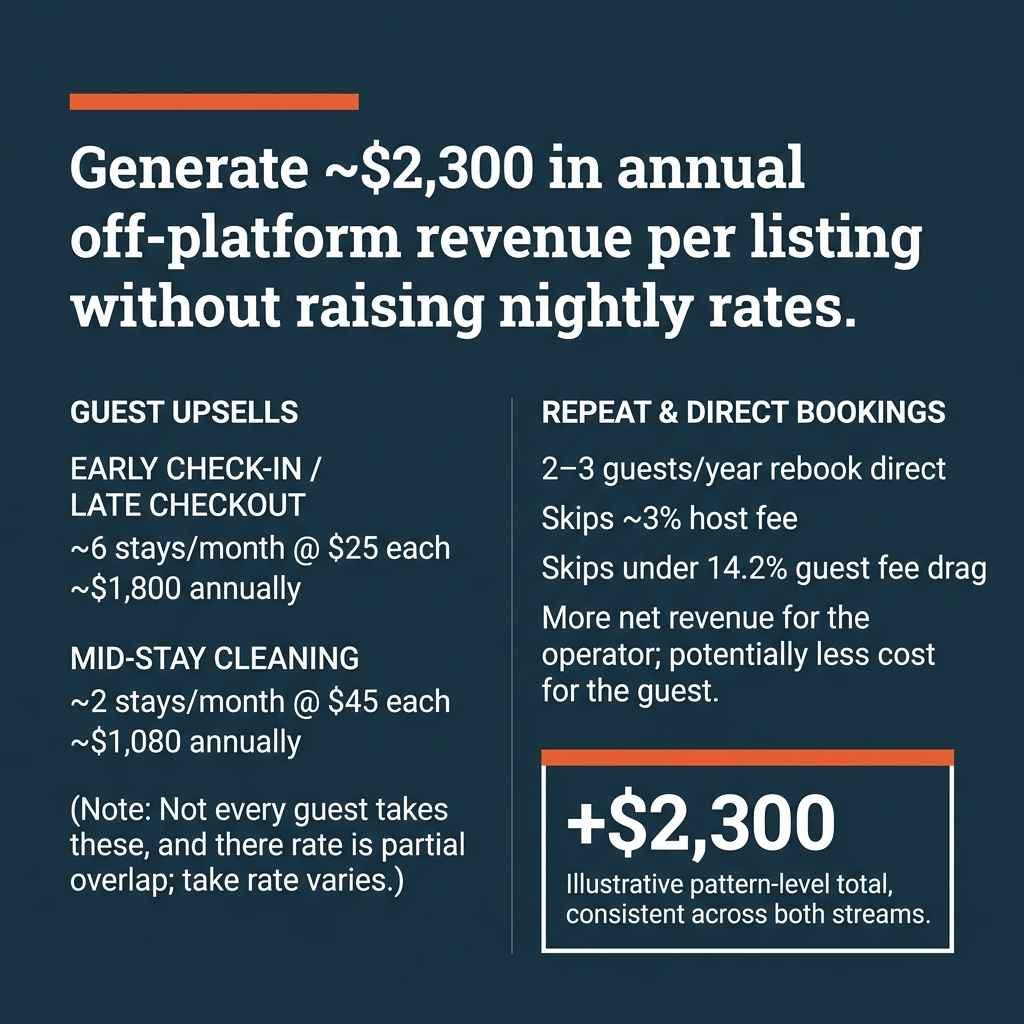
Over twelve months, one listing added roughly $2,300 in off-platform revenue — same property, same nightly price, no second door. The money came from things guests were already willing to pay for. They just weren't being asked.
Here's exactly where it came from, and the one move you can make this week to start.
J. Massey is a short-term rental operator and the founder of CashFlowDiary. He has trained more than 10,000 entrepreneurs in STR operations and rental arbitrage, and publishes the systems he builds in real time.
Why off-platform beats a rate hike
A rate increase gambles with occupancy. An upsell adds revenue to a stay that is already confirmed. The guest already said yes to the property. You're offering value on top of a transaction that's done — not asking a new guest to pay more to walk in the door.
Off-platform revenue is simply money earned from the guest beyond the nightly rate booked through the platform. It arrives in two streams: guest upsells, and repeat bookings that come to you direct.
The model isn't new. The hotel industry pulls 20–30% of total revenue from ancillary services — a hotel-industry benchmark, not a CFD number. STR operators run a smaller version of the same playbook. Most just never set it up, because the booking feels like the finish line instead of the start.
Where the $2,300 actually came from
The math, anonymized from the pattern:
Early check-in and late checkout. Offered to roughly 6 stays a month at $25 each. Call it ~$150/month, about $1,800 over the year. Not every guest takes it — the ones with a flight landing at 10am or leaving at 8pm do. They'll happily pay $25 to skip four hours in a coffee shop.
Mid-stay cleaning. Offered to longer stays, about 2 a month at $45 each. Roughly $90/month, about $1,080 a year. Families and five-night-plus guests say yes, especially when the stay crosses into a second week.
A reality check, because the math matters: those streams overlap, and the take rate is partial. You're not stacking $150 and $90 and calling it $240 every month. Some months it's $180, some it's $100. Netted out across both, the year landed near $2,300 from one listing — sitting on top of the roughly $14,000 the typical US host earned in supplemental income in 2022.
The booking isn't the finish line. It's the start of the relationship — and most operators hang up right when the second sale gets easy.
The upsell half: what guests already want
Start with add-ons that solve a real guest problem, not a 15-item menu:
Early check-in / late checkout — solves a schedule gap, $25, zero extra inventory.
Mid-stay cleaning — charge your cleaner's cost plus $10–15 for coordination.
Grocery or fridge stocking — guests pre-order, you charge cost plus a coordination fee.
Local experiences — partner with a guide and earn a referral fee on what the guest would book anyway.
Pet fees — if you allow pets, charge for them. Guests expect it.
💡 Pick one upsell to start. Run it for 60 days. Track the take rate before you add a second. A menu you don't measure is just clutter on your listing.
One compliance note worth saying plainly: upsell income is taxable, and some services carry licensing or permit rules depending on your market. Airbnb's 2025 price-transparency changes also affect how add-on fees show up on the platform. Confirm with a tax pro and check your local rules before you charge.
The repeat half: turn one booking into the next
The second stream is the one operators leave on the table most. A direct repeat booking skips the platform's fee structure entirely. Under Airbnb's split-fee model — still the default for hosts who aren't on property-management software — the host pays about 3% and the guest pays around 14% on top. On a $900 booking, that's $100+ in combined fees gone on a direct rebook. Some of that can go back to the guest as an incentive while you still net more than the platform would have paid you.
Why it's worth chasing: retaining an existing guest costs a fraction of winning a new one. The widely-cited rules of thumb — a 5% lift in retention raising profit 25–95%, a new customer costing roughly 5x a retained one — were written for other businesses, but the principle lands the same for an operator running a real one. The guest who already trusted you with their trip is the cheapest booking you'll ever get.
How a guest becomes a repeat booker is almost embarrassingly simple:
⚡ After checkout, send one message: "Thanks for staying — if you're ever back in [city], reach out directly." One sentence. No hard sell. That's the whole script.
The rest is just running a property that earns the return: clean space, clear instructions, fast replies, no surprises. Guests remember the stays that didn't create friction — and those are the ones that come back direct.
Your first move this week
You don't need a system. You need one offer:
Pick one upsell. Early check-in or late checkout is the easiest start.
Set a price. Check what local hotels charge for the same flexibility, then price under it.
Mention it in your pre-arrival message. "If an early check-in or late checkout works better for your schedule, let me know — I can sometimes accommodate it for a small fee."
After checkout, send the one-line follow-up. Open the door for the next booking.
Track it in a spreadsheet. Guest, upsell type, dollar amount. After 90 days you'll see your pattern. That's your baseline.
That's it. One upsell, one follow-up message, one spreadsheet column — and a property that was already booked starts earning more without a single rate change.
Want someone to look at your listing and tell you where your $2,300 is hiding? Book a free diagnostic call → and we'll map the off-platform revenue in your specific setup.
P.S. — We're publishing the full off-platform revenue playbook as we build it. You're already on the list to get it as it drops.
Last updated June 25, 2026 · CashFlowDiary — the systems, in real time.