


Hey,
Something is happening in Montreal right now that I want you to understand — because it's not just a Montreal story.
It's a story about what happens when a city bans short-term rentals and then the world shows up expecting places to stay.
The Setup
Montreal passed a seasonal STR ban that runs November 1 through September 30. Almost year-round. Only October actually opens.
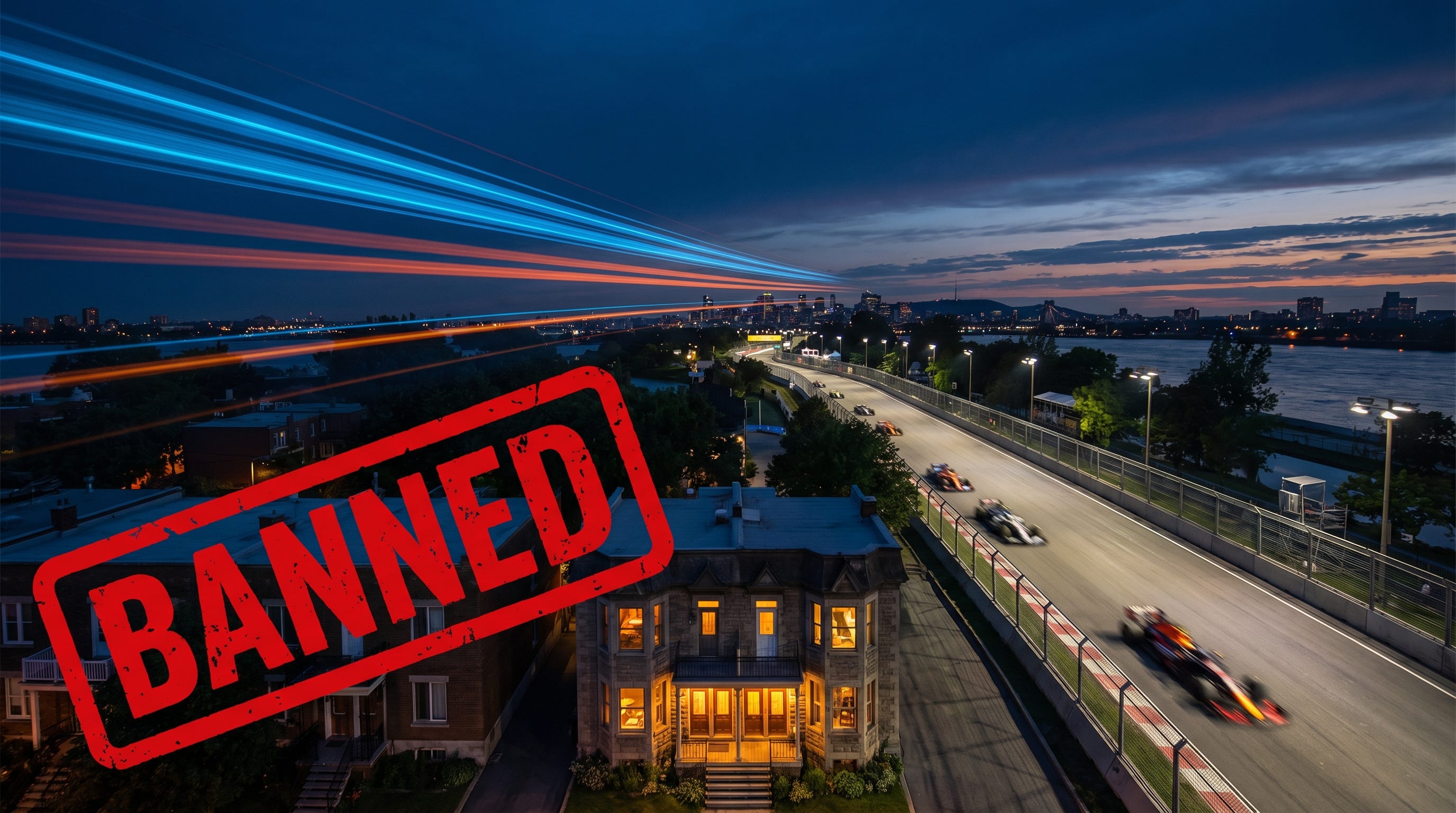
The problem? Formula 1's 2026 Canadian Grand Prix lands May 22–24. Dead center in the ban window.
Two hundred thousand fans. Global media. Tens of thousands traveling from North America and Europe — many of whom specifically need the kind of accommodation that only short-term rentals can provide at scale.
And Montreal just banned that accommodation model. Every single one.
The Number
A commissioned economic study by Raymond Chabot Grant Thornton — one of Canada's most credible professional services firms — put a specific figure on the damage:
$19 million CAD in lost tourism economic activity. In a single event weekend.
"Montréal's seasonal short-term rental ban will result in a shortfall of 26,000 available nights during the 2026 Formula 1 Canadian Grand Prix."
— Raymond Chabot Grant Thornton, March 2026
That's not projection. That's the documentation of a 26,000-night shortfall. Guests who don't book. Dollars that don't circulate through restaurants, neighborhoods, and local businesses.
Hotels can't fix this. Hotel pricing in Montreal during F1 is already running 160% above baseline — not because the market is thriving, but because it's broken. When prices spike that far, most visitors don't pay. They cancel. They go to Austin. They go to Miami.
Montreal gets nothing.
Why This Matters for You
Here's what the data actually shows across cities that introduced restrictions like Montreal's: several of them reversed course.
Ocean City, MD — reversed a 2024 STR permit ban after visitor spending dropped 18% year-over-year despite 94% hotel occupancy
Dallas, TX — paused STR enforcement ahead of FIFA World Cup 2026, citing $375M in projected visitor spending
South Lake Tahoe, CA — had its ban overturned by a court that found the city failed to conduct adequate economic impact analysis
San Diego, CA — walked back proposed STR caps after a $1.1 billion annual economic activity study surfaced
Maui, HI — delayed a complete ban vote twice after a $900M annual activity study was published
The consistent trigger: economic evidence.
The operators who showed up with numbers changed the conversation. The ones who showed up angry after the vote did not.
The Framework
Think of STR operators as an import-export business.
What we export is the experience of the local economy — the food, the culture, the neighborhood, the feel of a place you can only get by actually staying there. What we import is money. People travel from outside your market specifically because accommodation exists. Then they spend — at the coffee shop on the corner, the restaurant with no hotel deal, in parts of the city the big chains never reach.
That's the argument to make to city councils. Not that the rules are unfair. That removing our infrastructure has a documented, dollar-amount cost.
Montreal now has that cost in writing.
I wrote the full breakdown — every data point, what happened in each city, and exactly what to do if your market is debating restrictions right now.
→ Read the full Montreal breakdown
This is the kind of data that changes what's possible for STR operators. Not reaction. Preparation.
The window to be in the room with numbers — before your city votes — is always shorter than you think.
— J.
P.S. — The Montreal story doesn't end with F1. The UCI Road World Championships run September 19–27 — also inside the ban window. That pushes combined economic exposure past $30 million CAD. Cities rarely commission these studies before they vote. When the numbers surface after, policy almost always follows. Read the full analysis →